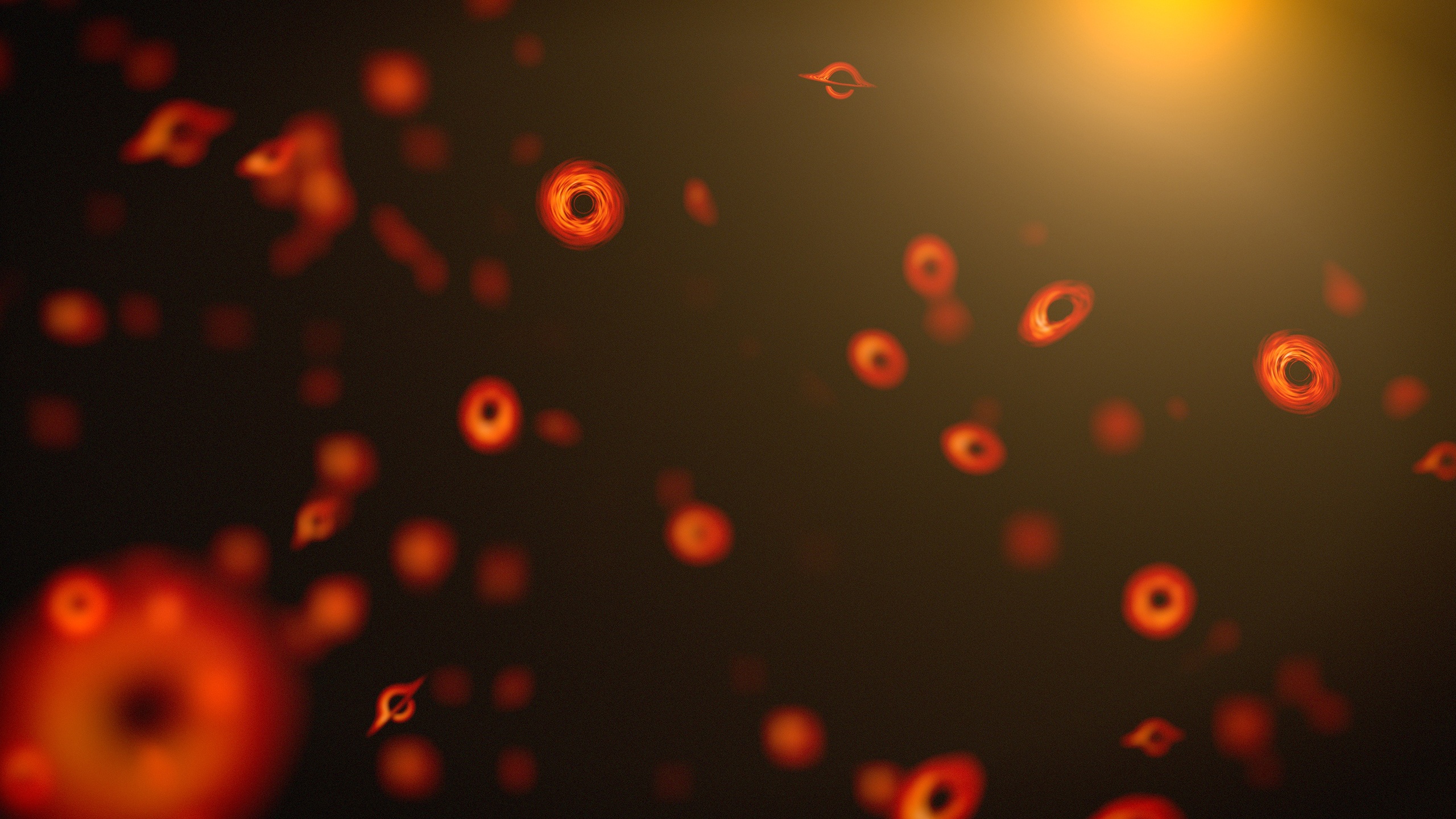
Are primordial black holes real? They could have arisen in the unusual physics that governed the universe shortly after the Big Bang. The idea dates back to the 1960s, but due to a lack of evidence it remains purely hypothetical.
If they exist, a new paper suggests they may be hiding in places so unlikely that no one would have ever thought to look.
Black holes form when massive stars reach the end of their lives and undergo gravitational collapse. However, no stars were involved in Primordial Black Holes (PBHs). Physicists believe that PBHs formed in the early universe from extremely dense pockets of subatomic matter that collapsed directly into black holes. They could form some or all of the matter we call dark matter.
However, they remain hypothetical as none have been observed.
New research in Physics of the Dark Universe suggests researchers aren't looking in the right places. The title is: “In search of small, primordial black holes on planets, asteroids and here on Earth.” The co-authors are De-Chang Dai and Dejan Stojkovic from Case Western Reserve University and the State University of New Zealand, respectively York.
The authors claim that evidence of PBHs could be found in objects as large as hollowed-out planetoids or asteroids and as small as rocks here on Earth.
“Small primordial black holes could be captured by rocky planets or asteroids, consuming their liquid cores from the inside and leaving behind hollow structures,” the authors write. “Alternatively, a fast black hole may exit a narrow tunnel in a solid object as it passes through. “We could search for such microtunnels in very old rocks here on Earth,” the authors claim, explaining that the search would not require special, expensive equipment.
The author's work relies heavily on other research suggesting that PBH masses between 1016 and 1010 solar masses could be candidates for dark matter. These PBHs could be captured by stars or trapped inside them as they form. The PBH would slowly consume gas inside the stars.
However, these authors go in a different direction. “We extend this idea to planets and asteroids, which can also be expected to host PBHs,” they write, explaining that the PBHs could be captured by these objects either during their formation or after their formation. Inside a rock body, the PBH would consume the liquid core, hollowing it out and leaving it empty.
“We need to think outside the box because what has been done to find ancient black holes hasn’t worked.”
Dejan Stojkovic, SUNY
“If the object has a liquid central core, a trapped PBH can absorb the liquid core, whose density is higher than the density of the outer solid layer,” Stojkovic said.
This illustration from research illustrates what could happen if a PBH is in a rock body. (A) A planet forms around a small primordial black hole (or alternatively, a planet captures a black hole at its center) (B) The central core is slowly absorbed by the black hole. If the outer shell has strong enough compressive strength, the shell can support itself, resulting in a hollow object. (C) If the liquid core solidifies before it is completely eaten by the black hole, an empty shell is created between the outer layer and the central core. Image source: Stojkovic et al. 2024.
If the asteroid or other body suffers an impact, the PBH could escape, leaving nothing but a hollow shell that could be detectable.
“If the density of the object is too low for its size, that is a good indication that it is hollow,” Stojkovic said. Examining an object's orbit with a telescope is enough to reveal voids.
Another possibility the authors present is fast-moving tiny PBHs that leave microscopic tunnels in objects. “Because the cross-section of a small PHB is very small, a PBH that is fast enough will most likely create a straight tunnel after passing through the asteroid,” the authors explain. In this case, a straight tunnel through an asteroid could be evidence of a PBH.
A fast-moving PBH could leave a straight tunnel the size of its Schwarzschild radius. If the asteroid's composition is strong, the tunnel would not collapse immediately. Image source: Stojkovic et al. 2024.
PBHs could also create microscopic tunnels in rocks and other objects on Earth. “The same effect could enable the discovery of a PBH here on Earth if we search for the sudden appearance of narrow tunnels in metal plates,” the authors write.
What's special about these hypothetical PBHs is detection. Other scenarios require space telescopes, gravitational wave observatories, or even microwave monitoring of distant quasars to detect them. But in this work, detection may be much cheaper and easier.
The James Webb Space Telescope or the Laser Interferometer Space Antenna are proposed methods for detecting PBHs. Image source: European Space Agency CC BY-SA 4.0
“The chances of finding these signatures are slim, but searching for them would not require many resources and the potential reward of being the first evidence of an ancient black hole would be immense,” Stojkovic said. “We need to think outside the box because what has been done to find ancient black holes hasn’t worked.”
“Although our estimate indicates a very low probability of finding such tunnels, searching for them does not require expensive equipment and long preparation, and the payoff could be significant,” the authors explain.
“You have to look at the costs versus the benefits. Does it cost a lot to do this? No, that is not the case,” Stojkovic said in a press release.
This is thinking outside the box or definitely beyond the standard model. Cosmology is at a standstill, so to speak, as we wrestle with the idea of dark matter. Could PBHs be dark matter? Could they behave as the authors suggest and be discovered in this way?
“The smartest people on the planet have been working on these problems for 80 years and have not yet solved them,” Stojkovic said. “We don’t need a simple extension of the existing models. We probably need a whole new framework.”
Like this:
Load…
