The Earth and Moon have been locked in a gravitational dance for billions of years. Every day as the Earth rotates, the moon tugs at the world's oceans, causing the tides to rise and fall. This makes the Earth's day a little longer and the moon a little further away. The effect is small, but it adds up over geological time. About 620 million years ago, a day on Earth lasted only 22 hours and the moon was at least 10,000 km closer than it is today.
Evidence for this evolving dance only goes back about two billion years in the geological record. Furthermore, the Earth was so different that there simply isn't enough evidence to collect. Instead, we must rely on computational models and our understanding of the dynamics. We know that Earth did not have a large moon when it formed. Then, about 4.4 billion years ago, a Mars-sized protoplanet called Theia collided with our world, creating the Earth-Moon system. What's interesting is that most computer simulations for this collision produce a moon that is much closer to Earth than we would expect. There were no vast oceans on the early Earth, so there were no tides to push the moon into a larger orbit. So how did the moon get to its current distance?
The possible structure of a lava planet. Photo credit: Farhat et al
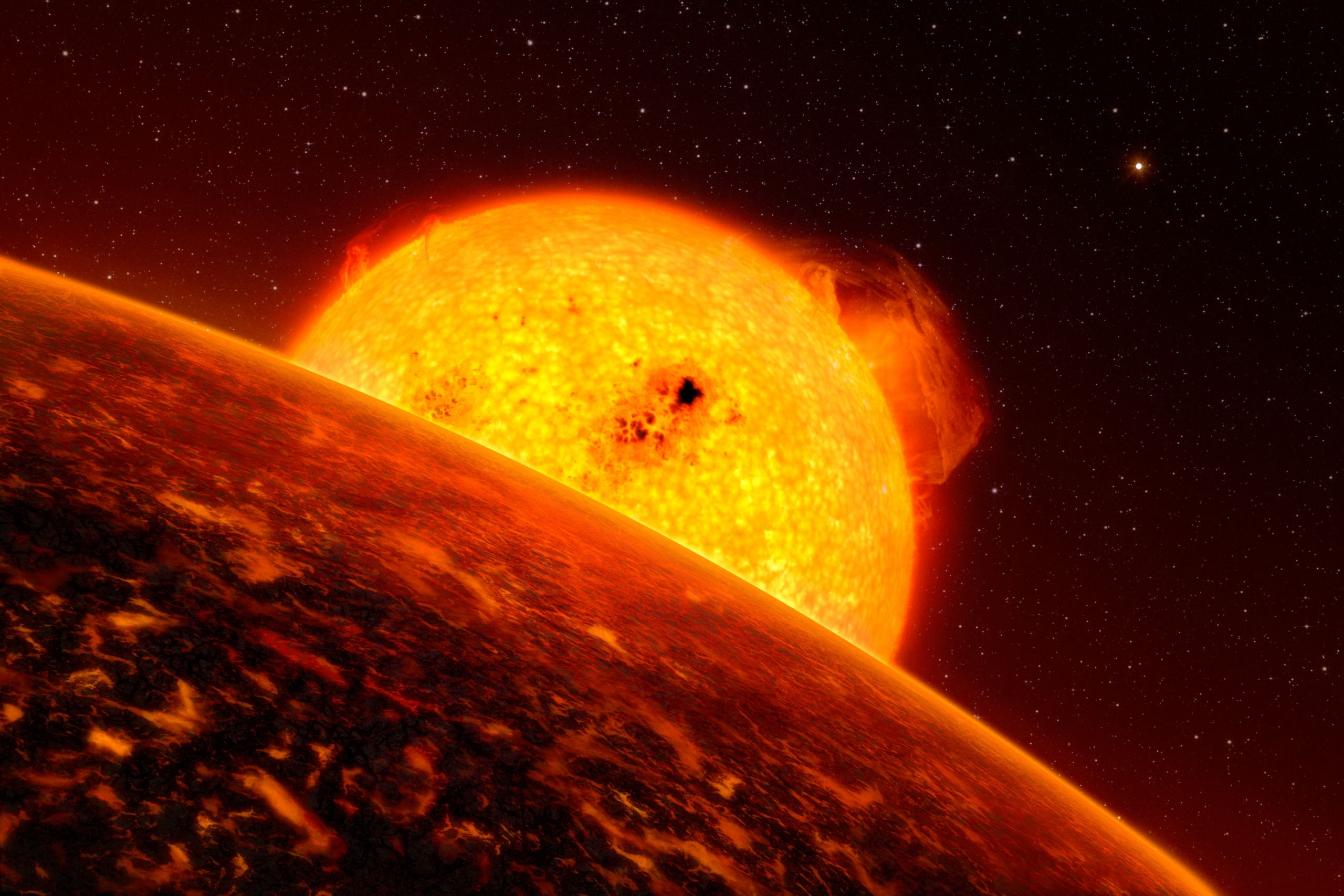
A new study argues that while Earth did have tides back then, they were made of lava, not water. Shortly after the Great Collision, the Earth would have been covered by an ocean of hot lava. Because the moon was so close, the lava would have experienced strong tides. Because lava is much denser than water, the impact of the flood would have been much greater. The Earth's rotation would have slowed much faster and the Moon would quickly move further away. Based on their simulations, the authors argue that the Moon's distance would have increased by 25 Earth radii in just 10,000 to 100,000 years. This would explain how the Moon approached its current range of distances fairly quickly.
The idea of tides on an ocean world also has implications for planets around other stars. Planets that form very close to their sun would be extremely hot, and many of them could have lava oceans for a billion years or longer. Simulations of such worlds show that lava floods would accelerate the rotational dynamics of such a world and could cause them to become tidally locked on a million-year timescale rather than a billion-year timescale. If this model is correct, it would have significant implications for potentially habitable worlds. Most exoplanets orbit red dwarfs, as red dwarfs make up about 75% of the stars in our galaxy. The habitable zone of red dwarfs is very close to the star, meaning that many of them originally formed as lava worlds. This would mean that one side of most potentially habitable worlds would always face the sun, while the other side would be forever in the cold. Life on these worlds would be very different from what we see on Earth.
Reference: Farhat, Mohammad et al. “Tides on Lava Worlds: Application to Nearby Exoplanets and the Early Earth-Moon System.” arXiv preprint arXiv:2412.07285 (2024).
Like this:
Load…
