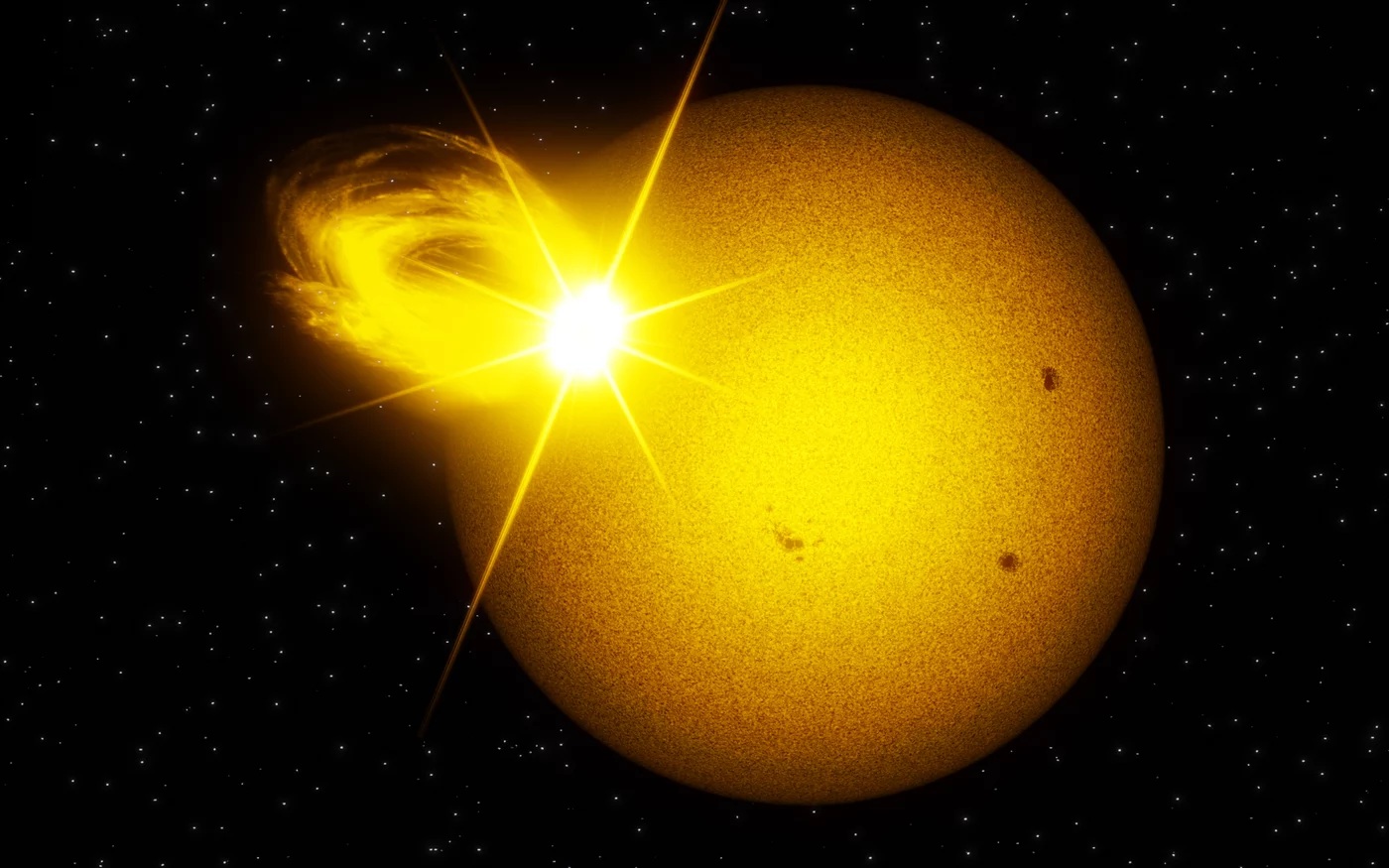
There was significant solar activity last year. This was particularly true in the month of May, which saw more than 350 solar storms, solar flares and geomagnetic storms. This included the strongest solar storm in 20 years, producing auroras at far lower latitudes than usual, and the strongest solar flare observed since December 2019. Given the threat they pose to radio communications, power grids, navigation systems, and spacecraft and astronauts, numerous agencies are actively monitoring the Sun's behavior to learn more about its long-term behavior.
However, astronomers have not yet determined whether the Sun can produce “superflares” and how often they might occur. While tree rings and samples of millennia-old glacial ice are effective in recording the strongest superflares, they are not effective methods for determining their frequency, and direct measurements of solar activity have only been available since the Space Age. In a recent study, an international team of researchers has chosen a new approach. By analyzing Kepler data from tens of thousands of Sun-like stars, they estimate that stars like ours produce superflares about once a century.
The study was carried out by the reseMax Planck Institute for Solar System Research (MPS), the Sodankylä Geophysical Observatory (SGO) and the Space Physics and Astronomy Research Unit at the University of Oulu, the National Astronomical Observatory of Japan (NAOJ), the Laboratory for Atmospheric and Space Physics (LASP) at the University of Colorado Boulder (UCF), the National Solar Observatory (NSO), the Commissariat of Atomic and Alternative Energies of Paris-Saclay and the University of Paris-Cité as well as several universities. The article covering their research was recently published in the journal Science.
Superflares are characterized by the intense amount of radiation they emit, about 1032 ergs or 6.2444 electron volts (eV). For comparison, consider the Carrington event of 1859, one of the most violent solar storms in the last 200 years. While this solar flare caused widespread disruption and led to the collapse of telegraph networks in northern Europe and North America, it released only a hundredth of the energy of a superflare. While tree rings and glacier samples have recorded powerful events in the past, the ability to observe thousands of stars simultaneously tells astronomers a lot about how often the strongest bursts occur.
This is certainly true of the Kepler Space Telescope, which for years continuously monitored around 100,000 main sequence stars for signs of periodic dips that indicate the presence of exoplanets. The same observations recorded countless solar flares, which appeared as short, pronounced peaks in brightness in the observational data. Like Prof. Dr. Sami Solanki, director at MPS and co-author of the paper, stated in an MPS press release:
“We cannot observe the sun for thousands of years. Instead, however, we can observe the behavior of thousands of Sun-like stars over short periods of time. This helps us estimate how frequently superflares occur.”
For their study, the team analyzed data obtained by Kepler between 2009 and 2013 from 56,450 Sun-like stars. The images were carefully examined for signs of potential superflares, which were only a few pixels in size. The team also carefully selected the stars and only considered those whose surface temperature and brightness were similar to those of the Sun. The researchers also ruled out potential sources of error, including cosmic rays, transient phenomena (asteroids or comets), and other types of stars that flare up near a Sun-like star.
Overall, the Kepler data provided the team with evidence of 220,000 years of stellar activity. From this, they were able to identify 2,889 superflares from 2,527 of the observed stars, producing an average of one superflare per star per century. While previous research found average intervals of a thousand or even tens of thousands of years, these studies could not determine the exact source of the observed eruptions. They also had to limit themselves to stars without close neighbors, making this latest study the most precise and sensitive yet.
Nevertheless, previous studies that took into account indirect evidence and observations from the last few decades have found longer distances between superflares. In the past, whenever the Sun has released a large amount of energetic particles that have reached Earth's atmosphere, the interaction has produced a detectable amount of radioactive carbon-14 (C14). This isotope will remain in tree and glacier samples over thousands of years of slow decay, allowing astronomers to identify strong solar events and determine how long ago they occurred.
Using this method, researchers were able to identify five extreme solar particle events and three candidates within the last twelve thousand years – suggesting an average rate of one superflare per 1,500 years. However, the team acknowledges that more violent solar particle events and superflares may have occurred in the past. “It is unclear whether gigantic flares are always accompanied by coronal mass ejections and what the relationship is between superflares and extreme solar particle events,” said co-author Prof. Dr. Ilya Usoskin from the University of Oulu. “This requires further investigation.”
While the new study doesn't reveal when the Sun will experience its next superflare, the results urge caution. “The new data is a stark reminder that even the most extreme solar events are part of the sun’s natural repertoire,” said co-author Dr. Natalie Krivova from MPS. In the meantime, the best way to stay prepared is to monitor the sun regularly to ensure reliable forecasts and early warnings. Until 2031, these efforts will be supported by ESA's Vigil spacecraft, which is supporting the MPS through the development of its Polarimetric and Magnetic Imager (PHI) instrument.
Further reading: MPS, science
Like this:
Load…
