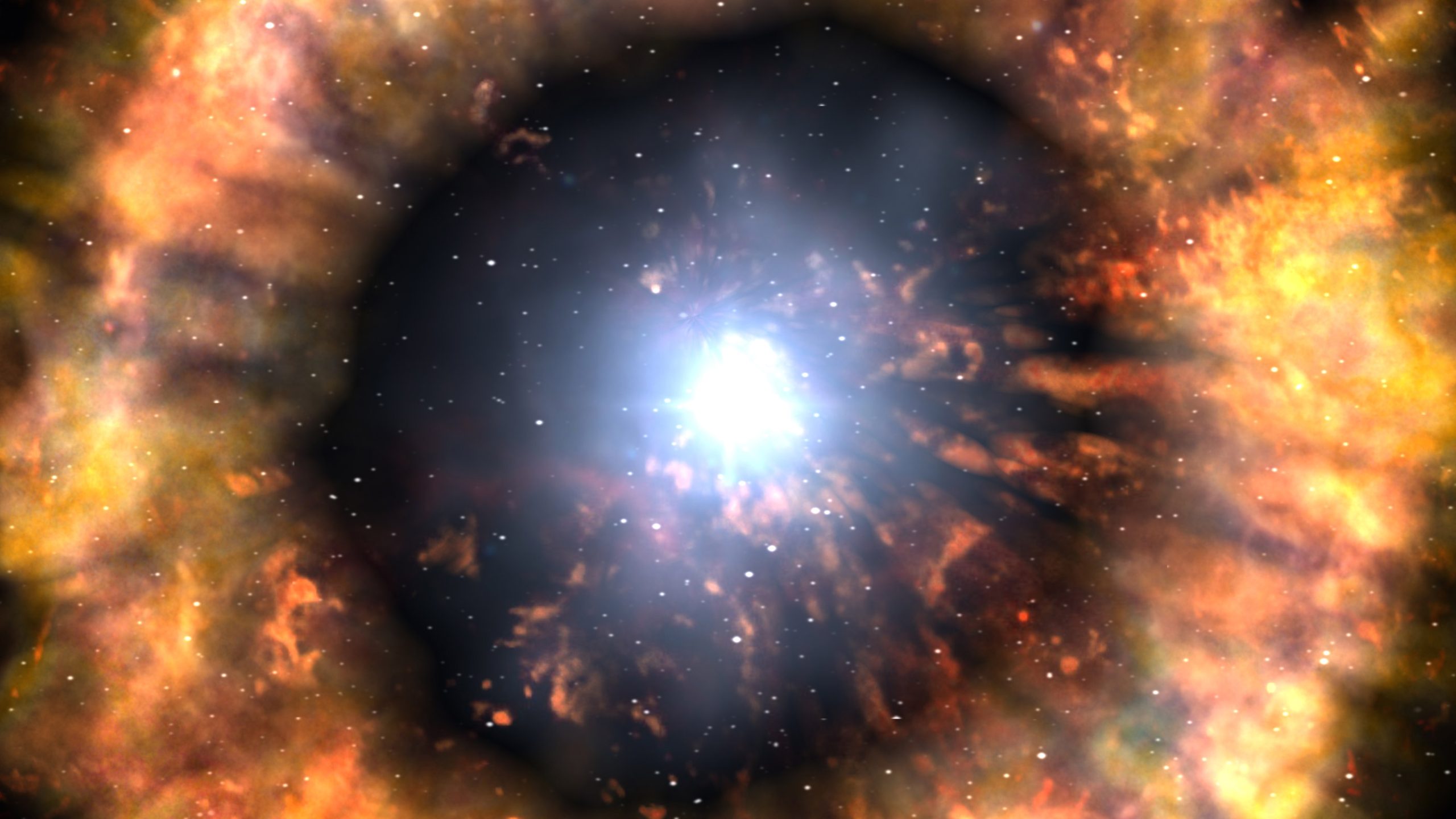
Even if you knew nothing about astronomy, you would understand that exploding stars are a powerful and momentous event. How could that not be? Supernovae play a central role in the universe with their energetic, destructive demise.
There are different types of supernovae that explode throughout the universe, with different precursors and different remnants. The Zwicky Transient Facility has discovered 100,000 supernovae and classified 10,000 of them.
The Zwicky Transient Facility (ZTF) is a wide-field astronomical survey named after the prolific Swiss astronomer Fritz Zwicky. In the early 1930s, Zwicky and his colleague Walter Baade coined the term “supernova” to describe the transition of normal main sequence stars into neutron stars. In the 1940s, Zwicky and his colleague developed the modern supernova classification system. Because of these and many other scientific contributions, the ZTF bears his name. (Zwicky was also a humanist and philosopher.)
The ZTF observes in both the optical and infrared wavelengths and was built to detect transients with the Samuel Oschin Telescope at the Palomar Observatory in San Diego County, California. Transients are objects that change quickly in brightness or objects that move. While supernovae (SN) don't move, they definitely change brightness quickly. They can dwarf their entire host galaxy for months.
In 2017, the ZTF launched its Bright Transient Survey (BTS), a project to search for supernovae (SNe). This is by far the largest spectroscopic SNe study ever carried out. The BTS has discovered 100,000 potential SNe and more than 10,000 of these have been confirmed and classified by distance, type, rarity and brightness. This type of astronomical study creates a rich data set that will continue to help researchers in the future.
“There are trillions of stars in the universe and one of them explodes about every second. Reaching 10,000 classifications is amazing, but what we should really celebrate is the incredible progress we have made in our ability to search the universe for transients, or objects that change in the sky, and the science that informs our extensive data will enable,” said Christoffer Fremling, a staff astronomer at Caltech. Fremling leads the ZTF's Bright Transient Survey (BTS).
The effort to catalog supernovae dates back to 2012, when astronomical databases began officially tracking them. Since then, astronomers have discovered nearly 16,000 of them, and the ZTF is responsible for more than 10,000 of these discoveries.
The first documented SNe discovery occurred in 185 AD, when Chinese astronomers recorded the appearance of a “guest star” in the sky that glowed for eight months. In the nearly two millennia since then, we have seen much more. 1987 was a turning point for supernova science when a massive star exploded in the nearby Large Magellanic Cloud. Named SN 1987A. It was the first supernova explosion since the invention of the telescope. This was also the first direct detection of neutrinos from a supernova, and this detection is considered by many to be the beginning of neutrino astronomy.
A timeline of important events in the history of supernova astronomy. Click to enlarge. Image source: ZTF/Caltech/NSF
Every night, the ZTF registers hundreds of thousands of events, including everything from small, simple asteroids in our inner solar system to powerful gamma-ray bursts in the distant universe. The ZTF uses two telescopes that serve as a kind of “triage” facility for supernovae and transients. The Samuel Oschin Telescope has a 60-megapixel wide-angle camera that captures the visible sky every two nights. Astronomers detect new transient events by subtracting images of the same patch of sky from subsequent scans.
ZTF team members then examine these images and send the most promising images to the other ZTF telescope, the Spectral Energy Distribution Machine (SEDM). This robotic spectrograph works with the 60-inch Palomar telescope.
“We combine the brightness information from the ZTF camera with the data from the SEDM to correctly identify the origin and type of a transient, a process that astronomers call transient classification,” said Yu-Jing Qin, a postdoctoral fellow at Caltech who leads much of the process daily operation of the BTS survey.
ZTF detections are also sent to other observatories around the world that can study transients using other spectroscopic facilities. About 30% of ZTF transients were confirmed in this way.
ZTF detects so many transients that it is difficult for astronomers to keep up. In recent years, Caltech has made efforts to develop machine learning tools that can examine SEDM spectroscopic data, classify the transients, and send them to the Transient Name Server. In 2023, the BTSBot system was deployed to manage the discovery flow.
“Since BTSbot began operations, it has found about half of the brightest ZTF supernovae before a human,” said Northwestern University graduate student Nabeel Rehemtulla, developer of BTSBot. “For certain types of supernovae, we have automated the entire process and BTSbot has performed exceptionally well in over a hundred cases so far. This is the future of supernova surveys, especially when the Vera Rubin Observatory becomes operational.”
Although every supernova discovery is scientifically valuable, there are some highlights among all of these discoveries.
The ZTF has discovered thousands of Type 1a supernovae. They occur in binary star systems in which one star is a white dwarf. The white dwarf draws gas from its companion and the gas accumulates on the white dwarf. This eventually leads to a supernova explosion. SN 2022qmx is one of those Type 1a supernovae that appeared to be much brighter than it should be. It turned out that an intervening galaxy gravitationally focused the SN's light, making it appear 24 times brighter.
The ZTF is also responsible for detecting the nearest and farthest SNe (with the help of the JWST).
Some highlights from the ZTF's 10,000 supernovae. Click on the image to enlarge it. Photo credit: ZTF/Caltech/NSF
“When we started this project, we didn’t know how many astronomers would follow up on our discoveries,” said Caltech’s Fremling. “Seeing that there are so many is a testament to why we built ZTF: to survey the entire sky for changing objects and share that data with astronomers around the world as quickly as possible.” That is the purpose of the Transient Name Server (TNS).”
In the TNS, the global astronomical community announces the detection and classification of transients to avoid duplication of work. Since 2016, the TNS has processed over 150,000 reported transients and over 15,000 reported supernovae.
“Everything is public in the hope that the community comes together and makes the most of it,” Fremling said. “That way we don’t have, say, ten telescopes around the world doing the same thing and wasting time.”
The ZTF will soon have a powerful partner in time domain astronomy. The Vera Rubin Observatory (VRO) is expected to see its first light in the next few months and then begin its 10-year Legacy Survey of Space and Time (LSST). The LSST also detects transients, but is far more sensitive than the ZTF. It is expected to detect millions of supernovae, and tackling all of these discoveries will require a machine learning tool similar to BTSbot.
“The machine learning and AI tools we have developed for the ZTF will be crucial when the Vera Rubin Observatory becomes operational,” said Daniel Perley, an astronomer at Liverpool John Moores University in the United Kingdom Kingdom, who developed the search and discovery procedures for the BTS. “We have already planned to work closely with Rubin to transfer our machine learning knowledge and technology,” Perley added.
Astronomical surveys like those conducted by ZTF and VRO provide fundamental data that researchers will use for years to come. It is impossible to know how it will be used in each case or what discoveries it will lead to. Even better, ZTF and VRO overlap.
This will be a very important and exciting time in time-domain astronomy, according to Caltech astronomy professor Mansi Kasliwal, who will lead the ZTF for the next two years.
“The 2025 and 2026 period in which ZTF and Vera Rubin can both work together is fantastic news for time domain astronomers,” Kasliwal said. “By combining data from both observatories, astronomers can directly address the physics of why supernovae explode and discover fast and young transients that are inaccessible to ZTF or Rubin alone. I look forward to the future,” Kasliwal added.
Like this:
Load…
