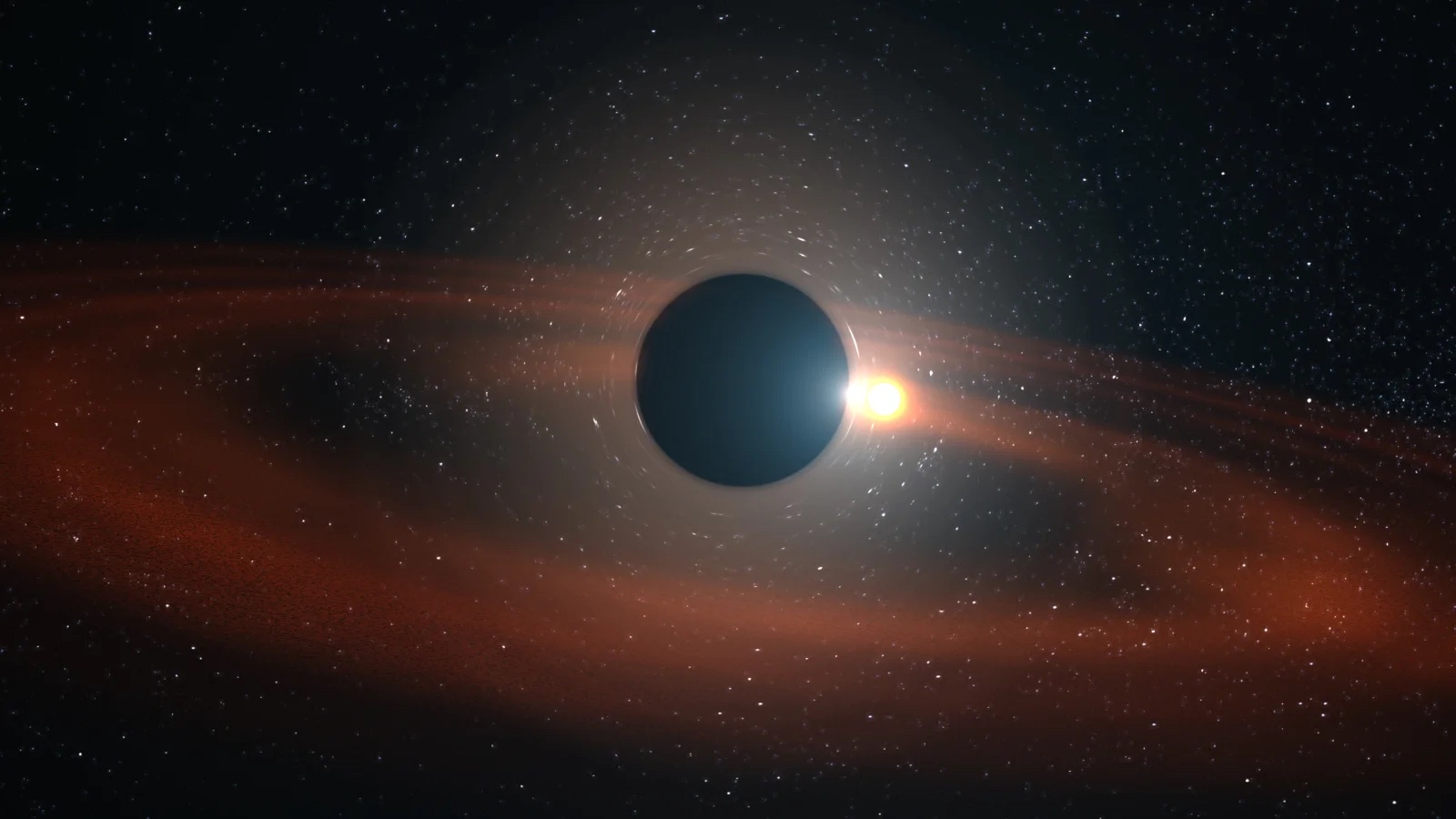
A team of astronomers has discovered a surprisingly fast and bright burst of energy from a galaxy 500 million light-years away. The radiation burst peaked just after four days and then quickly subsided. The team identified the burst, conducted using the Catalina Real-Time Transient Survey and supporting observations from the Gran Telescopio Canarias, as the result of a small black hole devouring a star. The discovery offers an exciting insight into star evolution and a rare cosmic phenomenon.
Black holes are star corpses in which gravity is so strong that nothing, not even light, can escape. They form when massive stars near the end of their lives collapse under their own gravity, forming an infinitesimal point known as a singularity. The area of space around the singularity is limited by the event horizon, the point beyond which nothing can escape. Despite the challenges of observing them, they can be discovered by observing the effects of their gravity on nearby objects such as gas clouds. There are still many mysteries surrounding black holes, which is why they remain an intense area of research.
3D rendering of the accretion disk of a rapidly spinning black hole and a resulting black hole-propelled jet. Photo credit: Ore Gottlieb et al. (2024)
A team of astronomers led by Claudia Gutiérrez of Catalina's Space Sciences Institute and Space Studies Institute used data from the Catalina Real-Time Transient Survey (CRTS) to study transient events. Launched in 2004, the CRTS is a large-scale survey that searches for variable objects such as supernovae and asteroids. It uses a network of telescopes based in Arizona to scan large areas of the sky to detect short-lived events. It was of great use as it provided insights into the life cycle of stars and the behavior of distant galaxies.
The 60-inch Mt. Lemmon Telescope is one of three telescopes used in the Catalina Sky Survey. Image: Catalina Sky Survey, University of Arizona.
The team discovered the bright burst in a galaxy 500 million light-years away and published their findings in the Astrophysical Journal. The event occurred in a tiny galaxy about 400 times less massive than the Milky Way. The burst was identified as CSS161010, it reached maximum brightness in just 4 days and 2.5 days later the brightness was reduced by half. Subsequent work revealed that the previous discovery had been detected by the All-Sky Automated Survey for SuperNovae. Fortunately, the discovery occurred early enough to allow follow-up observations by other ground-based telescopes. Typically, these types of events are difficult to study due to their rapid evolution.
Only a handful of events like CSS161010 have been discovered in recent years, but their nature has remained a mystery. The team led by Gutiérrez analyzed the spectral properties and found hydrogen lines that reveal material moving at speeds up to 10% of the speed of light. The changes observed in the hydrogen emission lines are similar to those observed in active galactic nuclei where supermassive black holes exist. The observation suggests that it is a black hole, although not a massive one.
The object's brightness decreased 900-fold over the following two months. Further spectral analysis at this point still revealed blue-shifted hydrogen lines, indicating high-velocity gas outflows. This was not typically seen in supernova events, suggesting a different origin. The team believes the event is due to a small black hole swallowing a star.
Source: Astronomers have discovered an outburst caused by a black hole swallowing a star
Like this:
Load…
