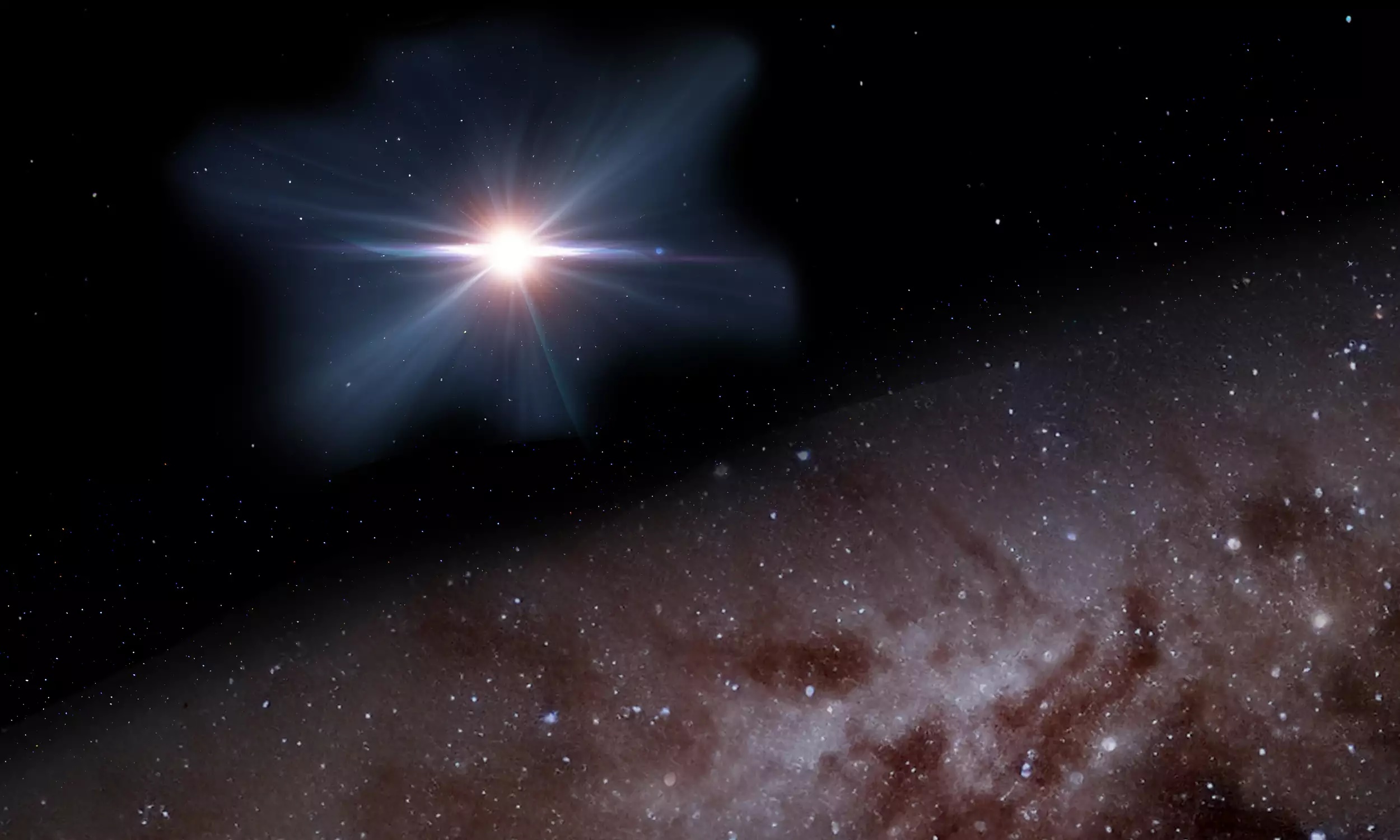
Almost every galaxy has a supermassive black hole. The beast at the heart of our galaxy contains the mass of millions of suns, while some of the largest supermassive black holes can have more than a billion solar masses. For years, it was assumed that these black holes increased in mass over time and only reached their current size after a billion years or more. But observations from the Webb Telescope show that even the youngest galaxies contain massive black holes. How could supermassive black holes grow so large so quickly? The key to the answer could be the powerful jets that black holes can create.
Although it may seem counterintuitive, it is difficult for a black hole to consume matter and grow. The gravitational pull of a black hole is immensely strong, but surrounding matter is much more likely to remain trapped in orbit around the gravitational source than to fall directly into it. To enter a black hole, matter must slow down so much that it falls inward. When a jet of material from a black hole flies away from its polar region, this high-speed plasma can pull rotational motion from the surrounding material, allowing it to fall into the black hole. For this reason, black holes with strong jets also experience the strongest growth.
We can see many rapidly growing black holes in the distant universe as quasars or active galactic nuclei. So we know that in the middle age of the cosmos, many supermassive black holes rapidly increased in mass. One idea is that recent supermassive black holes also had active jets that would allow them to gain a million solar masses or more quite quickly. But proving that is difficult.
The problem is that it is extremely difficult to observe jets from the earliest times of the cosmos. The light from that distant time is so redshifted that its once brilliant beacon has become faint radio light. Before this latest study, the most distant jet we observed had a redshift of z = 6.1, meaning it traveled nearly 12.8 billion years to reach us. In this new study, the team discovered a blazar with a redshift of z = 7.0, meaning it dates back to a time when the universe was just 750 million years old.
A blazar occurs when the jet of a supermassive black hole is aligned so that it is aimed directly at us. Since we are looking directly into the beam, we see the beam at its strongest. Blazars usually allow us to calculate the true intensity of a jet, but in this case the redshift is so strong that our conclusions have to be a little more subtle.
How distant jets could be magnified with Doppler? Photo credit: Bañados et al
One possibility is that the jet from this particularly massive black hole is actually aimed directly at us. According to this, the black hole is growing so quickly that it would easily gain more than a million solar masses within the first billion years. However, it would be extremely rare for a black hole jet to be aimed directly at us from this distance. So, statistically speaking, that would mean that there are many more early black holes that are just as active and growing just as fast. They're just not aligned in a way that we can observe them.
Another possibility is that the blazar is not entirely directed in our direction, but rather the cosmic expansion of space and time has focused its energy on us for 12.9 billion years. In other words, thanks to relativistic cosmology, the blazar could appear more energetic than it actually is. But if that's the case, then the jet from this black hole is less energetic but still powerful. And statistically speaking, that would mean that most early black holes are equally powerful.
So this latest work tells us that either there was a fraction of early black holes that evolved into beasts incredibly quickly, or that most black holes grew rapidly, starting even earlier than we can observe . In both cases, it is clear that early black holes produced jets, and these jets enabled the first supermassive black holes to appear at the beginning of cosmic time.
Reference: Bañados, Eduardo et al. “A blazar in the age of reionization.” Nature Astronomy (2024): 1-9.
Like this:
Load…
