

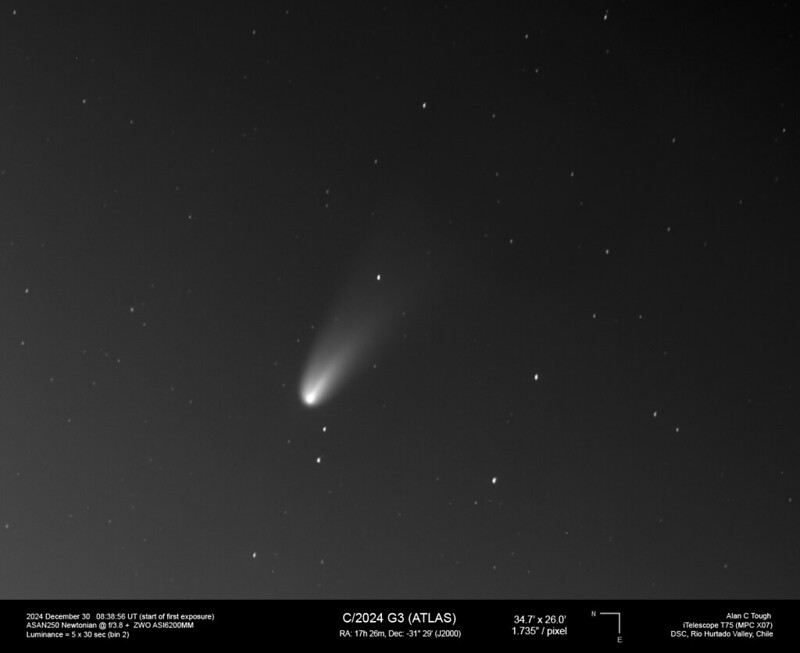
Comet C/2024 G3 ATLAS could put on a brief show this month.
Comet G3 ATLAS on December 30th. Photo credit: Alan C. Tough
“Perhaps” the most anticipated comet of 2025 is just around the corner. There is currently only one comet with real potential to become visible to the naked eye in 2025: Comet C/2024 G3 ATLAS. This comet reaches perihelion on January 13 at a distance of 0.094 astronomical units (AU, 8.7 million miles or 14 million kilometers, within Mercury's orbit) from the Sun and “may” reach peak brightness of -1 or brighter to reach. At magnitude +4 in late December, Comet G3 ATLAS could be a beautiful object low in the morning sky for Southern Hemisphere observers…if (a big if) it holds together and functions as expected.
In fact, the comet triggered an outburst on the first weekend of 2025, increasing in brightness from +4 to +1 (a sixteen-fold increase in brightness in a few days). This could be a harbinger of good (or bad) things to come soon.
“The comet has had an outburst in the last few days,” Nicolas Lefaudeux told Universe Today. “If the burst is related to the decay, nothing would likely be seen after perihelion. If the eruption is related to new active areas or the fission of a large core, the representation could be much better than in the simulations.”
The prospects for the tail of comet G3 ATLAS at perihelion. Photo credit: Nicolas Lefaudeux
A recent report from the International Astronomical Union's Central Bureau of Astronomical Telegrams suggests an optimistic peak of magnitude -3 near perihelion after the outburst, “if” the comet holds together.
Comet G3 ATLAS in the low at dawn opposite Mercury on January 11th. Photo credit: Starry Night.
The discovery
The comet was discovered on the night of April 5, 2024 by the Asteroid Terrestrial-Impact Last Alert System (ATLAS) survey as a magnitude +19 object in the constellation Bee Apus in the Southern Hemisphere.
The orbit of comet G3 ATLAS through the inner solar system. Image credit: NASA/JPL
The orbital period of this specimen is approximately 160,000 years. It is unclear whether comet G3 ATLAS is visiting the inner solar system for the first time or is a new resident from the distant Oort cloud. The last time the comet passed the inner solar system (assuming it did so in the past), wearing clothes was a hot novelty among our homo sapiens ancestors.
Comet G3 ATLAS from January 2nd. Photo credit: iTelescope/Tara Prystavski.
Comet G3 at Perihelion: Perish or Prosper?
The prospects of seeing this comet will be difficult. Unlike last year's comet C/2023 A3 Tsuchinshan-ATLAS, which displayed a magnificent tail in its evening appearance, G3 ATLAS will be a shy tail both before and after perihelion as it leaves our solar environment and hugs the southern horizon in the evening sky .
Comet G3 ATLAS, after perihelion at dusk on January 15th. Photo credit: Starry Night.
A daytime comet could be in sight if G3 ATLAS outperforms at perihelion… but it will be a challenging observation very close to the Sun. Make sure you don't see the sun's dangerous glare behind a building or structure if you're trying to spot the comet in daylight. Like A3 T-ATLAS, the joint NASA-ESA SOHO Observatory will see the comet crossing near perihelion through its LASCO C3 viewer.
Comet G3 ATLAS against SOHO in January. Photo credit: Starry Night.
Best bets for Comet G3 ATLAS
At perihelion on Monday, January 13, 2025, the comet will be just four degrees from the Sun. On the same day, the comet also makes its closest approach to Earth at a distance of 0.938 AU. The comet “could” reach -4 around the same time. Reach brightness (about as bright as Venus)…if it manages to hold together at perihelion.
Here's a recent long-distance telescope image of the comet taken by Nick James in late December:
Comet G3 ATLAS from December 15th. Photo credit: Nick James/BAA Comet Section/iTelescope.
Comet G3 ATLAS has been elusive until now. For Northern Hemisphere observers, the comet was shy, hovering just five degrees above the morning horizon before reaching perihelion in early January. The comet reappears after dark deep in the west, but again, people to the north only get a very brief view 5-10 degrees above the horizon at dusk as the comet travels south parallel to the horizon. As is usual with comets, the southern hemisphere appears to have better visibility.
Here's a detailed look at what you can expect from the comet in the coming months. (Note that “happens near” denotes a conjunction of one degree or less):
January
6-Near the Lagoon Nebula (Messier 8)
7-Near the globular cluster (Messier 28)
8-Crosses the ecliptic plane to the north
11-Enter the SOHO LASCO C3 view
13 – At perihelion, less than 5 degrees from the Sun
14 crossings into the constellation Capricorn
15-Leaves the SOHO LASCO C3 view and crosses the ecliptic plane to the south
21-Nods the corner of the constellation Microscopium
22 crossings into the constellation Piscis Austrinus
The light curve for comet G3 ATLAS. Adapted from Seichii Yoshida's Weekly Information About Bright Comets.
February
May 1st: Drop below +6. Strength
6 crosses in the constellation Grus
21-Nods the corner of the constellation Sculptor
25 crosses in the Phoenix constellation
march
March 1st: May be below +10 again. strength fall.
Observing and imaging the comet will be challenging due to two main factors: First, for Northern Hemisphere observers, it will never actually leave the low-contrast twilight sky. Second, a comet's stated brightness is “smeared” across its apparent surface, dropping the comet's apparent brightness by a stop or two. We can hope that Comet G3 ATLAS performs above average in this regard. My strategy is to find high ground to observe and find the lowest, flattest horizon (e.g. the ocean as seen from a beach) you can find, and scan the horizon at low magnification with binoculars, to detect the flickering of a comet.
Good luck and clear skies on this first comet mission in 2025.
Like this:
Load…

Comments are closed.