

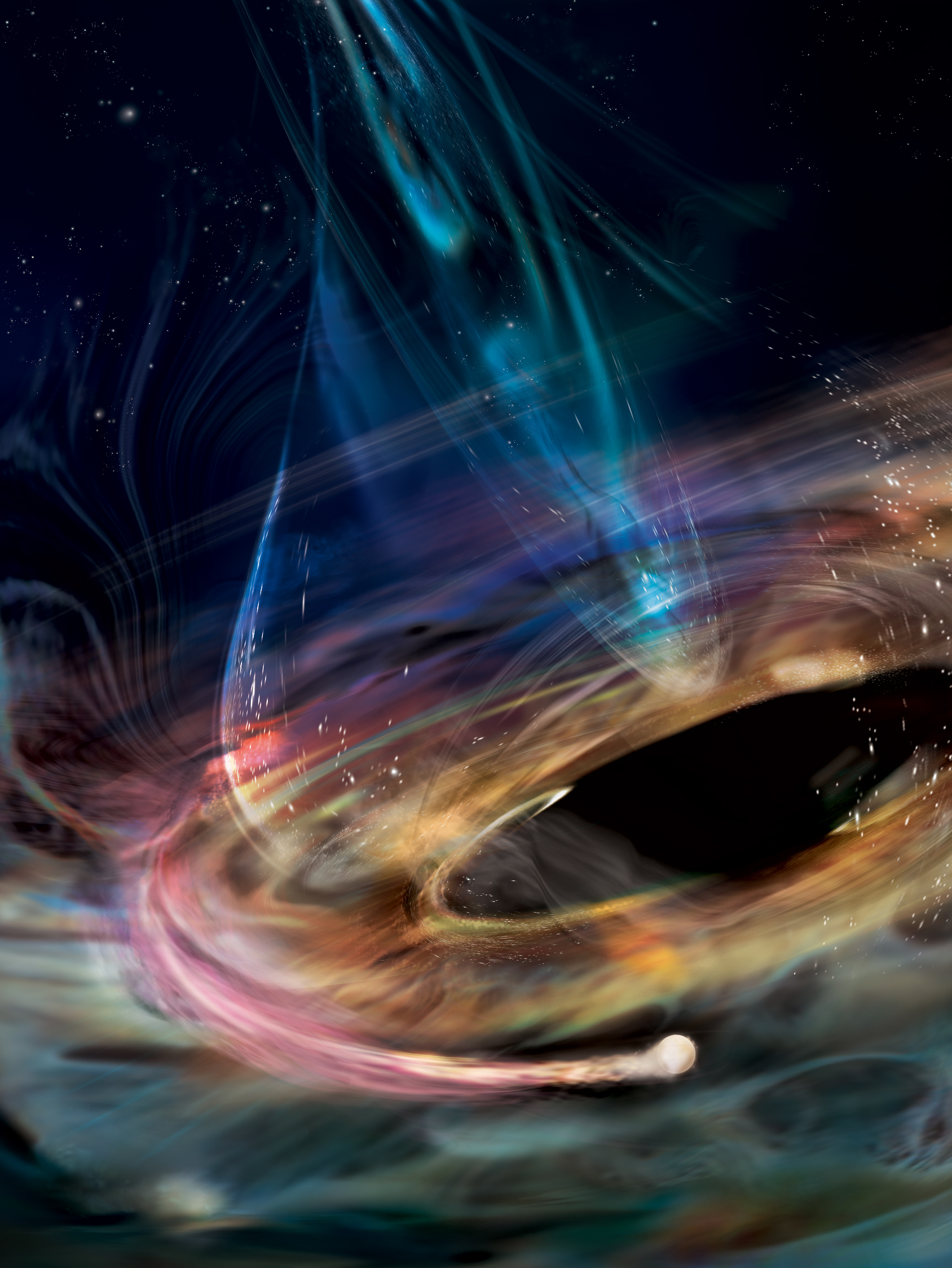
Black holes are among the most mysterious and powerful objects in the universe. These giants form when sufficiently massive stars reach the end of their life cycle and experience gravitational collapse, shedding their outer layers in a supernova. Their existence was illustrated by the work of German astronomer Karl Schwarzschild and Indian-American physicist Subrahmanyan Chandrasekhar as a consequence of Einstein's general theory of relativity. In the 1970s, astronomers confirmed that supermassive black holes (SMBHs) reside at the centers of massive galaxies and play a crucial role in their evolution.
However, it was only in recent years that the first images of black holes were captured by the Event Horizon Telescope (EHT). These and other observations have revealed things about black holes that have challenged preconceived notions. In a recent study led by a team at MIT, astronomers observed oscillations that suggested an SMBH in a neighboring galaxy was engulfing a white dwarf. But instead of tearing it apart, as astronomical models predict, their observations suggest that the white dwarf slowed down as it descended into the black hole – something astronomers have never seen before!
The study was led by Megan Masterson, a graduate student at the MIT Kavli Institute for Astrophysics and Space Research. She was joined by researchers from the Nucleo de Astronomia de la Facultad de Ingenieria, the Kavli Institute for Astronomy and Astrophysics (KIAA-PU), the Center for Space Science and Technology (CSST), and the Joint Space-Science Institute of the University of Maryland Baltimore County (UMBC), the Centro de Astrobiologia (CAB), the Cahill Center for Astronomy and Astrophysics, the Harvard & Smithsonian Center for Astrophysics (CfA), NASA's Goddard Space Flight Center and several universities.
According to astronomers' understanding of black holes, these gravitational giants are surrounded by incoming matter (gas, dust and even light) that forms swirling, bright disks. This material and energy is accelerated to near the speed of light, releasing heat and radiation (mainly in the ultraviolet range) as it slowly accumulates on the black hole's “face.” These UV rays interact with a cloud of electrically charged plasma (the corona) surrounding the black hole, amplifying the radiation into the X-ray wavelength.
Since 2011, NASA's XMM-Newton has observed 1ES 1927+654, a galaxy 236 million light-years away in the constellation Draco with a black hole of 1.4 million solar masses at its center. In 2018, the X-ray corona mysteriously disappeared, followed by a radio burst and a surge in its X-ray emission – what is known as quasi-periodic oscillations (QPO). UMBC associate professor Eileen Meyer, a co-author of this latest study, also recently published an article describing these radio bursts.
“In 2018, the black hole began changing its properties right before our eyes, with a major optical, ultraviolet and X-ray burst,” she said in a NASA press release. “Many teams have kept a close eye on it since then.” Meyer presented her team's findings at the 245th meeting of the American Astronomical Society (AAS), held January 12-16, 2025, in National Harbor, Maryland. In 2021, the corona reappeared and the black hole appeared to return to normal for about a year.
However, from February to May 2024, radio data showed that they appeared to be jets of ionized gas extending about half a light-year from either side of the SMBH. “The launch of a black hole jet has never been observed in real time before,” Meyer noted. “We think the outflow began earlier, as the X-ray emission in front of the radio flare increased and the jet remained hidden from our view by hot gas until its outburst early last year.” A related article on the jet, co-authored by Meyer and Masterson was also presented at the 245th AAS.
Artist's impression of ESA's XMM-Newton mission in space. Photo credit: ESA-C. Carreau
Additionally, observations collected in April 2023 showed a month-long increase in low-energy X-rays, suggesting that a powerful and unexpected radio burst was underway. In response, intensive observations were conducted by the Very Long Baseline Array (VLBA) and other facilities, including XMM-Newton. Thanks to the XMM-Newton observations, Masterson found that the black hole exhibited extremely rapid X-ray fluctuations of 10% between July 2022 and March 2024. These oscillations are typically very difficult to detect near SMBHs, suggesting that a massive object is rapidly orbiting the SMBH and is slowly being consumed.
“One way to generate these oscillations is to orbit an object within the black hole’s accretion disk. In this scenario, each rise and fall of X-rays represents an orbital cycle,” Masterson said. Additional calculations also showed that the object is likely a white dwarf of about 0.1 solar mass orbiting at a speed of about 333 million km/h (207 million miles per hour). Typically, astronomers expect the orbital period to shorten and gravitational waves (GWs) to emerge, draining the object of its orbital energy and bringing it closer to the black hole's outer boundary (the event horizon).
However, the same observations conducted between 2022 and 2024 showed that the fluctuation duration decreased from 18 minutes to 7 minutes and the speed increased to half the speed of light (540 million km/h; 360 million miles per hour). Then something really strange and unexpected happened: the vibrations stabilized. As Masterson explained:
“That shocked us at first. But we realized that as the object approached the black hole, its powerful gravitational pull could begin to pull matter away from the companion. This loss of mass could offset the energy extracted by gravitational waves and stop the companion's inward motion.”
Artist's impression of two neutron stars at the point where they merge and explode as a kilonova. Photo credit: University of Warwick/Mark Garlick
This theory is consistent with what astronomers have observed with binary white dwarf star systems spiraling toward each other and destined to merge. The closer they got to each other, the more one began tearing matter away from the other rather than remaining intact, slowing the two objects' approach. Although this may be the case here, there is no established theory to explain the observations of Masterson, Meyer, and their colleagues. However, their model makes an important prediction that could be tested when ESA's Laser Interferometer Space Antenna (LISA) launches in the 2030s.
“We predict that if there is a white dwarf in orbit around this supermassive black hole, LISA should see it,” says Megan. The preprint of Masterson and her team's work recently appeared online and will be published in Nature on February 15, 2025.
Further reading: ESA, NASA, arXiv, AJL
Like this:
Load…

Comments are closed.