

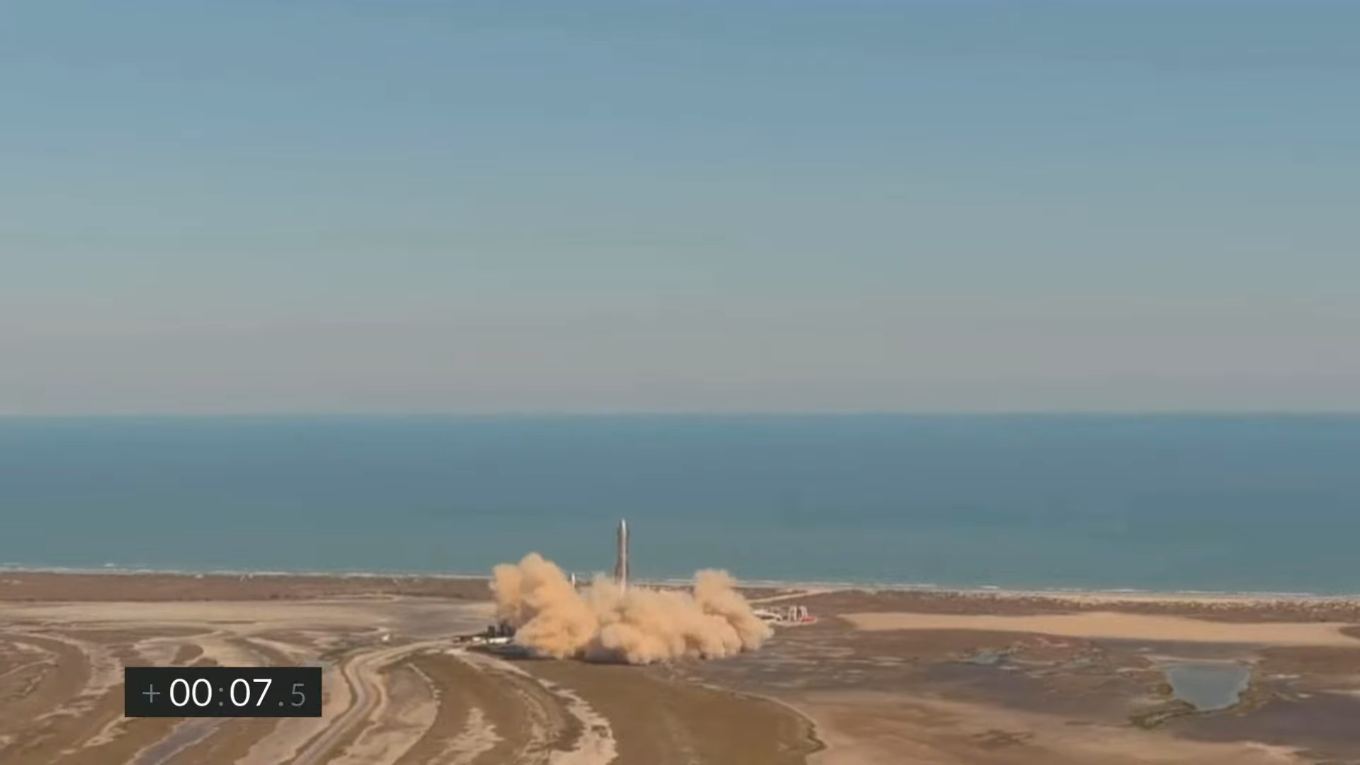
Another day, another round of testing (and yes, another blast). Today, Tuesday, February 2, 2021, flight teams conducted a high-altitude test flight with a Starship prototype at SpaceX’s launch facility near Boca Chica, Texas. Similar to the previous test in December, the SN9 was powered by three Raptor engines, flew to an altitude of 10 km, and then attempted another “belly flop” to test its fins and aerodynamic surfaces.
As always, the event was streamed live by SpaceX, NASASpaceFlight, LabPadre and several other observers. As with the SN8 test flight, SpaceX’s coverage offered multiple vantage points (landing pad, engine bay, fuselage, aerial drone, etc.). The flight began at 2:25 p.m. CST (4:25 p.m. EST; 12:25 p.m .: 3 p.m. PST) when the spacecraft ignited its three engines and began its ascent.
At 2:27 p.m., approximately one minute and forty-five seconds after the flight began, SN9 began shutting down its three Raptor engines, one at a time. Four minutes after the start of the flight (2:29:15 pm), the ground crew announced that the test vehicle had reached its peak of 10 km. At 2.29:48 p.m., all three engines had failed and the SN9 began to realign itself for its “bellyflop” maneuver and its descent.
The spacecraft SN9 ignites its three Raptor engines and takes off. Image Credit: SpaceX
The SN9 had a steady descent, and at 2:31:35 the ground teams attempt to restart two engines and swing the fuselage back to make a landing burn (with one engine). Unfortunately, one of the two Raptor engines stuttered and didn’t re-ignite, causing the SN9 to spin over and throw away a piece of debris before landing on its side.
This was a little different from the SN8, where an engine could not be restarted either. At this point, a low pressure issue arose after the ground teams switched to the SN8’s fuel collection tank. This prevented either of the two Raptor engines from re-igniting, causing the SN8 to land too hard and explode. It’s unclear at this point what caused the problem this time, but it could be a fuel line, a tank problem, or an issue with the one Raptor.
But then as now, Musk and the Boca Chica ground controllers were generally happy with the results. In both cases, the prototypes hit the mission’s ascent, engine shutdown, reorientation and descent elements. The only thing that has not yet been validated is the switchover during the “flip and burn,” where the engines draw fuel from the collection tanks to make their landing burn.
The SN9 explodes while trying to hold onto the landing. Image Credit: SpaceX
In addition, there was no damage to SN10, which was recently brought out and stationed near the SN9 launch pad. This is particularly fortunate as the SN10 is now on deck for the next altitude test. This is in line with SpaceX’s iterative process of creating lots of prototypes (sometimes with slight variations in design) and testing so as not to capture as much data as possible.
These high altitude tests will validate the design, flight systems, and re-entry capabilities of the spacecraft. Once this is complete, SpaceX will launch orbital test flights involving both the spaceship and the Super Heavy Booster. This will be the first fully reusable transportation system and most powerful launcher ever developed, capable of lifting more than 100 tons (110 US tons).
These tests are also the culmination of many years of work and the fulfillment of Elon Musk’s long-term vision to revive space exploration. This includes sending payloads and crews into orbit, to the moon, and to Mars. Hopefully things will go better with the SN10 prototype. At this point, SpaceX just needs to hold the landing and show that the “spin and burn” can be withdrawn, and it is “next stop: orbit!”
Further reading: SpaceX
Like this:
Loading…

Comments are closed.