

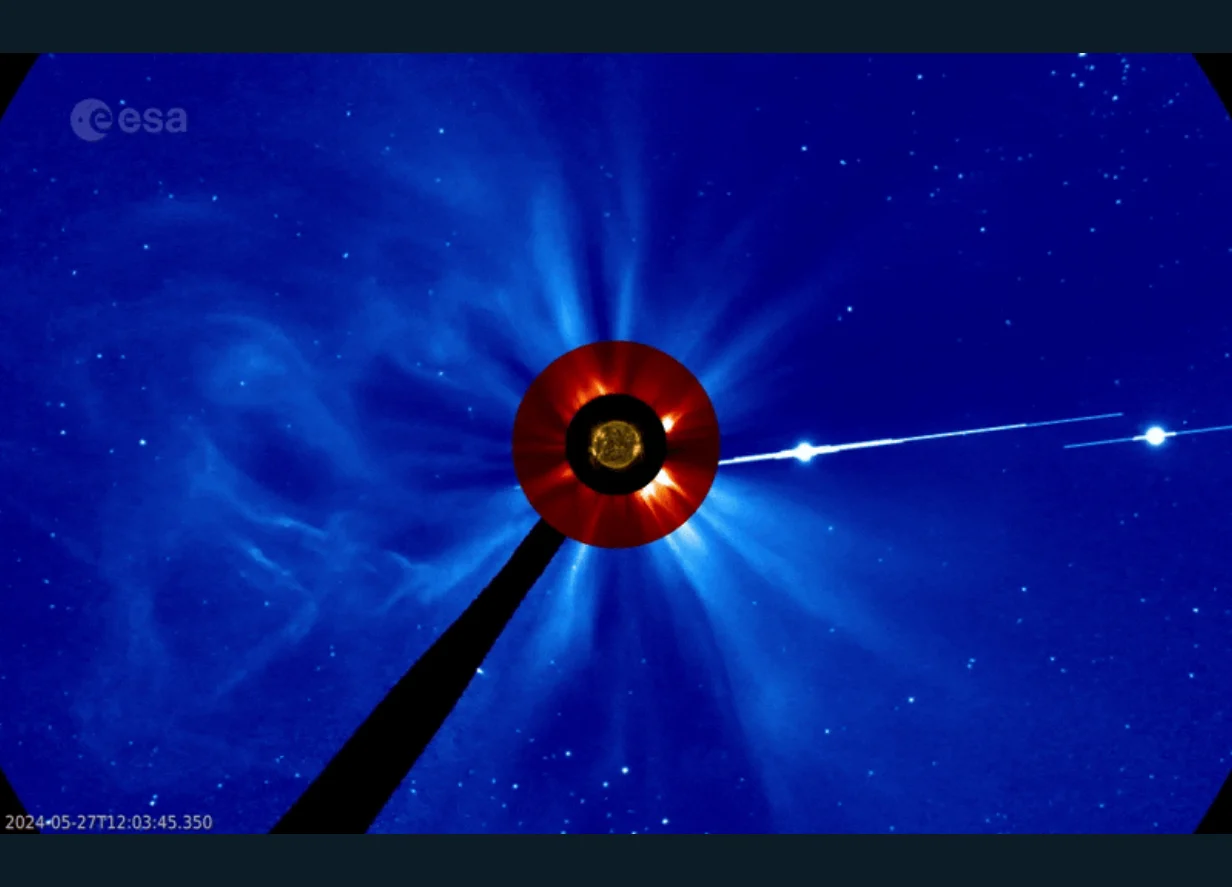
In May 2024, people around the world witnessed beautiful auroras that occurred far beyond the Earth’s polar regions. Even the Aurora Borealis, usually confined to the Arctic Circle, was visible as far away as Mexico. This rare event was the result of a massive solar storm, the strongest in over 20 years. As always, this storm bombarded Earth with charged solar particles that interacted with the planet’s magnetosphere. The storm also reached Mars, which was observed by two European Space Agency (ESA) orbiters – the Mars Express and the ExoMars Trace Gas Orbiter (TGO).
Together, the two spacecraft captured images of the event and obtained detailed information about the amount of radiation that reached Mars: the equivalent of 200 days of what is normally exposed in just 64 hours. The data was presented in a study published in Nature Communications, in which an international team of researchers used a method developed by ESA to reveal how this storm affected Mars. The results could lead to a better understanding of space weather and how solar storms interact with planets.
The technique is known as radio occultation, in which the Mars Express probe sent a radio signal to the TGO as it disappeared over the Martian horizon. While ESA routinely uses orbiter-to-orbiter radio occultation on Earth, this was one of the few cases in which it was used around Mars. Essentially, the radio signal was refracted by layers in Mars’ atmosphere before being picked up by TGO, allowing scientists to learn more about each layer. Data from NASA’s Mars Atmosphere and Volatile Evolution (MAVEN) mission were also used to confirm the electron densities.
*To study the Martian atmosphere, ESA’s two Mars orbiters use a technique called “radio occultation”. Photo credit:ESA*
Colin Wilson, an ESA Mars Express and TGO project scientist and co-author of the study, said in an ESA press release:
This technique has actually been used to explore the solar system for decades, but using signals sent to Earth from a spacecraft. It was only about five years ago that we started using it on Mars between two spacecraft such as Mars Express and TGO, which typically use these radios to transmit data between orbiters and rovers. It’s great to see it in action.
The superstorm coincided with the return of the hyperactive sunspot region AR3664 to the Earth-facing side of the Sun. The explosion sent out an X2.9 class flare and a large cloud of material. a coronal mass ejection (CME) – towards Earth and Mars. On Mars, the storm caused a dramatic increase in electrons in two layers of its atmosphere – 110 and 130 km (68 and 80 miles) above the surface – by 45% and 278%, respectively, the most electrons ever observed in this region of Mars’ atmosphere. ESA research fellow Jacob Parrott, the study’s lead author, said:
The impact was remarkable: Mars’ upper atmosphere was flooded with electrons. It was the largest solar storm response we’ve ever seen on Mars. The storm also caused computer errors in both orbiters – a typical danger of space weather because the particles involved are so energetic and difficult to predict. Fortunately, the spacecraft were designed with this in mind and were built with radiation-resistant components and special systems to detect and correct these faults. They recovered quickly.
*ESA’s Swarm satellites are mapping Earth’s magnetic field as it is distorted by the May 2024 solar storm. Photo credit: ESA*
Thanks to Earth’s magnetosphere, the upper atmosphere’s response was less intense, as much of the storm’s particles were deflected away from the planet or toward the poles (causing the auroras). This highlights the differences between our planets and also shows the importance of studying how space weather affects different bodies in the solar system. Because solar storms can endanger astronauts and equipment in orbit, as well as disrupt satellites and power grids on the surface, predicting space weather is critical.
However, this is difficult because the Sun emits solar flares and CMEs unpredictably, so studying them is a matter of luck and timing. Fortunately, the team was able to use the new technology just ten minutes after the solar storm reached Mars. In total, the team captured the aftermath of three solar events that were part of the same storm but differed in the type of material ejected and the way it was carried out. These included a radiation burst, a high-energy particle burst, and a CME. Colin said:
The results improve our understanding of Mars by showing how solar storms release energy and particles into the Martian atmosphere – important because we know that the planet has lost both large amounts of water and most of its atmosphere to space, most likely due to the continuous wind of particles emanating from the Sun. But there’s another side: the structure and content of a planet’s atmosphere influences the propagation of radio signals through space. If Mars’ upper atmosphere is full of electrons, it could block the signals we use to explore the planet’s surface by radar. This would make this an important consideration in our mission planning – and impact our ability to study other worlds.
Further reading: ESA

Comments are closed.