

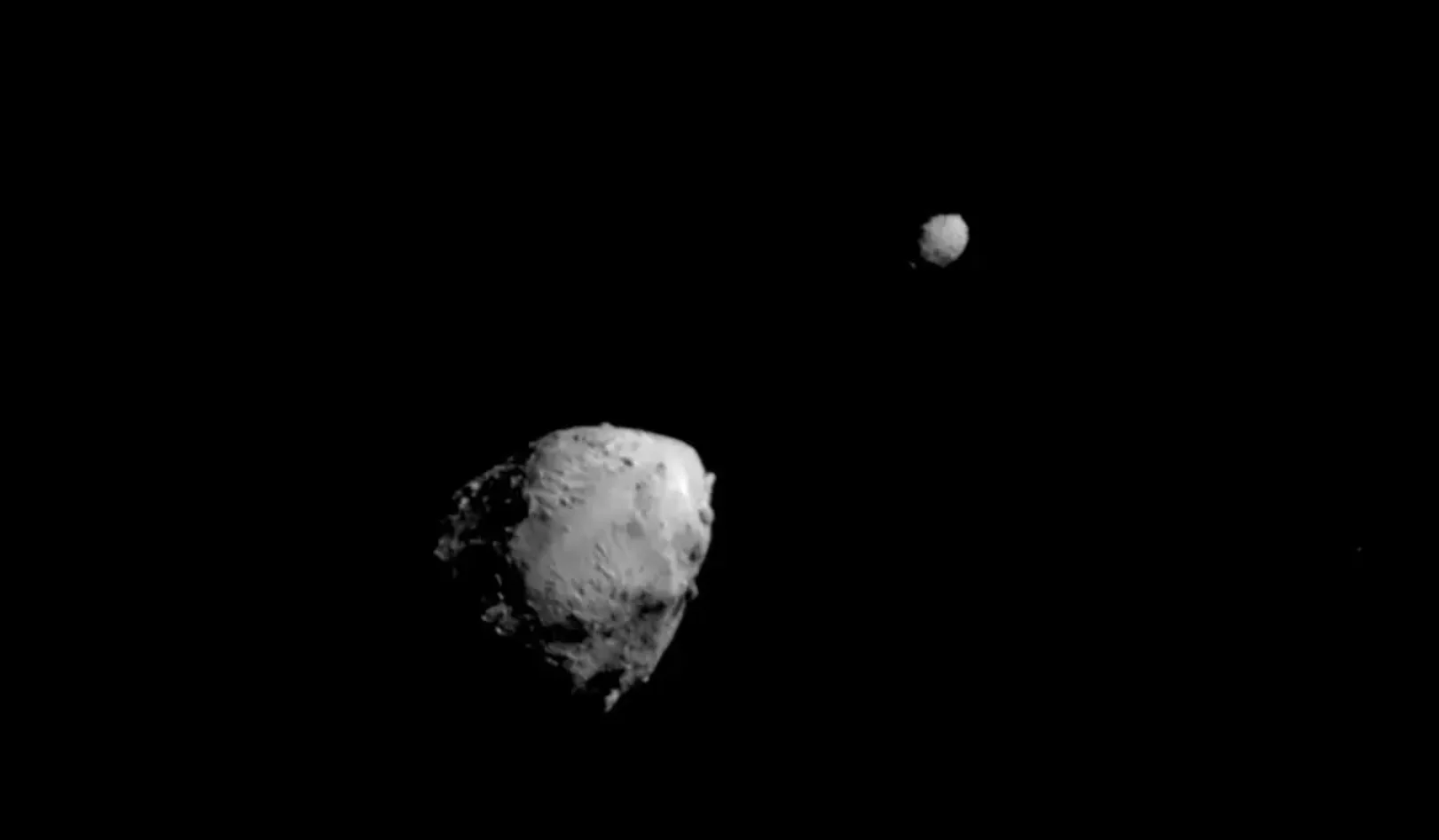
NASA’s Double Asteroid Redirection Test (DART) spacecraft impacted the asteroid moon Dimorphos, which orbits the larger asteroid Didymos, in September 2022. The purpose of this mission was to test the kinetic impactor method, a possible strategy for changing the orbit of asteroids so that they do not pose a threat to Earth. The test was a success, as images from the Italian Space Agency’s LICIACube (traveling alongside the DART mission) showed after the impact. Combined with Earth-based observations, these confirmed that the moon’s orbit changed noticeably.
According to a recent update from NASA, DART’s impact also changed the orbits of both asteroids around the sun. Because Didymos and Dimorphos are part of a binary system and orbit each other around a common center of mass, changes to one asteroid affect the other. As an international team of researchers described in a study published in the journal Science Advances, observations showed that the 770-day orbital period of asteroids around the sun changed by a fraction of a second after the impact. This is a sign It is the first time that a man-made object has changed the orbit of a celestial body around the sun.
When DART hit Dimorphos, follow-up observations showed that the moon’s orbit shortened by 33 minutes. The impact also created a cloud of rocky debris that carried its own momentum away from the asteroid. This gave the asteroid momentum in addition to the impact, called the momentum amplification factor. According to the new study, the momentum amplification factor from DART’s impact was about two, meaning the debris doubled the force exerted by the spacecraft alone. This caused Didymos’ orbit to change by 0.15 seconds.
*This LICIACube image, taken moments after the impact on September 26, 2022, shows rocky debris spreading from Dimorphos. Image credit: ASI/NASA*
Thomas Statler, the chief solar system small body scientist at NASA Headquarters, said in a NASA press release:
This is a minor change in orbit, but given enough time, even a minor change can cause a significant deflection. The team’s astonishingly precise measurement reaffirms kinetic impact as a technique to protect Earth from asteroid threats, and shows how a binary asteroid could be deflected by impacting just one member of the pair.
To show that DART had a detectable impact on both asteroids, researchers had to measure Didymos’ orbit with extreme precision. To do this, the team combined radar and other ground-based observations and tracked the asteroid as it passed in front of background stars (also called occultations). This was challenging because tracking stellar occultations requires precise timing and being in the right location. The team relied on volunteer astronomers around the globe who recorded 22 stellar occultations between October 2022 and March 2025. Steve Chesley, co-leader of the study and senior research scientist at JPL, said:
Combined with years of ground-based observations, these stellar occultation observations were crucial in calculating how DART had changed Didymos’ orbit. This work is highly dependent on the weather and often requires travel to remote regions with no guarantee of success. This result would not have been possible without the efforts of dozens of volunteer occultation observers around the world. This technique allowed the team to obtain extremely precise measurements of the asteroid’s speed, shape and position.
*The infographic above shows Dimorphos’ current orbit around Didymos and its expected orbit after the DART impact. Image credit: NASA/Johns Hopkins APL*
“The change in the orbital speed of the binary star system was about 11.7 micrometers per second, or 1.7 inches per hour. Over time, such a small change in an asteroid’s motion can mean the difference between a dangerous object hitting or missing our planet,” added Rahil Makadia of the University of Illinois Urbana-Champaign and lead author of the study. However, both NASA and ESA have determined that the change in Didymos’ orbit poses no threat to Earth. Studying changes in Didymos’ motion also helped researchers calculate the densities of both asteroids, which revealed that Dimorphos is slightly less dense.
This supports the theory that it formed from rocky debris dropped by a rapidly spinning Didymos that eventually coalesced into a “debris pile” asteroid. Although Didymos is not a potentially hazardous object (PHO) and therefore does not pose a collision threat to Earth, the success of the DART mission demonstrates the effectiveness of the kinetic impactor method. The first step, however, is to detect PHOs far enough in advance that a kinetic impactor can be sent to rendezvous with them. This is the purpose of NASA’s Near-Earth Object (NEO) Surveyor mission: a next-generation space survey telescope and the first built for planetary defense.
Further reading: NASA

Comments are closed.