

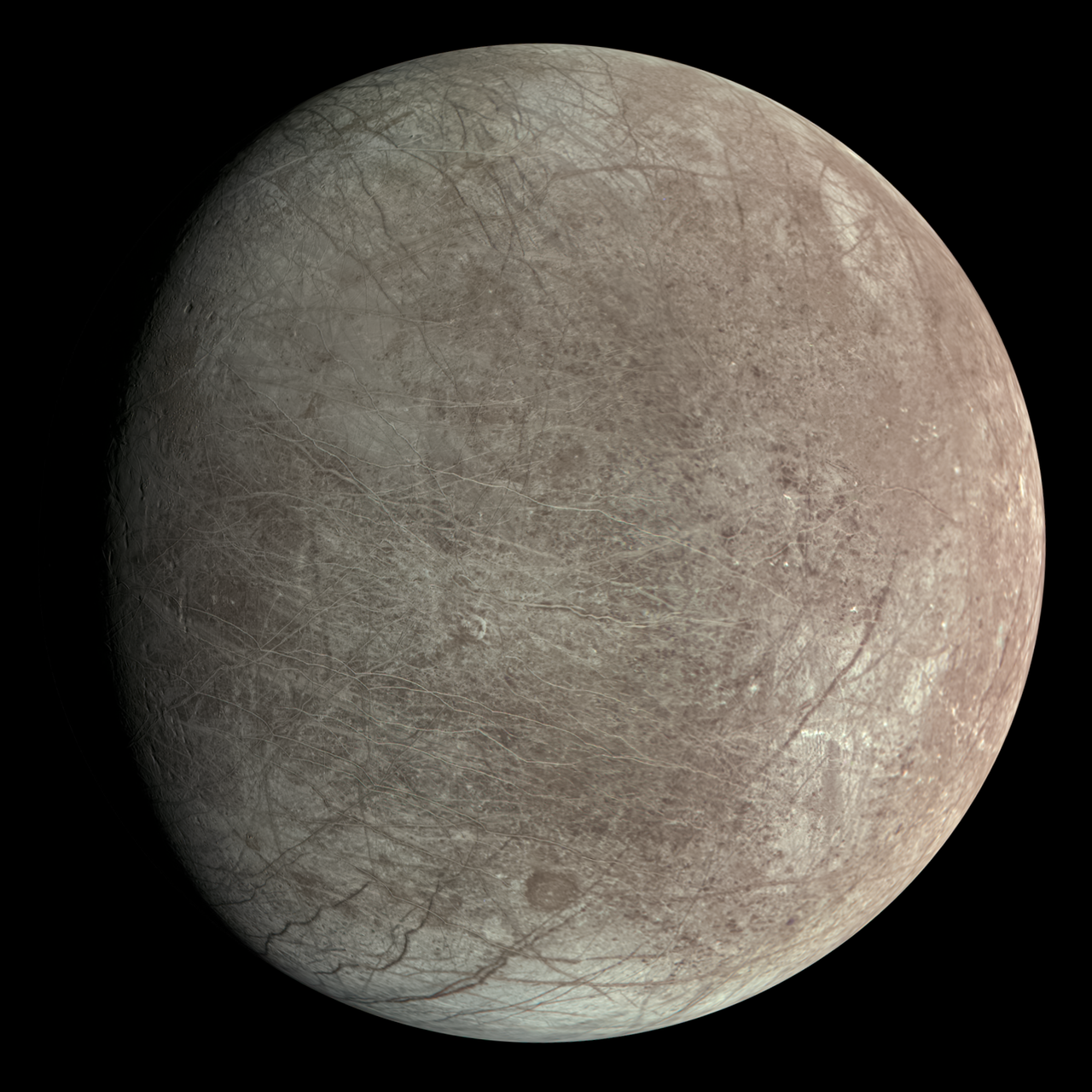
Europe is not supposed to look the way it does. Jupiter’s icy moon is marked by a chaotic patchwork of rugged terrain, crisscrossing ridges and disturbed surface regions, suggesting that something dynamic is happening beneath its frozen shell. Scientists have long suspected that beneath this ice lies a vast liquid ocean, kept warm by the gravitational effects of Jupiter’s enormous gravity. Now a new study using the James Webb Space Telescope adds a crucial piece to the puzzle, and the implications reach to the heart of astrobiology.
The surface of Europa, imaged by the Galileo spacecraft in the late 1990s (Source: NASA)
The research, led by Gideon Yoffe and colleagues, applied a sophisticated technique called spectral decomposition to JWST observations of Europe’s leading hemisphere. Think of it like a chemical fingerprint from a distance. Each molecule absorbs and reflects light at characteristic wavelengths, leaving a distinctive signature that a sufficiently sensitive telescope can detect and map. By analyzing nine separate spectral bands covering water ice, carbon dioxide and other compounds, the team was able to decipher the different chemical layers on Europa’s surface and reconstruct where each one is located.
They found that carbon dioxide, previously detected on Europa, was concentrated in a geologically chaotic region called the Tara Regio, an area where the surface appeared to have fractured and refrozen, attracting material from deeper depths. The working assumption was that it was a localized feature, but the new analysis suggests otherwise. Carbon dioxide accumulation extends well beyond the Tara region, spreading in a broad, lenticular distribution across multiple regions of the chaos terrain. Crucially, wherever carbon dioxide is richest, the ice itself has unusual textural properties, as if the surface had been reworked from below.
A series of images of Europa in different wavelengths from the James Webb Space Telescope. The different wavelengths indicate the presence of different forms of carbon dioxide on Europa (Source: NASA)
This combination, the pattern of carbon dioxide, and the anomalous ice texture suggest something more interesting than simple radiation-driven surface chemistry. The team’s results suggest that the distribution of volatiles across Europa reflects not only where the material is deposited, but also where the surface can best hold on to it. The microstructure of the ice itself may determine what is retained and where. This is a more subtle and physically rich picture than the simple story of carbon dioxide arriving and staying there.
Carbon dioxide is one of the six elements considered vital to life as we know it. If the surface deposits come from the subsurface ocean, as the concentration in geologically young Chaos terrain suggests, then that ocean contains carbon. It is also in chemical communication with the surface, exchanging material across the ice in ways that we are only beginning to understand and explore.
Europa Clipper, NASA’s dedicated mission to Jupiter’s moon, will begin its close flybys in 2031. If this is the case, the chemical map created by JWST will tell exactly where to look.
Source: Spectral decomposition reveals surface processes on Europa

Comments are closed.