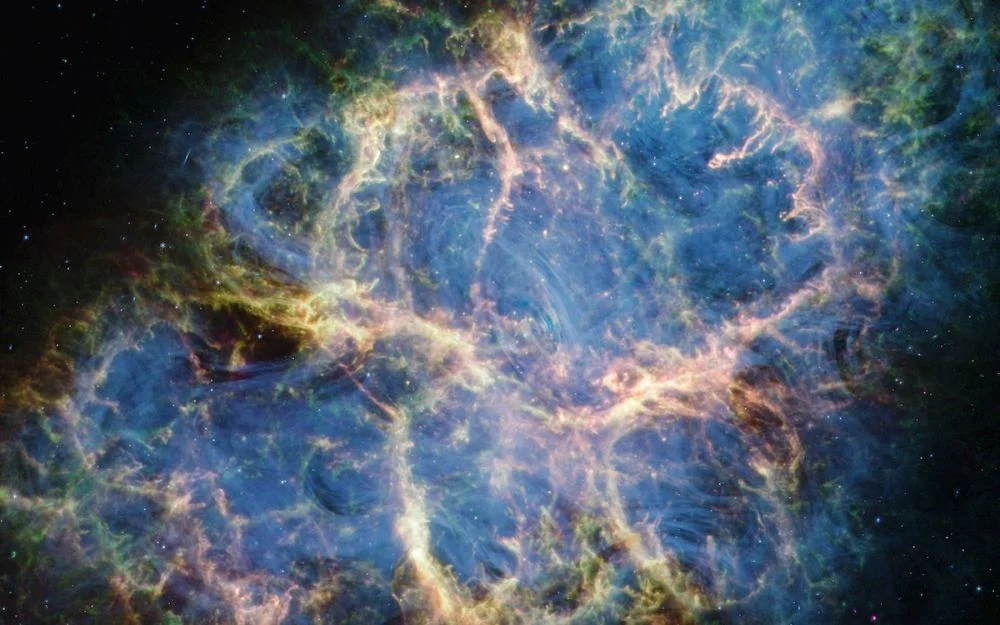
Most objects that astronomers and astrophysicists study have existed for billions of years. Things like supermassive black holes, the Milky Way, and even the Sun and Earth predate humanity by billions of years.
But not the Crab Nebula. It is the supernova remnant (SNR) of a supernova that exploded about 6,500 years ago. Its light reached Earth in 1054 and the exploding star is named SN 1054. Ancient astronomers recorded its appearance in the night sky, particularly Chinese astronomers, who called it a “guest star.”
The Crab Nebula is one of the most studied objects in astronomy. Its distinctive appearance makes it recognizable to more than just astronomers, and it has been imaged in detail many times by various telescopes, including the Hubble. His Crab Nebula image is like the space telescope’s calling card.
There’s a lot going on in a complex object like the Crab Nebula, also known as M1 and NGC 1952. In addition to being classified as an SNR, it is also a pulsar wind nebula. A central pulsar generates the winds that push an expanding bubble of high-energy particles outward. It also drives the outward propagation of magnetic fields.
*This image is a combination of optical light from Hubble (red) and X-ray light from Chandra Observatory (blue). The red star in the center is the Crab Pulsar, and the middle part of the image shows the Pulsar Wind Nebula. Image credit: Optical: NASA/HST/ASU/J. Hester et al. X-ray: NASA/CXC/ASU/J. Hester et al. – https://hubblesite.org/contents/media/images/2002/24/1248-Image.html, Public Domain, https://commons.wikimedia.org/w/index.php?curid=238064*
A typical pulsar emits one radio pulse per revolution. Some have two. In most pulsars the two appear at different parts of the rotation.
But the Crab Nebula stands out from other pulsars. Its two radio pulses and its high energy pulses appear in the same phase. These pulses look like a zebra pattern in their spectrum, with noticeable gaps between them, and astrophysicists are struggling to explain why.
New research in the Journal of Plasma Physics explains why the crab has its unusual zebra-striped pattern. It is entitled “Theory of striped dynamic spectra of the high-frequency interpulse of the Crab pulsar” and the sole author is Mikhail Medvedev. Medvedev is from the Department of Physics and Astronomy at the University of Kansas. This is not Medvedev’s first published research on the Crab Nebula and he has been working to understand these unusual pulses for years.
“This peculiar spectral pattern was first reported in 2007 and subsequently studied in detail,” writes Medvedev. “Despite considerable theoretical effort over the subsequent fifteen years, no satisfactory mechanism has been proposed to resolve the…puzzle.”
It all boils down to the crab’s magnetosphere.
Pulsars are strongly magnetized neutron stars. Their magnetic fields are compressed just like the neutron star itself. This makes them extremely amplified. They can be a billion times stronger. These extreme magnetic fields dominate almost everything about pulsars. In fact, pulsars are considered natural laboratories for extreme physics due to their magnetic fields, extreme gravity, and extreme rotations.
Medvedev’s research shows that gravity is responsible for the unusual zebra pattern.
“Gravity changes the shape of space-time,” Medvedev said in a press release.
“Light does not travel in a straight line in a gravitational field because space itself is curved,” he said. “What would be straight in flat spacetime becomes curved when gravity is strong. In this sense, gravity acts as a lens in curved spacetime.”
We know this to be the case because of gravitational lensing. This lensing effect has been discussed and researched extensively, but not when it comes to neutron stars, said Medvedev.
“In images of black holes, gravity alone shapes the structure,” he said. “Gravity and plasma work together in the crab pulsar. This represents the first real application of this combined effect.”
This animation consists of different frequency observations of the Crab Pulsar from five different observatories: the VLA (Radio) in red; Spitzer Space Telescope (infrared) in yellow; Hubble Space Telescope (visible) in green; XMM-Newton (ultraviolet) in blue; and Chandra X-ray Observatory (X-ray) in purple.
But there’s more to the Crab Nebula’s emission pattern than just zebra-like gaps. There are also high-frequency intergap emissions, but they do not have a broad spectrum like other pulsars.
“There is a remarkable pattern in the pulsar spectrum,” Medvedev said. “Unlike ordinary broad spectra – such as sunlight, which contains a continuous range of colors – the crab’s high-frequency intermediate pulse shows discrete spectral bands. If it were a rainbow, it would be as if only certain ‘colors’ appeared, with nothing in between.”
“The stripes are absolutely clear, with complete darkness in between,” Medvedev said. “There is a bright band, then nothing, bright band, nothing. No other pulsar shows this type of band. This uniqueness made the crab pulsar particularly interesting – and challenging – to understand.”
In his previous work, the physicist was able to explain the clear streaks in the pulsar’s radio emissions. The neutron star’s plasma caused diffractions in its electromagnetic pulses. They were largely responsible for the patrols.
However, the high contrast was still unclear. That changed when he took gravity into account.
“The previous theoretical model was able to reproduce fringes, but not with the observed contrast. Incorporating gravity provides the missing piece,” Medvedev said. “The plasma in the pulsar’s magnetosphere can be thought of as a lens – but a defocusing lens. In contrast, gravity acts as a focusing lens. Plasma tends to spread light rays; gravity pulls them inward. When these two effects are superimposed, there are certain ways in which they compensate for each other.”
The defocusing lens of plasma and the focusing lens of gravity are in a kind of tug-of-war that neither can ever win. The different forces create both in-phase and out-of-phase interference bands in the radio waves, creating the zebra pattern.
“For reasons of symmetry, there are at least two such paths for light,” he said. “When two nearly identical paths bring light to the observer, they form an interferometer. The signals are combined. At some frequencies they reinforce each other (in phase) and produce bright bands. At others they cancel each other (out of phase) and produce darkness. This is the essence of the interference pattern.”
There is still a lot of work to be done, even if the model explains the impulses of the Crab pulsar.
“It appears that little additional physics is required to qualitatively explain the streaks,” Medvedev said. “Quantitatively there may be refinements.”
“The pulsar rotates, and the inclusion of rotation effects could lead to quantitative, although not qualitative, changes,” Medvedev said.
Medvedev’s work could also lead to a better understanding of other rotating and gravitational objects. Pulsars themselves are difficult to study, and Medvedev’s work could advance the study of pulsars in general. For example, the exact source of a neutron star’s impulses is unknown, although the polar regions are strongly considered. In this case, scientists are not yet sure how far above the poles the impulses arise.
“Our model also imposes constraints on the source of the pulsar radio emission,” Medvedev writes.
