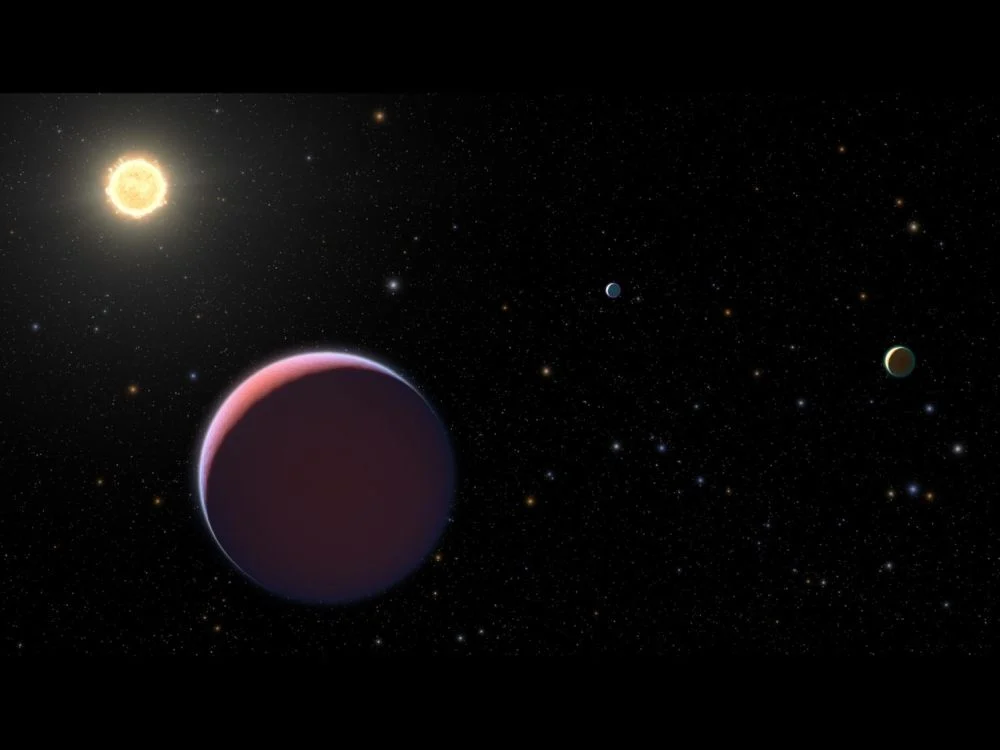
There are some strange types of exoplanets that have no counterpart in our solar system. One of these types are super puff planets. These special balls have larger radii than Neptune, but only a few Earth masses. This means that they have a large volume and a low density. How this particular type of exoplanet forms is unclear, and current models of gas giant formation cannot explain them.
Kepler-51 is a 500-million-year-old Sun-like star about 2,620 light-years away that hosts three super-puff planets. One of them, Kepler-51d, is the coolest and least dense of the three. It’s the subject of new research in the Astronomical Journal. In it, the researchers test the three hypotheses that attempt to explain Kepler-51d and super-puffs in general.
The research is “The James Webb Space Telescope NIRSpec-PRISM Transmission Spectrum of the Super-Puff, Kepler-51d,” and the lead author is Jessica Libby-Roberts. Libby-Roberts is from the Department of Astronomy and Astrophysics and the Center for Exoplanets and Habitable Worlds, both at Pennsylvania State University.
“We think the three inner planets orbiting Kepler-51 have tiny cores and huge atmospheres that give them a density similar to cotton candy,” lead author Libby-Roberts said in a press release. “These extremely low-density super-puff planets are rare and defy conventional understanding of how gas giants form. And if it wasn’t difficult enough to explain how one gas giant formed, there are three in this system!”
Maintaining a large, puffy atmosphere requires a massive core with enough gravity to prevent the atmosphere from being ripped away. Typically, these types of planets are also further away from their stars, which also makes it harder for the star to remove their atmosphere. But Kepler-51d is only as far from its star as Venus is from the Sun. And because Kepler-51 is young, only about 500 million years old, it is more active than older stars like the Sun.
“Kepler-51 is a relatively active star, and its stellar winds should easily blow gases away from this planet, although the extent of this mass loss over Kepler-51d’s lifetime remains unknown,” Libby-Roberts said. “It’s possible that the planet formed further away and moved inward, but we still have a lot of questions about how this planet – and the other planets in this system – formed. What is it about this system that created these three really strange planets, a combination of extremes we haven’t seen anywhere else?”
Kepler-51d is one of the least dense exoplanets of this type and is also the coolest in the system. Its planetary mass is about 5.6 Earth masses and its radius is about 9.3 Earth radii. That means it has almost ten times the radius of Earth, but just over five times the mass of Earth. A planet of this size, light and cold defies our understanding of planet formation. The authors write that “…the observed properties of this planet cannot be easily explained by most planet formation theories.”
The exoplanet’s properties make it a valuable scientific target to test the various hypotheses that attempt to explain super-puffs.
As the title of the study makes clear, this research is based on JWST’s NIRSpec instrument. When NIRSpec captured the transmission spectrum of Kepler-51d’s atmosphere, it was featureless. There were no strong signs of molecular absorption. The spectrum looks like an inconspicuous slope.
This is the transmission spectrum of Kepler-51d observed with JWST/NIRSpec-PRISM, covering a range of 0.6–5.3 μm. This wavelength range is typically rich in chemical fingerprints. If they were present and detectable, molecules such as H2O, CO2 and NH3 would be visible in the spectrum. The problem is that the haze can obscure all of these features, creating the slope in the spectrum. Photo credit: Libby-Roberts et al. 2026. AnJ.
“At 350 K, we expect to observe a rich range of molecular features (methane, water, carbon dioxide and ammonia) assuming an aerosol-free chemical equilibrium atmosphere for Kepler-51d – especially given its extreme scale altitude of about 1700 km. Instead, the lack of clearly identifiable features in an extended H/He-rich atmosphere between 0.6 and 5.3 μm is a first for JWST,” the researchers write. However, some molecules containing carbon, oxygen, nitrogen and other chemicals must be present to trigger the formation of the haze.
There are three working hypotheses that attempt to explain super-puffs like Kepler-51d.
The first is that the planet has a massive hydrogen/helium shell. Planets typically don’t maintain this atmosphere because they are too bright. The loss of these atmospheres explains the observed Fulton gap or radius gap in the exoplanet population. While the exoplanet’s atmospheric spectrum is featureless, forward modeling shows that it likely has low metallicity for several reasons, supporting the H/He envelope hypothesis. However, to maintain this atmosphere, scientists must assume that a planet must be massive and not too close to its star, which contradicts this hypothesis.
The second hypothesis is that Kepler-51d exhibits high-altitude photochemical opacities. This is consistent with submicron-sized haze particles in the exoplanet’s upper atmosphere. Spectra of other super puffs show the same thing. Because opacities block all molecular features in the spectrum, the JWST results support this.
The third is that the planet actually has a ring system that is tilted toward us. That would make the planet appear larger than it is. This would in turn make the density appear much lower. The researchers found that a ring system can fit the data, but it must be a very short-lived system. This is because the planet is so close to its star that any ring system would be unstable. Since the planet is only about 500 million years old and the ring system could only survive for about 100,000 years, that means we would be very lucky to be able to observe it at just the right time for a ring system to exist. This is a very low probability and that is why researchers do not support this explanation.
Rings are made of dust and also block light in a uniform pattern. “Instead, we see a linear trend where more light is blocked at longer wavelengths,” Libby-Roberts said.
*This artist’s illustration features a super puff planet. With low masses and large radii, they defy our models of planet formation. Image source: By Pablo Carlos Budassi – Own work, CC BY-SA 4.0, https://commons.wikimedia.org/w/index.php?curid=136006077*
The researchers conclude that the high-altitude photochemical haze hypothesis best fits the evidence.
“We think the planet has such a thick layer of haze that absorbs the wavelengths of the light we look at, so we can’t really see the features underneath,” said study co-author Suvrath Mahadevan. Mahadevan is a professor of astronomy and astrophysics at Penn State Eberly College of Science. “It appears to be very similar to the haze we see on Saturn’s largest moon Titan, which contains hydrocarbons such as methane, but on a much larger scale. Kepler-51d appears to have a huge amount of haze – almost as large as the radius of Earth – and would be one of the largest we have seen on a planet to date.”
Lead author Libby-Roberts echoed Mahadevan’s comments. “Rings would have to be short-lived, made of very specific materials and arranged at just the right angle, which seems unlikely, but we can’t rule it out completely. If we could observe the planet at even longer wavelengths, such as with JWST’s mid-infrared instrument, we might be able to detect the materials that would be in a ring or see the full extent of the haze layer.”
Missions like Kepler TESS have shown us how diverse the exoplanet population is. Our models of planet formation are largely based on what we see in the solar system. But they are being put to the test by the discovery of super-puff planets like Kepler-51d.
“Before astronomers found planets outside our solar system, we thought we had a pretty good understanding of how planets formed,” Libby-Roberts said. “But we started finding exoplanets that didn’t fit our solar system at all, and we have these alien worlds that really challenge our understanding of planet formation. We haven’t found a solar system like ours yet, and if we can explain how all these different planets formed, we can better understand how we fit into the bigger picture and what place we occupy in the universe.”
Without detailed knowledge of Kepler-51d’s composition and structure, researchers cannot explain how the super puff formed. However, JWST’s NIRSpec spectrum can help rule out certain scenarios and limit others. The next step is to examine the other super-puff planets in the system using both NIRSpec and MIRI.
“Future observations of other super-puff planets in the Kepler-51 system using JWST could provide additional insights into how these planets (including Kepler-51d) formed and whether they all have a significant haze layer,” the researchers write. “At the moment, Kepler-51d is the only known planet with a featureless, tilted JWST transmission spectrum of 0.6-5.3 μm,” they conclude.
