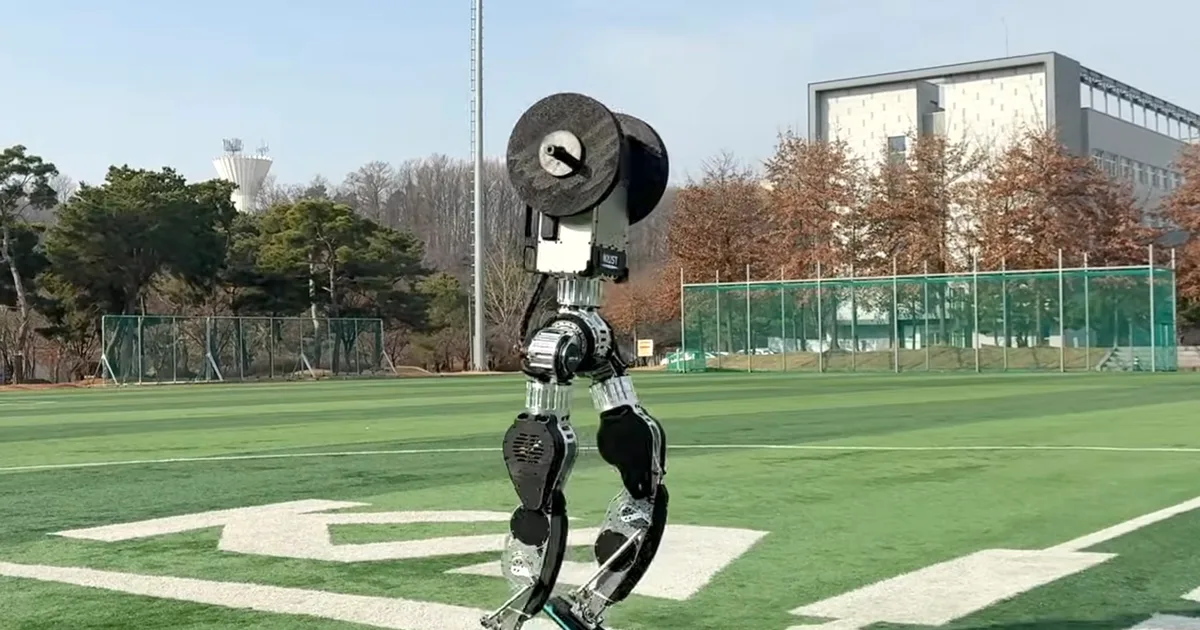
A new video (above) from South Korea shows the field testing and interaction capabilities of KAIST Humanoid v0.7, developed at the Korea Advanced Institute of Science and Technology (KAIST).
The impressive humanoid robot was developed at KAIST’s Dynamic Robot Control & Design Laboratory (DRCD) and uses actuators and other internally developed technologies.
In the video below, you can watch the bipedal bot walk, jog, and jump in an incredibly human-like manner. It also kicks a soccer ball at a goal (disappointingly, there’s no robot goalkeeper to challenge it) and performs a perfect moonwalk across astroturf. And it was the moonwalk that caused a stir in the comments on the video.
“Moonwalk was flawless,” one wrote, while another commented: “Okay, that was all impressive but you won me over with the moonwalk.”
In its robotics work, KAIST uses Physical AI, a form of AI technology that enables machines to understand and operate in the physical world, and helps explain why robots like the KAIST Humanoid v0.7 appear to move in such a human-like manner.
Instead of just “thinking in words” like typical AI, physical AI gives machines a sense of space and timing in real-world environments.
As part of KAIST’s broader collaborative intelligence initiative led by Young Jae Jang, the approach trains robots and systems to continuously learn through simulation and real-time feedback, rather than relying solely on huge historical data sets.
Essentially, physical AI connects the brain and body through the tight integration of software intelligence with hardware such as motors and sensors, so that the machines not only compute but also act, react and collaborate in complex environments, whether as part of fully automated factories or in humanoid robots that, for example, kick a ball.
Engineers are refining the KAIST Humanoid v0.7 with the goal of improving its mobile and dexterous capabilities, building on its existing walking and dynamic movement capabilities. Further integrating AI with mechanical hardware aims to make the robot perform more complex tasks such as carrying objects or operating machines, thus integrating physical AI into real-world humanoid robotic applications.
KAIST is one of South Korea’s top universities and is often compared to leading global technology schools such as MIT in the USA. KAIST was founded in the early 1970s to promote Korea’s scientific and technological growth. The focus is on research in areas such as AI, robotics, physics and engineering.
