

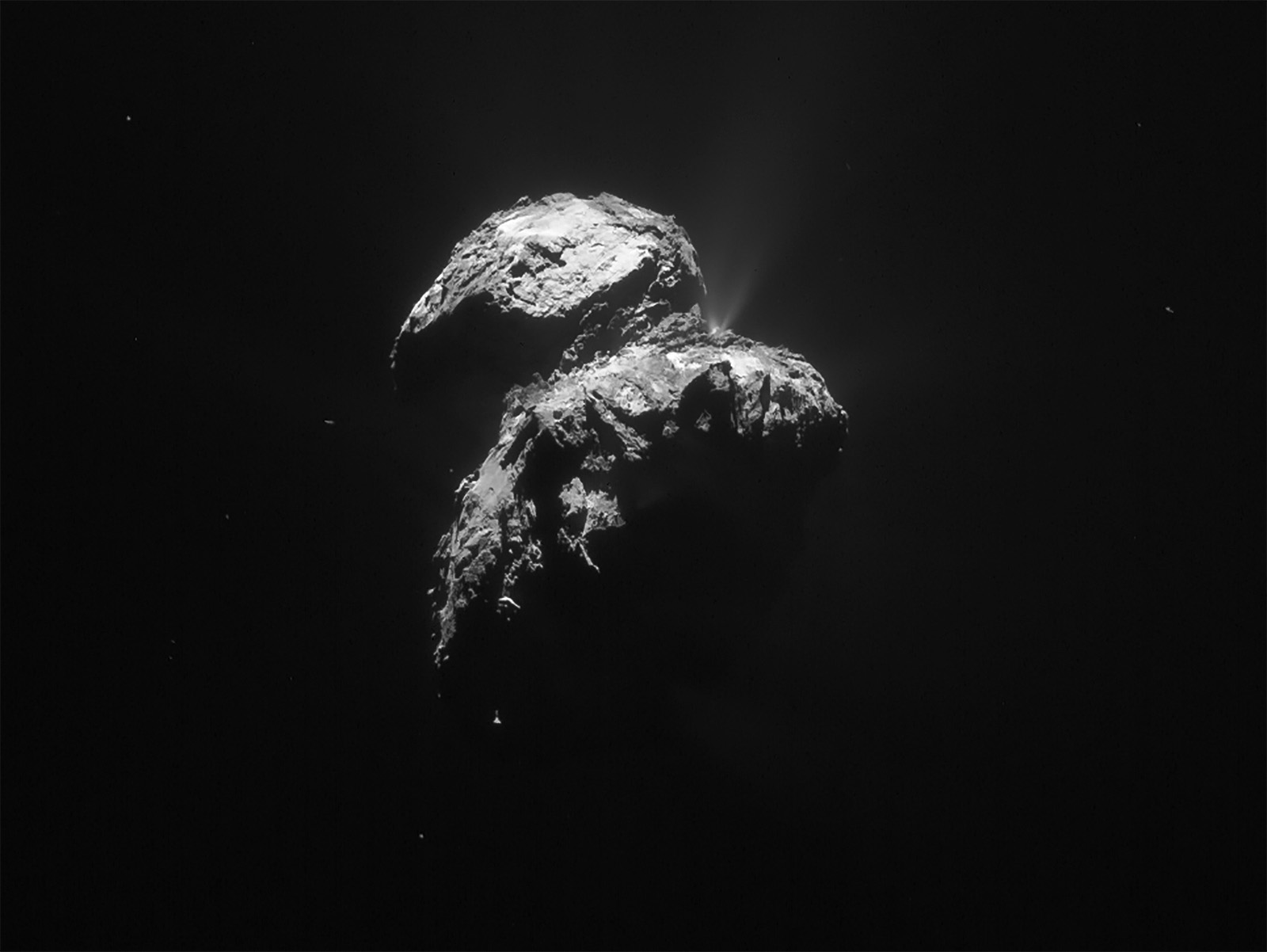
When do comets get their characteristic coma? Conventional wisdom has it that it only happens when they are close enough to the sun, but new research suggests that it begins when they are still out of the planets orbits.
When comets are roughly in orbit of Jupiter, the heat of the sun sublimes frozen water. This process turns the ice into a vapor that envelops the comet and eventually extends behind the core in a tail that can stretch for millions of kilometers – making a delightful nighttime show for any celestial watcher here on earth.
However, some comets such as C / 2017 K2 are active despite sitting twice as far from the Sun as Jupiter. Observations of this comet have shown that grains of dust continue to surround the nucleus – a distinct halo that is driven by some kind of internal activity.
A team of astronomers took a closer look at C / 2017 K2 and tracked the comet as it moved inward from a distance of 16 AU to 9 AU, as reported in a recent article in the preprint journal arXiv. They found that as the comet approached the Sun, its rate of mass loss rose to over 1,000 kilograms per second.
Stranger still, given the amount of dust around the core and the speed at which the dust was moving away from the comet, it must have ejected that dust when it was much, much further from the Sun: more than 35 AU, beyond orbit Neptune and in the Kuiper Belt.
The authors suggest that when the comet approached within 35 AU, it got warm enough to sublime frozen carbon monoxide and drive off the dust and particles that continued to surround it.
These results confirm how difficult it is to predict cometary paths, especially when they are so far from the Sun. A variety of processes can change a comet’s orbit slightly and lead to drastic differences in its ultimate trajectory. If we are ever to hope for better comet tracking functions, we must understand complex physical processes like these.
Like this:
Loading…

Comments are closed.