From NASA
The earth has a budget – an energy budget. Our planet is constantly trying to balance the flow of energy in and out of the earth system. But human activities throw that off balance and cause our planet to warm up in response.
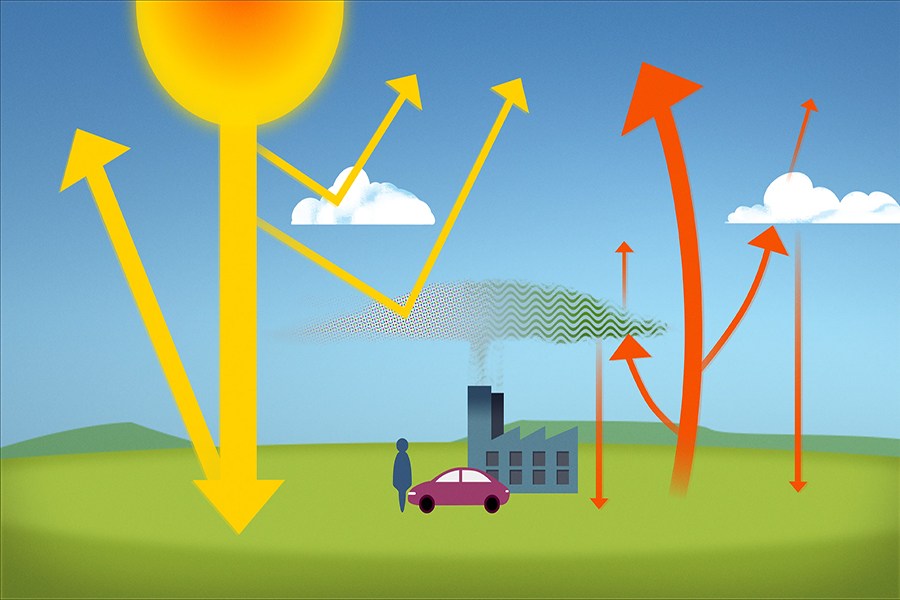
Radiant energy enters the earth system from the sunlight that shines on our planet. Some of this energy is reflected back into space from the earth’s surface or atmosphere. The rest is absorbed, heats the planet and is then given off as radiant thermal energy, just as black asphalt gets hot and radiates heat on a sunny day. Ultimately, this energy also goes to space, but some of it is reabsorbed by clouds and greenhouse gases in the atmosphere. The absorbed energy can also be released back to the earth, where it heats the surface even more.
Adding more components that absorb radiation – like greenhouse gases – or removing those that reflect it – like aerosols – affects the earth’s energy balance and causes more energy to be absorbed by the earth instead of escaping into space. This is known as radiative forcing and is the dominant way that human activities affect the climate.
A simplified animation of the planetary energy balance of the earth: The energy budget of a planet is balanced between incoming (yellow) and outgoing radiation (red). On earth, natural and man-made processes affect the amount of energy received and sent back into space. This study filters out fluctuations in the earth’s energy budget due to feedback processes and reveals the energy changes caused by aerosols and greenhouse gas emissions
Climate modeling predicts that human activities will release greenhouse gases and aerosols that affect the earth’s energy balance. Now a NASA study has confirmed these predictions for the first time with direct observations: The radiation forces increase due to human actions, influence the energy balance of the planet and ultimately cause climate change. The paper was published online in the journal Geophysical Research Letters on March 25, 2021.
“This is the first calculation of the Earth’s total radiative forcing using global observations, including the effects of aerosols and greenhouse gases,” said Ryan Kramer, first author of the paper and researcher at NASA’s Goddard Space Flight Center in Greenbelt, Maryland and the University of Maryland , Baltimore County. “It is direct evidence that human activity is changing the earth’s energy budget.”
NASA’s Clouds and the Earth’s Radiant Energy System (CERES) project investigates the radiation flux at the top of the Earth’s atmosphere. A number of CERES instruments have flown continuously on satellites since 1997. Each measures how much energy is entering and leaving the Earth system, which gives the total net change in radiation. This data, when combined with other data sources such as ocean heat measurements, shows that there is an energy imbalance on our planet.
“But it doesn’t tell us which factors are causing changes in the energy balance,” said Kramer.
Other satellites and instruments – like CERES – monitor the incoming energy from the sun and the energy that is released back into space. Credits: NASA’s Scientific Visualization Studio Download this image from NASA Goddard’s Scientific Visualization Studio
This study used a new technique to find out how much of the total energy change is caused by humans. The researchers calculated how much of the imbalance was caused by variations in frequently naturally occurring factors such as water vapor, clouds, temperature, and surface albedo (essentially the brightness or reflectivity of the earth’s surface). For example, the AIRS (Atmospheric Infrared Sounder) instrument on NASA’s Aqua satellite measures the water vapor in the earth’s atmosphere. Water vapor absorbs energy in the form of heat, so changes in water vapor affect how much energy ultimately leaves the Earth system. The researchers calculated the change in energy caused by each of these natural factors and then subtracted the values from the total. The leftover part is the radiative forcing.
The team found that human activity increased radiative forcing on Earth by around 0.5 watts per square meter from 2003 to 2018. The increase is mainly due to greenhouse gas emissions from power generation, transportation and industrial manufacturing. Reduced reflective aerosols also contribute to the imbalance.
The new technology is computationally faster than previous model-based methods, so researchers can monitor radiative forcing in almost real time. The method could be used to track how human emissions affect the climate, to monitor how well various mitigation efforts are working, and to evaluate models to predict future changes in climate.
“By creating a direct record of radiative forcing that is calculated from observations, we can assess how well climate models can simulate these forces,” said Gavin Schmidt, director of NASA’s Goddard Institute of Space Studies (GISS) in New York City. “That way, we can make more confident predictions about how the climate will change in the future.”
Caption in the header: A supercomputer model from NASA shows how greenhouse gases such as carbon dioxide (CO2) – a major driver of global warming – fluctuate in the earth’s atmosphere all year round. Higher concentrations are shown in red. Credits: NASA’s Scientific Visualization Studio / NASA’s Global Modeling and Assimilation Office. Download this image from NASA Goddard’s Scientific Visualization Studio.
From Sofie Bates
NASA’s Earth Science News Team
Last updated: March 25, 2021 Editor: Sofie Bates
Like this:
Loading…
