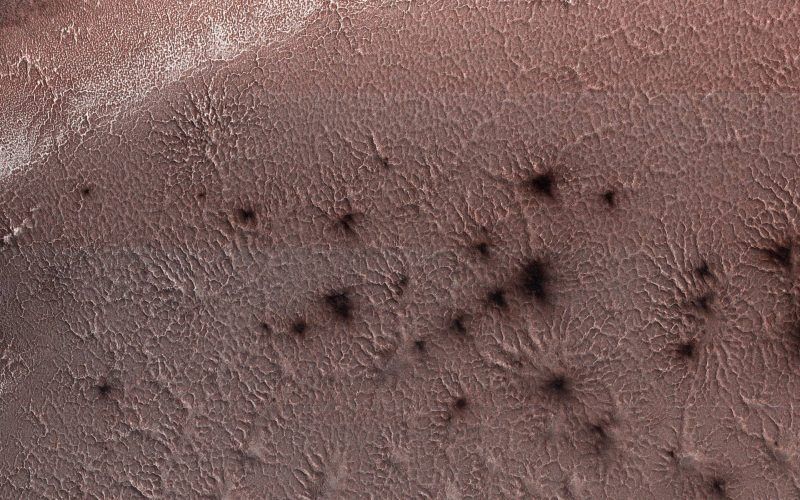
A person suffering from arachnophobia might think that a trip to Mars would fuel their fear. However, there is such a thing colloquially known as a Mars spider. It’s far more harmless than the eight-legged animal that scares millions of people, but its origins were only theorized until recently. Now a team led by a group at Trinity College Dublin has discovered that these “spiders” are, in fact, topological troughs that result when dry ice sublimates directly into a gas.
The “spiders” or, to give them their real name, “araneiforms” have been known for some time. These features of the spider life of the Martian terrain form in the spring, but they are not known to form on Earth. Araneiforms have been recorded by various satellites orbiting Mars over the past 20 years. Their transitory nature makes them particularly interesting to scientists who want to better understand Mars’ seasonality and weather patterns.
Araneiforms can be seen on Mars’ South Pole Cap in two high-resolution MOC images that were taken in the southern spring. Each picture is approximately 2 miles wide.
Photo credit: NASA / JPL / MSSS
There has long been a theory about where araneiforms came from. This theory, known as Keiffer’s Hypothesis, named after Hugh Kieffer, formerly the US Geological Survey, centered on the idea that the sun would warm the ground beneath blocks of dry ice and eventually sublimate the dry ice it was in contact with. Then pressure would build up in the block of ice, which would eventually break open and allow the gas to escape. The rapid escape of the gas then forms the dendritic pattern in the dust on the surface of Mars, which is characteristic of Araneiforms.
The only problem with this theory, which has been widely accepted in the scientific community, is that it has never been demonstrated experimentally. The coverage of the surface of Mars is not continuous enough to be able to catch a block of ice when it sublimates. Hence, although widely accepted, the theory has never really been proven.
YouTube video describing the Mars simulation chamber.
Credit – Europlanet’s YouTube Channel
This is where the team from Trinity College Dublin comes in. They teamed up with other scientists like Durham University and the Open University who conveniently had an important part of the kit known as the Mars Simulation Chamber. With this experimental set-up, environments with pressures and temperatures similar to those on the surface of Mars can be restored.
The Mars simulation chamber wasn’t the only interesting experimental device the team used, however. They took a note from the amusement arcades and used a claw similar to the one in the frustratingly designed games where children don’t regularly pick up toys. After drilling holes in blocks of dry ice, the team hung them with their claws just above a granular bed. They varied the size of the grains in the granulate beds in order to adapt them to certain surface conditions on Mars.
The research team was inspired by a classic arcade game.
Photo credit: Wikipedia User Nlan86
Using another well-understood technique, the Leidenfrost effect, the team was able to sublimate some of the dry ice directly when it came into contact with the granular surface that was being heated. The gas thus generated quickly escaped through a central hole the team drilled in each block of ice to simulate the rupture believed to occur in the dry ice blocks on the Martian surface.
After each experiment, a very recognizable araniform pattern was visible in the granular bed as soon as the dry ice block was lifted. This provided the first experimental evidence for the creation of these patterns resulting from the sublimation process described in Kieffer’s original theory.
This finding is likely that the best scientists will be able not to observe the actual process directly on Mars. Even if they finally do, arachnophobes can rest assured that all Mars spiders are most likely just terrain patterns caused by the noise of CO2 gas. At least as far as we can tell here.
Learn more:
Trinity College Dublin – Trinity researchers fight the spiders from Mars
Scientific Reports – The formation of araneiforms from carbon dioxide ventilation and powerful sublimation dynamics under Martian atmospheric pressure
SciTechDaily – Researchers fight the enigmatic “spiders” from Mars
The Independent – Scientists Breakthrough in Finding Explanations for “Spiders From Mars”
Mission statement:
This image by MRO, captured in May 2018, shows spiders beginning to form during the Martian spring.
Photo credit: NASA / JPL / University of Arizona
Like this:
Loading…
