

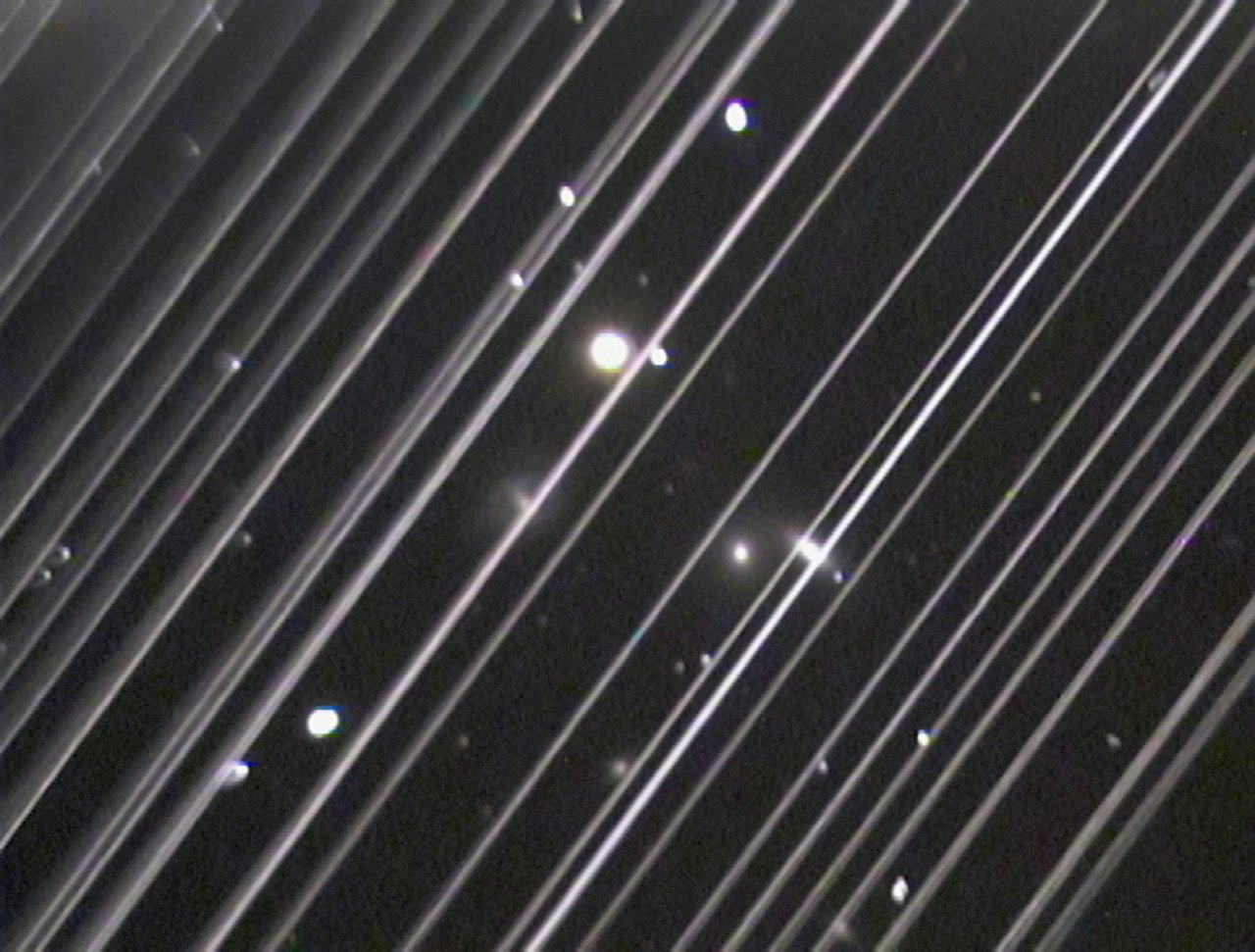
New research has shown that as the number of satellites in orbit increases, their accumulated light pollution brightens the night sky – making basic astronomy much more difficult to conduct.
The continued launch of so-called “mega-constellations” of satellites that provide global Internet access has been viewed with concern by astronomers around the world. These astronomers fear that individual images of distant objects will be destroyed by a satellite crossing in front of the telescope.
However, new research recently published in the Royal Astronomical Society’s monthly bulletin paints an even grimmer picture. As more and more satellites ascend, they each add a small amount to the overall brightness of the sky, known as light pollution.
“Our main motivation was to estimate the potential contribution to the brightness of the night sky from external sources such as space objects in orbit,” said Miroslav Kocifaj of the Slovak Academy of Sciences and Comenius University in Slovakia, who led the study. “We expected the increase in sky brightness to be small, if any, but our first theoretical estimates turned out to be extremely surprising and therefore encouraged us to report our results immediately.”
If all planned mega-constellations rise, our skies will be 10% brighter on most of the planet within a few years. To estimate this result, the research team took into account the individual shape, reflectivity and orbit of the satellites, as well as the contribution of random space debris such as spent rocket boosters.
The bottom line is that even the most pristine places on earth, far from cities, will still suffer.
“Unlike ground-based light pollution, this type of artificial light can be seen in the night sky over much of the earth’s surface,” said John Barentine, public policy director for the International Dark-Sky Association and co-author. “Astronomers build observatories away from city lights to look for dark skies, but this form of light pollution has a much wider geographic range.”
The researchers hope this will deter satellite manufacturers from taking astronomers’ concerns seriously and continuing to develop aggressive damage control strategies.
“Our results suggest that many more people than just astronomers are losing access to the pristine night sky,” said Barentine. “This paper can really change the nature of that conversation.”
Like this:
Loading…

Comments are closed.