

Reposted by Polar Bear Science
Published on December 10, 2020 |
It was only a few months ago that I discovered that the Burin Peninsula on the south coast of Newfoundland in eastern Canada was destroyed by a major tsunami in 1929, which inspired my new short novel UPHEAVAL. My story is about an ice tsunami that devastated Cape Breton Island in 2026 (a sea wave triggered by an underwater earthquake or landslide turns into an ice tsunami if it moves under sea ice before going ashore) . Here are the details of that little-known 1929 tsunami event – never heard of from a colleague who is a tsunami advisor for his Alaska area and family members who had lived in Nova Scotia.
THE TSUNAMI OF 1929
Summary
On November 18, 1929, a tsunami struck the Burin Peninsula of Newfoundland, causing significant loss of life and property. Huge waves hit the coast at 40 km / h, inundating dozen of communities and washing entire houses into the sea. The disaster killed 28 people and left hundreds more homeless or destitute. It was the most devastating earthquake event in Newfoundland and Labrador history and occurred at the beginning of a global depression.
Despite the magnitude of the earthquake that triggered the tsunami, no one in Newfoundland and Labrador suspected the impending danger. Large seismic events are rare in eastern North America and virtually non-existent in Newfoundland and Labrador. In 1929 the country didn’t even have a seismograph or tide meter that could warn of the tsunami. In addition, a recent storm had severed the only telegraph line connecting the Burin Peninsula with the rest of the island. It wasn’t until almost three days after the tsunami that the Squires government learned of the disaster and was able to send aid.
Grand Banks earthquake
On Monday, November 18, 1929, at 5:02 p.m., an underwater earthquake struck the southern edge of the Grand Banks, about 160 miles south of the Burin Peninsula of Newfoundland. It measured 7.2 on the Richter scale and was recorded in locations west of New York and Montreal, as well as east Portugal. In the Burin Peninsula, the ground tremor lasted about five minutes but did not cause any serious damage to homes or other structures. No one in the area had seen an earthquake before, and although some people understood what was happening, no one imagined the tsunami that would follow.
On the Grand Banks, the earthquake triggered a sizeable underwater landslide, which in turn pushed a series of large waves across the surface of the sea. The tsunami raced towards Newfoundland at a speed of up to 140 km / h before slowing to around 40 km / h in the shallower water. It was recorded on tide gauges in Bermuda, Portugal, the Azores, and along the east coast of the United States. However, Newfoundland was unaware of the huge waves rapidly approaching its south coast.
Tsunami hits the Burin Peninsula
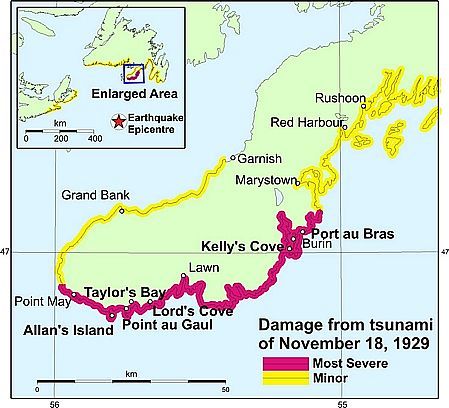
Around 7:30 p.m., residents of the Burin Peninsula noticed a rapid drop in sea levels as the lowest point of the first wave of the tsunami, known as the trough, hit the coast. As the water receded, parts of the ocean floor that were normally submerged were exposed and boats docked at various ports fell on their side. Minutes later, three consecutive waves hit the shore and the water level rose dramatically. In most places, sea levels swelled three to seven meters above normal, but in some of the peninsula’s long, narrow bays, such as Port au Bras, St. Lawrence and Taylor’s Bay, the water rose 13 to 27 meters.
The force of the waves lifted houses from their foundations, swept schooners and other ships into the sea, shattered stages and flakes, and damaged wharves, fish stocks, and other structures along the peninsula’s vast coastline. About 127,000 kilograms of cod were also washed away in the tsunami, which affected more than 40 communities on the Burin Peninsula. At Point au Gaul, giant waves destroyed nearly 100 buildings and much of the community’s fishing gear and food supplies. St. Lawrence lost all of its flakes, stages, and motor boats. According to government estimates, the damage to property on the Burin Peninsula later amounted to 1 million US dollars.
Worse than the property damage, however, was the loss of life. The tsunami killed 28 people in southern Newfoundland, more than any other documented earthquake event in Canadian history. 25 victims drowned during the disaster (six bodies washed into the sea and never found) and three more later died from shock or other tsunami conditions. The deaths were limited to six communities: Allan’s Island, Kelly’s Cove, Point au Gaul, Lord’s Cove, Taylor’s Bay, and Port au Bras. Fortunately, the tsunami hit on a quiet evening when most people were still awake and able to react quickly to the rising water. many managed to evacuate their homes and flee to a higher level.
Read the whole thing here.
See also the earthquake and tsunami of magnitude 7.2 “Grand Banks” of 1929
“90 years later, a tsunami in southern Newfoundland brings vivid memories” (CBC News Report, November 18, 2019):
The Newfoundland Tsunami of November 18, 1929: An Investigation of the Twenty-Eight Deaths in the “South Coast Disaster” (2006):
Ruffman, Alan. 1994. The tidal wave of November 18, 1929: Canada’s most tragic earthquake [Abstract]. Atlantic Geology. 30, No. 2, July, pp. 157-158.
Like this:
Loading…

Comments are closed.