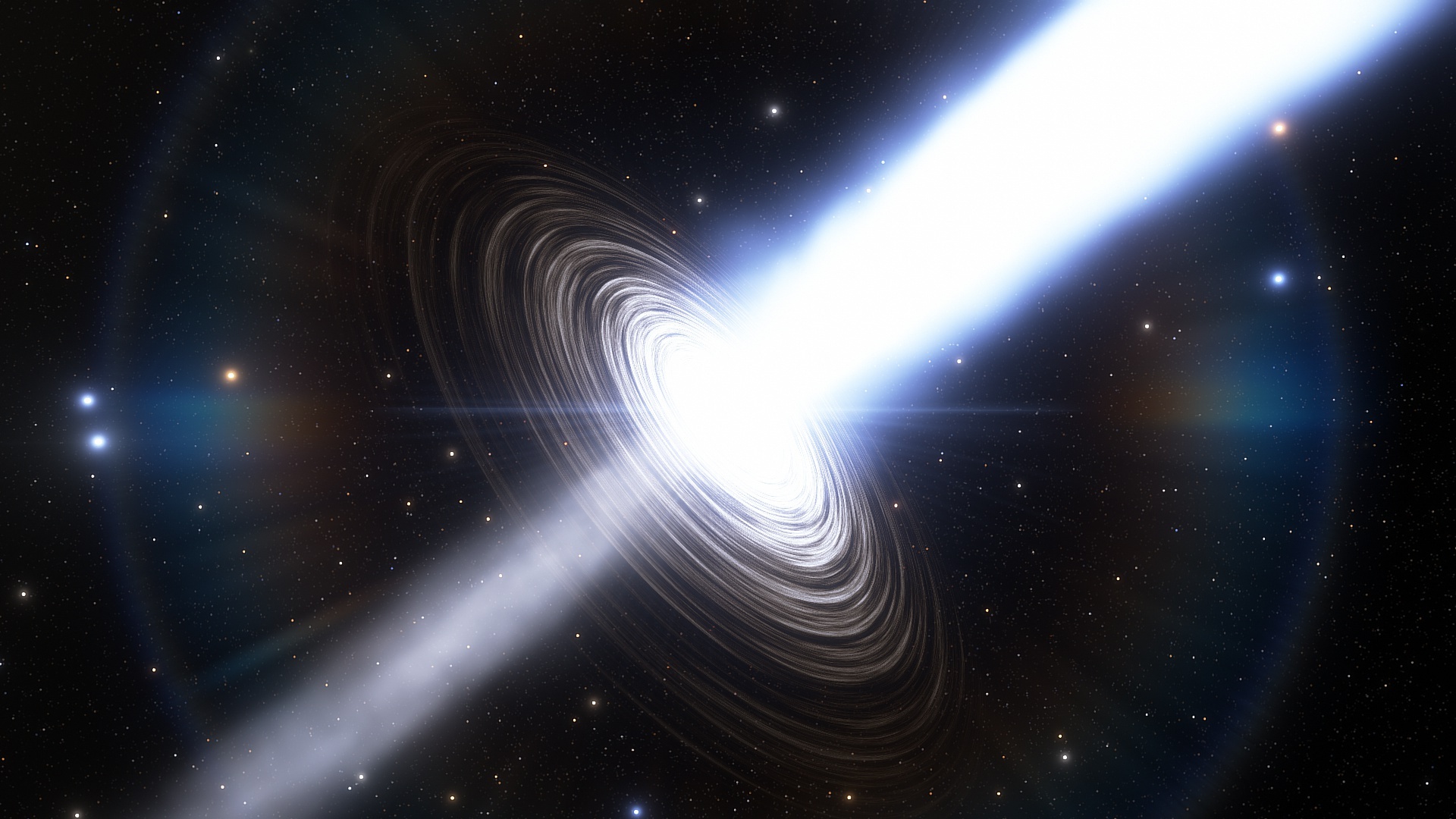
A monster lurks in the heart of many galaxies – even our own Milky Way. This monster has the mass of millions or billions of suns. Immense gravity envelops it in a dark cocoon of space and time – a supermassive black hole. Black holes are hidden in the dark and difficult to observe, but they can also shine brighter than an entire galaxy. While feeding, these sleeping monsters wake up and transform into a quasar – one of the most luminous objects in the universe. The energy that a quasar emits into space is so strong that it can disrupt star formation for thousands of light years in its host galaxies. But one galaxy seems to be winning a battle against its awakened flaming monster, and in an article recently published in the Astrophysical Journal, astronomers are trying to figure out how that galaxy survived.
Animation of interstellar matter falling into a black hole creating a quasar – ESA
Cosmic rivals
When interstellar dust and gas are drawn towards a supermassive black hole, it turns inward and forms an “accretion disk”. Eventually this material will fall through the “event horizon” – the boundary between the black hole and the rest of the universe, where matter and energy can no longer escape. The accretion disk is crushed by the gravity of the black hole, resulting in incredible friction, heat, and energy. The energy generated in the disk can outshine the entire surrounding galaxy.
A quasar not only competes with neighboring stars for the brightest object, but also for the raw material. The black hole literally eats up the fuel supply that could otherwise be used for future star formation in a particular galaxy. In addition, the radiation from the quasar can heat and blow away gas in its host galaxy – a process known as “blowing out”. The heated and dispersed gas can no longer form the dense, cold clumps that are required to initiate star formation. Our current understanding of galaxy evolution is that star formation ends as soon as a quasar forms in a galaxy – a step towards the galaxy’s inevitable death.
First image of a black hole. This picture shows the glowing accretion disk of the supermassive black hole in the center of the galaxy M 87. Our entire solar system would fit over the radius of the central black hole – captured by the Event Horizon Telescope
A new champion
However, 5.25 billion light years from Earth is in the galaxy CQ4479. The heart of CQ4479 is a supermassive black hole with 24 million solar masses. (For comparison: Sagittarius A * (pronounced “A – star”), the supermassive black hole in the center of the Milky Way, has 4.6 million solar masses.) This black hole feeds itself actively and has become a quasar. Gas from the galaxy crashes into the quasar at a speed of 0.3 solar masses (the mass of our sun) per year and creates a blazing accretion disk. The quasar shines in the light of 200 billion suns. But despite the quasar, CQ4479 still creates stars … many of them.
A recent image of the distant galaxy CQ4479 as captured by the Sloan Digital Sky Survey
Fireworks in the sky
CQ4479 is classified as a “starburst” galaxy, which has incredible star formation rates – contrary to what is expected in a galaxy with an active quasar. Our Milky Way generates stars with a value of 1.5 to 3 solar masses every year. CQ4479 created 95! It is believed that starbursts are the result of interactions between galaxies. When two galaxies collide, gases from each galaxy merge, which can lead to massive starburst periods. Even without a collision, the mutual gravity of galaxies close to one another can move interstellar gases that catalyze starbursts.
45 million light years away, the antenna galaxies are an example of a starburst galaxy formed by the collision of NGC 4038 / NGC 4039. The bright magenta regions are all places where new stars are born in the merging galaxies. Both galaxies collided about 500 million years ago. In 400 million, they will merge into one galaxy – Credit: NASA / ESA The Tarantula Nebula is the most violent starburst region among local galaxies. It is located in the Large Magellanic Cloud, a satellite dwarf galaxy in the Milky Way, at a distance of 160,000 light years. It contains some of the largest stars known. If the tarantula were at the same distance from the earth as the Orion Nebula (approximately 1300 light years), its bright light would cast shadows on the earth in the evening – c. NASA Hubble
The star formation rate of CQ4479 appears to be keeping pace with the growth of the supermassive black hole. Much star-forming material also remains in this galaxy. The quasar of CQ4479, classified as a “cold quasar”, exists alongside a galaxy that consists mainly of cold interstellar gas – about 50-70% of the total mass of the galaxy. At the current rate of star formation, the galaxy will run out of star-forming gases in about 500 million years – unless the quasar finally switches off star formation in the galaxy.
What is a Quasar – Universe Today Video with Fraser Cain?
See the past and future of a galaxy
The star formation time of CQ4479 already lasted 200-500 million years. And given the black hole’s mass and rate of growth, the quasar has been active for at least 50 million of those years. The quasar could then “delete” the star formation. In this case, CQ4479 provides insight into a stage of galaxy evolution that we have not studied in detail – the time when star formation slows down in the presence of an active quasar. The importance of this particular cold quasar discovery is that star formation does not stop immediately – an effect that may be negated by starburst galaxies battling their own black holes. This research also provides the first time that a quasar has been directly measured for its growth, star birth rate, and the amount of cold gas in relation to the host galaxy.
“This shows us that the growth of active black holes does not immediately stop the birth of stars, which contradicts all scientific predictions.”
Allison Kirkpatrick – Assistant Professor at the University of Kansas and co-author Galaxy M82 is the closest starburst galaxy to the Milky Way at 12 million light years. The starburst is believed to be triggered by the gravitational interaction with its neighbor, the Galaxy M81. The bright star-forming regions of M82 make it shine
five times brighter than our own galaxy. – NASA
Despite being billions of light years away, telescopes still see quasars so blindingly that they obscure the visibility of their surrounding galaxy. The measurements of the quasar in CQ4479 used by the research team were carried out with the aircraft telescope SOFIA (Stratospheric Observatory for Infrared Astronomy) from NASA / the German Aerospace Center SOFIA. When traveling aboard a 747 aircraft, SOFIA’s 3-meter telescope can separate the light from the CQ4479 quasar from the surrounding stars – the only telescope in the world (or worldwide) capable of doing this.
The telescope has the advantage that it can be viewed like a space telescope at high altitudes over much of the Earth’s atmosphere and still be able to return to Earth for maintenance and upgrade. The future James Webb Space Telescope will see the universe in infrared light, just as SOFIA does now to look into the heart of CQ4479. Webb will then have the ability to study distant quasars and pursue this research on galaxy evolution and the relationship between quasars, star gas and star formation.
The SOFIA telescope mounted on the aircraft in action – c. NASA
A sleeping giant
The black hole of our own Milky Way, which is closer to home, has also shown evidence of quasar activity over the past million years. Known as the “Fermi Bubbles,” two giant bubbles of gamma and X-rays emanate from the core of our galaxy and extend 50,000 light years perpendicular to the galactic plane. The bubbles radiate outward at a speed of almost a thousand kilometers / s and may be the result of our supermassive black hole hitting a cloud of interstellar gas millions of years ago. That time is over now, but the energy released is still traveling through space and visible to our telescopes – an echo of the howl of our own awakened monster.
A diagram of the Fermi bubbles in relation to the rest of the galaxy
– NASA Goddard Space Flight Center
More to discover
Original Research Publication Dying of Light: An X-Ray Fading Cold Quasar at z ~ 0.405 – IOPscience Kevin C. Cooke et al. 2020 (available with academic institution credentials)
What is a quasar? – Universe Today Video
Galaxy survives black hole forces | wtsp.com
Galaxy survives the festival of the black hole – for now | NASA
Astronomers still have no idea what caused them – today’s universe – to find the source of the giant gas bubbles pouring out of the Milky Way
27.2 Supermassive Black Holes: What Quasars Really Are – Douglas College Astronomy 1105 (bccampus.ca)
Like this:
Loading…
