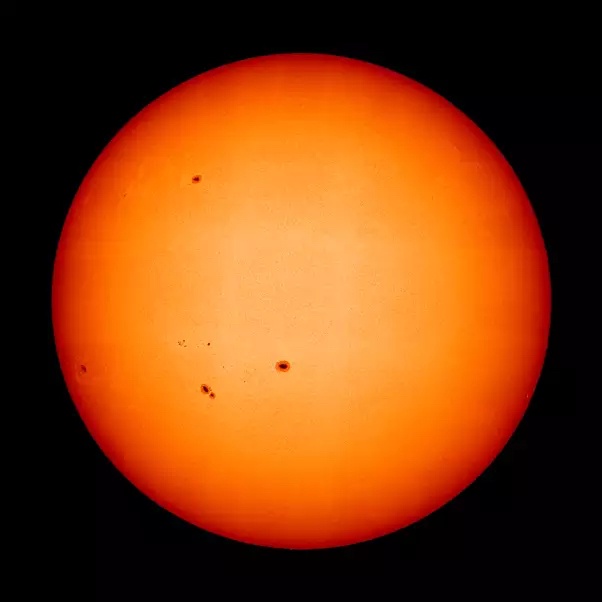
Our local star, the Sun, has been the source of many studies, from ground-based telescopes to space-based observatories. The ESA Solar Orbiter approaches the Sun, capturing images in unprecedented detail. In March last year it reached the halfway point and captured a series of 25 images. They have now been put together to create an image with an astonishingly high resolution. You can even zoom in to see individual grains in the solar photosphere.
Compared to Earth, the Sun is massive, but compared to other stars it is pretty average. It provides energy to sustain life through the process of nuclear fusion deep in its core. The hydrogen atoms are fused into helium and produce so much energy that heat and light flood our planet. Like all other stars, the Sun is a large ball of electrically charged gas with an apparent surface temperature of about 5,500 °C. It measures an incredible 1.39 million kilometers in diameter and is an average of 150 million kilometers away from us. It makes up 99% of the solar system's mass and is responsible for its immense gravitational pull, which has kept planets, asteroids and comets in their orbit for the last 4.6 billion years!
The Sun on November 1, 2023 with Unistellar's eQuinox 2 telescope and Smart Solar Filter. Photo credit: Nancy Atkinson.
Without a doubt, it is the most prominent astronomical object to grace our skies, and so it is no surprise that it has been the target of many, many studies. ESA's Solar Orbiter is one of those space-based observatories that has begun to reveal some of the secrets of our nearest star. Launched in February 2020, it was intended to capture images of the Sun's poles and measure its magnetic fields and solar wind. The Solar Orbiter's orbit is very specific and follows an elliptical orbit that brings it within 42 million km of the Sun.
Solar orbiter
There are instruments on board Solar Orbiter to study the dynamics of the Sun. The most exciting of these are those designed for direct observation of the Sun, which include the Extreme Ultraviolet Imager (EUI) and the Polarimetric and Helioseismic Imager (PHI), which, in combination with other instruments on board, produce some incredibly high resolution images can generate. With Solar Orbiter already halfway to the Sun, ESA has released a stunning new image of our nearest star, based on data from EUI and PHI.
At the time the images were taken, Solar Orbiter was 74 million km from the Sun (Mercury is about 50 million km away), too close to capture a single image of the entire Sun. Instead, 25 images were taken within a few hours and then assembled into the mosaic that has just been published. The finished result can be seen here and has a resolution of around 175 km per pixel. Previous observations went deeper, for example the Gregor Solar Telescope on Tenerife achieved a resolution of just 50 km per pixel, but only for a small section of the sun.
Large mosaics were never possible because the turbulence in the atmosphere made it impossible to stitch together enough images. The picture is breathtaking. If you zoom in, you can see the granulation pattern throughout the sun's photosphere and even some sunspots in super-high resolution.
Source: The Sunfire Up Close
Like this:
Load…
