

Exoplanets with a wide range of environmental conditions have been discovered. WASP-76b is one of the most extreme, with a daytime temperature of over 2,000 degrees. A team of researchers has discovered that it is even more bizarre than initially thought! It is tidally bound to its parent star, so strong winds orbit it. They contain large amounts of iron atoms that flow from the lower to the upper layers of the atmosphere.
Exoplanets exist outside our solar system and orbit other stars. The first confirmed discovery was in the 1990s and since then over 5,200 have been discovered. Many of them are gas giants like Jupiter or Saturn and others are small rocky, Earth-like planets that may not be habitable. As more advanced telescopes and detection techniques develop, not only will our detection rates continue to increase, but so will our ability to explore these alien worlds.
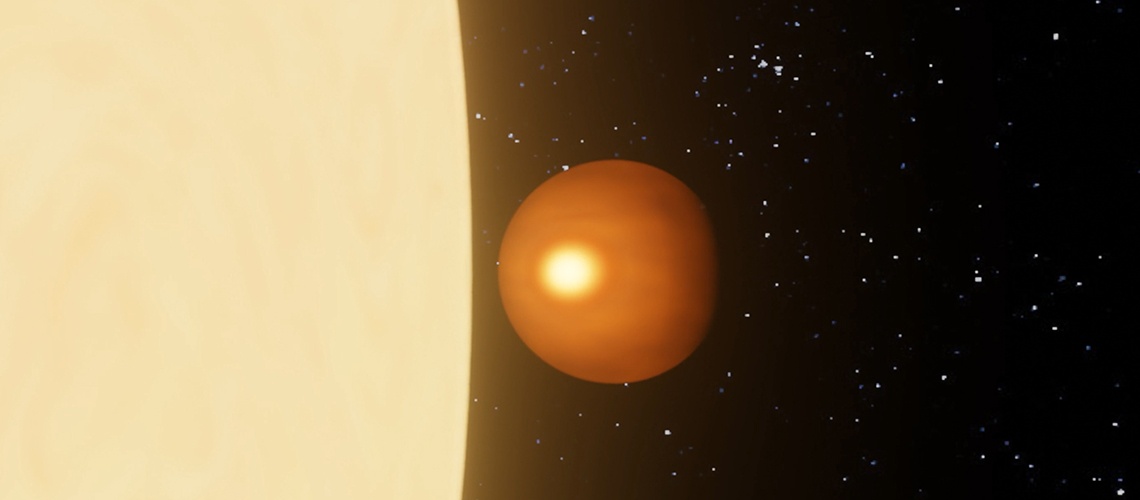
Artist's impression of the splendor of exoplanet WASP-76b. Image credit: ESA
One such exoplanet, WASP-76b, has been getting quite a bit of attention recently. It is an ultra-hot gas giant located 640 light-years away from us in the direction of the constellation Pisces. It was discovered in 2013 and has an orbit very close to its parent star, completing one orbit in just 1.8 Earth days! Its proximity to the star has led to the extreme daytime temperatures of over 2,000 degrees. It is believed that the intense heat vaporizes iron, which then condenses into liquid on the cooler night side and falls as iron rain!
A team of astronomers, including some from the University of Geneva, reported in the journal Astronomy & Astrophysics their findings of strong iron winds in the atmosphere of WASP-76b. Astronomers have been watching this planet since its discovery to understand the mechanisms in the atmosphere of this ultra-hot Jovian world. It really is a fascinating world and last April a rainbow was even discovered there!
The team focused on the day side, where temperatures are much higher. They used the ESPRESSO spectrograph, installed on the European Southern Observatory's Very Large Telescope (yes, that's what it's called!). It is known for its stability and high spectral resolution, allowing it to see wonderfully fine details in a star's spectrum.
The four 8.2-metre unit telescopes of the Very Large Telescope in the Paranal Observatory complex. ESO/VLT
Using a technique called high-resolution emission spectroscopy, the team studied the visible light spectrum. The approach is based on detecting emission lines in a spectrum and allows the chemical composition to be deciphered. Here they discovered the chemical signature of iron and found that it was moving from the lower to the higher layers of the atmosphere.
Studying the atmospheres of exoplanets helps us deepen our understanding of the different environments on these alien worlds. Since WASP-76b is a gas giant, the discoveries help us learn a little more about the climate of worlds that are exposed to extreme radiation from their parent star.
Source: Iron winds on an ultra-hot exoplanet
Like this:
Load…

Comments are closed.