

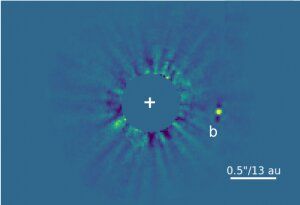
The field of exoplanet photography is just underway. Astronomers around the world are striving to capture clear images of the more than 4,000 exoplanets discovered to date. Some of these exoplanets are more interesting for imaging and research than others. This is certainly the case with a type of exoplanet known as the brown dwarf. And now scientists have taken the first picture of this exact type of exoplanet.
Brown dwarfs are “substellar objects” – they do not have enough mass to initiate nuclear fusion in their core and therefore could not become a real star, but are much more massive than any traditional planet. The one pictured by a team of astronomers at the Subaru telescope and the WM Keck observatory in Manuakea has a mass 46 times that of Jupiter.
However, this particular brown dwarf is interesting for reasons other than its size. Of primary interest is its orbit and the star system in which it is located. The planetary system it is in is known as HD 33632. The star in HD 33632 is a main sequence star in many ways, similar to our sun. The brown dwarf, now very creatively known as HD 33632Ab, orbits the star at a distance of about 20 AU (roughly the distance from Mercury to Pluto).
Youtube video describing some of the subtleties of brown dwarfs.
Photo credit: Paul Sutter (UT staff) Youtube Channel
This solar distance, combined with the similarities between the star of HD 33632 and our sun, makes the existence of a brown dwarf in this system extremely informative for models predicting how these systems might be formed. The image captured by the scientists also provides valuable data points for the analysis of other directly imaged exoplanets. There is a chance that the HD 33632Ab’s atmosphere contains carbon monoxide and water, making it a useful barometer for comparing other exoplanet atmospheres.
Our ability to see the atmosphere of an exoplanet, even one as large as HD 33632Ab, is thanks to advances in adaptive optics and near-infrared imaging systems. These systems in the Subaru and Keck observatories have teamed up to capture this unique image. Subaru used the exoplanet hunting system SCExAO / CHARIS, while Keck contributed images from a near-infrared camera called NIRC-2. These combined instruments resulted in a much clearer image than would have been possible with just one of the observatories.
Graphic showing the size of brown dwarfs compared to planets and stars.
Photo credit: NASA
This finding will certainly not be the last application of this combination of powerful exoplanet imaging technologies. Nor will it be the last exoplanet or brown dwarf that we will directly map as a species. But when these images trickle in, what we begin to find will hopefully become more fascinating as we take a look at these newly discovered worlds.
Learn more:
WM Keck Observatory: Direct image of a newly discovered brown dwarf
UT: Astronomers find 100 brown dwarfs in our neighborhood
TechExplorist: This is the direct picture of a newly discovered brown dwarf
Sci-News.com: Astronomers directly envision a brown dwarf around a nearby Sun-like star
Main Image: Immediate image of the HD 33632 star system, including the brown dwarf on the right side of the screen.
Photo credit: WM Keck Observatory
Like this:
Loading…

Comments are closed.