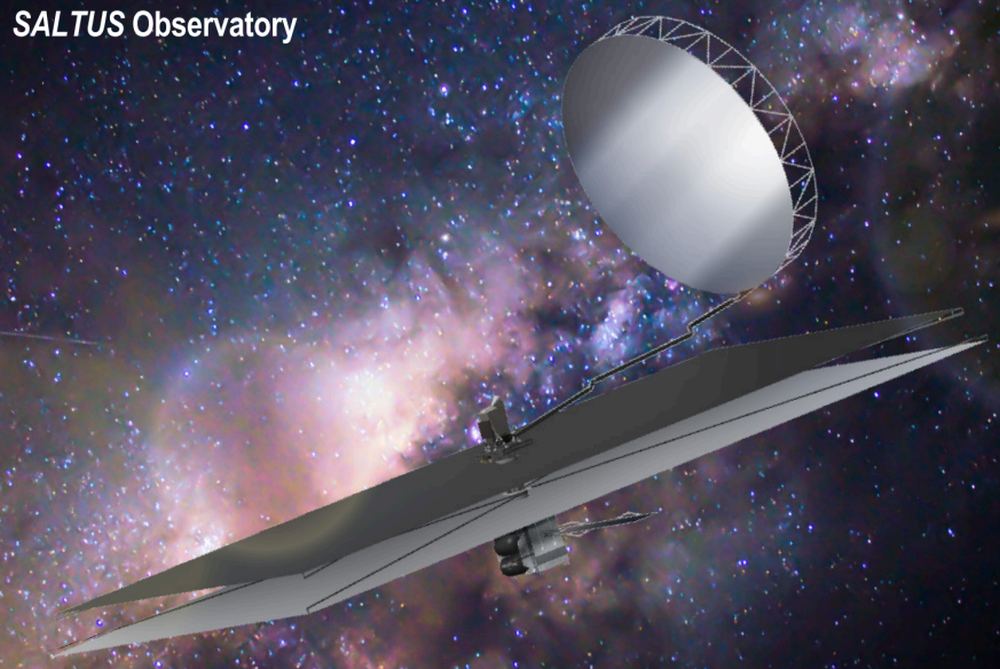
The universe wants us to understand its origins. Every second of every day, it sends us a multitude of signals, each a clue to a different aspect of the cosmos. But the universe is the original trickster, and its multitude of signals is an almost unrecognizable cacophony of light, distorted, shifted, and stretched during its long journey through the expanding universe.
What else can talking monkeys do in this situation but build another telescope that can better understand a specific part of this noisy light? That's what astronomers think we should do, and it's no surprise.
Because of the size of the universe and its ongoing expansion, the light from the universe's first galaxies is stretched into the infrared. This ancient light contains clues to the origins of the universe, and therefore our origins. To capture and decipher this light, a powerful infrared telescope is needed. The Earth's atmosphere blocks infrared light, which is why we continue to build infrared space telescopes.
Infrared telescopes are also good at observing planets as they form. Dense environments like protoplanetary disks are opaque to most light, but infrared light can shed light on what's going on in these planet-forming environments. The dust absorbs light, then emits it in the infrared, and also scatters it. This confuses optical telescopes, but infrared telescopes like SALTUS are designed to deal with it.
A team of astronomers from the US and Europe has joined the call for a new infrared space telescope. The provisional name is SALTUS, Single Aperture Large Telescope for Universe Studies. In a new article, the astronomers outline the scientific arguments for SALTUS.
“The SALTUS probe mission will provide a powerful far-infrared (far-IR) focused space observatory to explore our cosmic origins and the possibility of life elsewhere,” write the authors of the new article.
The title of the article is “Single Aperture Large Telescope for Universe Studies (SALTUS): Science Overview.” Gordon Chin of NASA's Goddard Space Flight Center is the lead author. The article is available as a preprint on arxiv.org.
If built, SALTUS will be different from the powerful JWST. JWST has four instruments covering an infrared frequency range from 600 to 28,500 nanometers, or 0.6 to 28.5 micrometers, from the near infrared (NIR) to the mid-infrared (MIR). SALTUS would cover a range from 34 to 660 µm, in the far infrared (FIR). SALTUS's range is not available to any current observatory, either in space or on Earth.
There are no exact definitions of the exact ranges NIR, MIR and FIR, but this table is a useful representation. Image credit: Wikipedia
Infrared telescopes need to be kept cool. They use sunshields and cryogenic coolers to keep temperatures low and make the infrared light detectable. The longer the wavelength of the infrared light, the cooler the sensor needs to be. Sunshields are passive and cool the primary mirror, but the instruments require active cryogenic cooling, and these systems have a finite lifetime, limiting mission duration. In the case of SALTUS, the base mission duration is five years.
During these five years, SALTUS will use its 14-meter primary mirror and its two instruments to open a “powerful window on the universe through which we can explore our cosmic origins,” the authors of the paper say.
The two instruments are the SAFARI-Lite (SALTUS Far-Infrared Lite) spectrometer and HiRX (High-Resolution Receiver). With these instruments, SALTUS will complement the observation capabilities of JWST and ALMA, the Atacama Large Millimetre/submillimetre Array.
Its aperture is so large that it will be the only far-infrared observatory with arcsecond spatial resolution. One arcsecond is defined as the ability to view two posts 4.8 mm apart one kilometer away as separate posts. “This will enable a revelation of the true nature of the cold Universe, which holds the answers to many of the questions about our cosmic origins,” the authors write.
SALTUS has a unique design among space telescopes. It features an inflatable primary mirror, which is new for space telescopes but has proven itself in decades of use in ground-based telecommunications. A two-layer sunshade keeps the inflatable mirror cool.
SALTUS's large aperture provides high sensitivity and addresses some fundamental questions.
How does habitability evolve during planet formation? To answer this question, SALTUS will detect carbon, oxygen and nitrogen in 1,000 different protoplanetary disks. It is able to detect numerous types of molecules and atoms, as well as different lattice modes of ices and some minerals. No existing telescope has this capability.
Thanks to SALTUS's far-infrared observation capabilities, it can see a portion of the protoplanetary disks that is obscured at other wavelengths. This will open a new window into planet formation and the evolution of habitability. Image credit: Chin et al. 2025/Miotello et al. Protostars and Planets 2023.
Habitability, as far as we understand it, revolves around water. Water begins its journey in the same molecular clouds where stars form. SALTUS will follow water's journey from molecular clouds to protoplanetary disks to icy planetesimals and comets that bring water to planets like Earth. An important part of SALTUS's work will be determining deuterium-to-hydrogen ratios.
This simple graphic shows how water gets to planets and can lead to habitability. SALTUS will track the journey of water by observing hundreds of protoplanetary disks. Image credit: Chin et al. 2024.
How do galaxies form and evolve? SALTUS will measure how galaxies form and gain mass. It will measure heavy elements and interstellar dust from the Universe's first galaxies to the present day. The telescope will also study the coevolution of galaxies and their supermassive black holes (SMBHs).
Tracking the rapid evolution of dust grains in galaxies during the first billion years of the Universe is part of understanding the formation and evolution of galaxies. SALTUS can do this by observing PAHs, polycyclic aromatic hydrocarbons, and their spectral lines. Some PAH spectral lines are very faint, but are fully visible to SALTUS.
There is a causal link between star formation and active galactic nuclei (AGN), which influences the growth and evolution of galaxies. However, the two phenomena occur on completely different spatial scales, and the phase that connects them is obscured by dust. SALTUS's high-resolution and sensitive far-infrared spectroscopy will give astronomers a clearer view of AGN and how they shape galaxies.
SALTUS would be placed in a Sun-Earth halo L2 orbit. Its maximum distance from Earth would be 1.8 million km (1.12 million miles). This orbit would give the telescope two continuous 20º viewing zones around the ecliptic poles, resulting in complete coverage of the sky every six months.
The SALTUS concept was developed in response to the 2020 Decadal Survey and NASA's Astrophysical Roadmap. It is a direct response to NASA's 2023 Astrophysics Probe Explorer (APEX) solicitation, and the questions it is designed to answer arise directly from this work.
“SALTUS has the sensitivity and spatial resolution needed to answer not only the open scientific questions of 2023, but more importantly, the unknown questions that will be raised in the 2030s,” the authors write in their abstract. “SALTUS is forward-looking and well suited to meet the current and future needs of the astronomical community.”
Like this:
Is loading…
