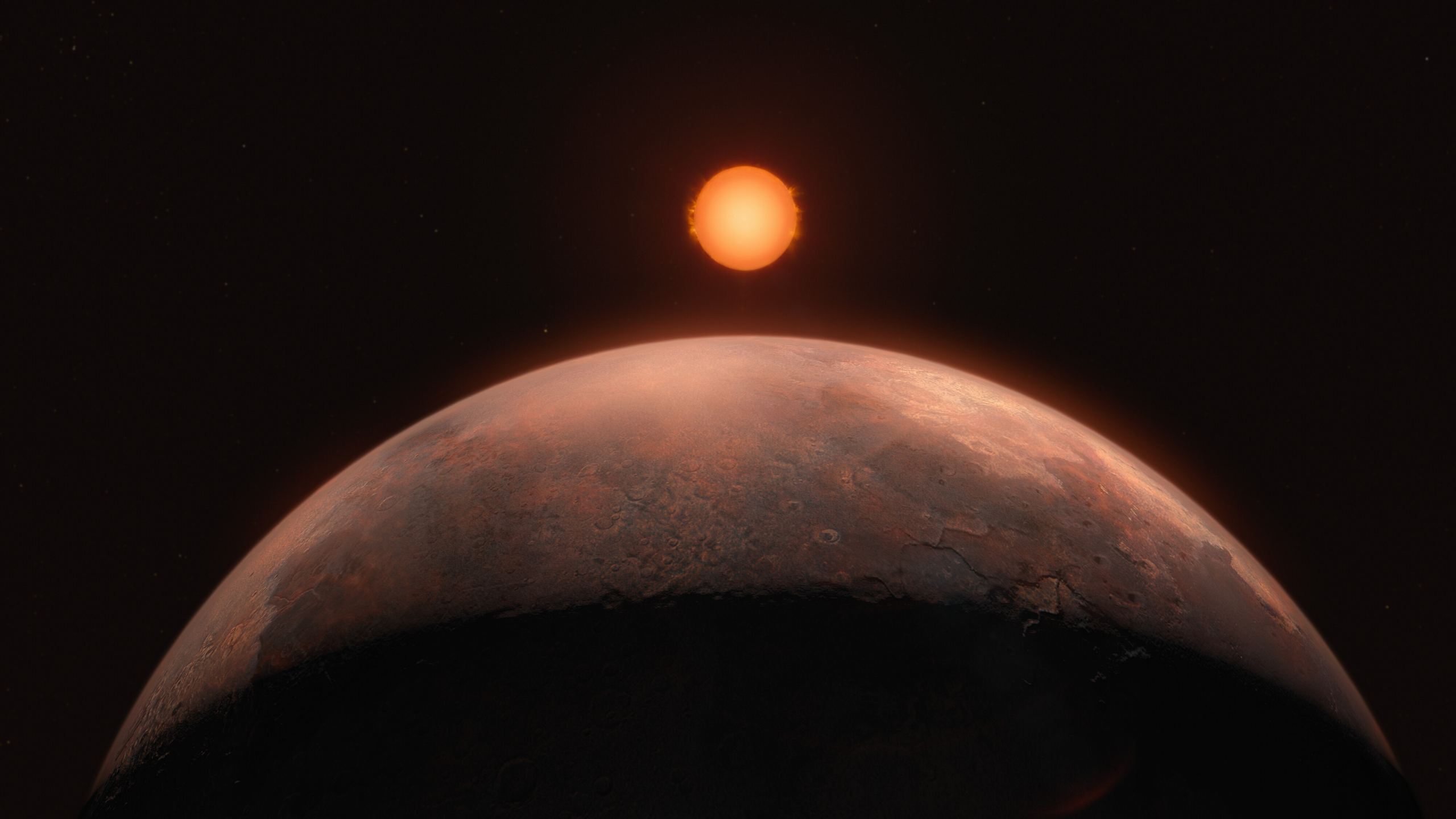
The thing about exoplanets is that astronomers don't see them the way most people think. This is partly due to the way we announce them. Whenever an interesting exoplanet is discovered, the press release usually includes colorful artwork depicting oceans, mountains, and clouds. Something visually fascinating like the picture above. However, the reality is that we have only directly imaged a few exoplanets, and even then they only appear as small, blurry blobs. Most of the known exoplanets were discovered by the transit method, in which the star dims slightly as the planet passes by it. So what astronomers actually see is a periodic flicker of starlight.
This isn't a problem for astronomers because they're interested in data, not pretty pictures. Typically, the data is strong enough to confirm the presence of an exoplanet without directly observing it. But sometimes observational data can be a little fuzzy, meaning we might think a planet is there just for further observations to prove us wrong. Therefore, sometimes an exoplanet is announced but the discovery is later withdrawn. But sometimes a planet is confirmed, then unconfirmed, then confirmed again, as in the case of a recent study of Barnard's Star.
Barnard's Star is a small red dwarf just 6 light years from Earth. Back in 2018, observations of the star suggested the presence of a super-Earth-sized companion called Barnard b. The interesting thing about this exoplanet is that it was discovered not using the usual transit method, but using a different approach, called the radial velocity method. When a planet orbits a star, the planet's gravitational pull causes the star to wobble slightly toward and away from us. Since the relative motion of the star can cause a slight shift in its spectrum, we can observe the shift to determine whether the planet is there. However, the radial velocity method is more difficult to perform than the transit method, which is one of the reasons fewer exoplanets have been discovered this way. And in this particular case, the data was pretty sparse, and so Barnard b was moved to the unconfirmed category.
Diagram detailing the radial velocity method. Photo credit: Las Cumbres Observatory
This new study concludes that the 2018 discovery was a false positive. The data does not support the existence of a super-Earth orbiting Barnard's star. However, the data confirms the presence of an exoplanet. Barnard b exists, just not the one we thought. This newly confirmed planet is not a super-Earth, but rather has less mass than our world. It orbits the star every three days, which is one of the reasons it was so difficult to detect.
It took five years of observational data to confirm this exoplanet, which only further highlights how difficult it is to find planets this way. But the good news is that the data also points to the presence of other planets. More data and studies are needed to confirm it, but it is quite possible that Barnard's Star has an entire system of small worlds, similar to the TRAPPIST-1 system.
Reference: JI González Hernández, et al. “A planet with a mass below Earth orbiting Barnard's Star.” Astronomy and Astrophysics 690 (2024): A79.
Reference: Ribas, Ignasi et al. “A candidate super-Earth planet orbiting near the snow line of Barnard's star.” Nature 563.7731 (2018): 365-368.
Like this:
Load…
