How did complex life arise and evolve on Earth and what does this mean for the search for life beyond Earth? This is what a study recently published in Nature seeks to address, in which a pair of researchers examined how plate tectonics, oceans and continents are responsible for the emergence and development of complex life on our planet and how this could address the Fermi Paradox by improving Drake's Equation regarding the reasons why we have not found life in the universe, or the parameters for the search for life. This study has the potential to help researchers better understand the criterion for discovering life beyond Earth, particularly in the context of the geological processes observed on Earth.
Here, Universe Today discusses this study with Dr. Taras Gerya, Professor of Geosciences at the Swiss Federal Institute of Technology (ETH-Zurich) and co-author of the study, regarding the motivation behind the study, significant results, follow-up studies, what this means for the Drake equation and what implications the study has for the Discovery of life outside Earth. So what was the motivation behind this study?
Dr. Gerya explains to Universe Today: “The motivation for this was the Fermi Paradox (“Where is everyone?”), which indicates that the Drake Equation typically predicts that there are between 1,000 and 100,000,000 actively communicating civilizations in our galaxy gives what is an overly optimistic estimate. We tried to figure out what might need to be corrected in this equation to make the Drake equation prediction more realistic.”
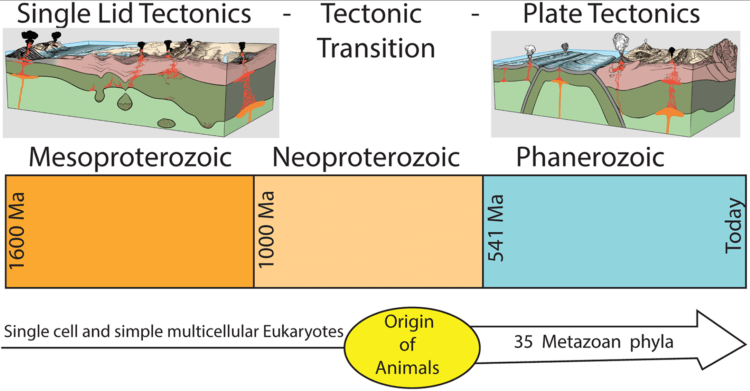
For the study, the research duo compared two types of planetary tectonic processes: single lid (also called stagnant lid) and plate tectonics. A single lid refers to a planetary body that does not exhibit plate tectonics and cannot be broken down into separate plates that exhibit motion by sliding toward each other (convergent), sliding past each other (transforming), or sliding away from each other (divergent). This lack of plate tectonic activity is often attributed to the lid of a planetary body being too strong and dense to be broken apart. Ultimately, the researchers estimated that 75 percent of planetary bodies that have active convection within their interior do not exhibit plate tectonics and have single-lid tectonics, with Earth being the only planet that exhibits plate tectonics. Therefore, they concluded that single-lid tectonics “is likely to dominate the tectonic styles of active silicate bodies in our galaxy,” the study said.
In addition, the researchers examined how planetary continents and oceans contribute to the development of intelligent life and technological civilizations. They pointed to the importance of the emergence of life in the oceans, as they are protected from harmful space weather and single-celled life thrived in the oceans during the first billion years of Earth's history. However, the researchers also emphasize that dry land offers a variety of advantages for the development of intelligent life, including adaptations to different terrains, such as: B. Eyes and new senses, which, among other biological assets that made life possible, helped animals quickly evolve to hunt in order to adapt to the various terrestrial environments on the planet.
Ultimately, researchers concluded that dry land contributed to the development of intelligent life around the world, including abstract thought, technology and science. So what were the key findings of this study and what follow-up studies are currently in progress or planned?
Dr. Gerya tells Universe Today: “This very special condition (>500 million years of coexistence of continents, oceans and plate tectonics) is required on a planet with primitive life to develop intelligent technological communication life.” This condition is very rarely met: only <0.003-0.2% of planets with life may meet this condition.”
Dr. Gerya continues: “We plan to study water evolution in the planet's interior to understand how the stability of surface ocean volume (which implies the stability of coexistence of oceans and continents) can be maintained for billions of years (like on Earth) . We also plan to study the survival of technological civilizations using models of societal collapse. We have also launched a project on the evolution of oxygen levels in the planet's interior and atmosphere to understand how oxygen-rich atmospheres (especially essential for the development of technological civilizations) can be formed on planets with oceans, continents and plate tectonics. Progress in these three directions is essential but depends heavily on the availability of research funding.”
As previously mentioned, this study was motivated and attempts to improve the Drake equation, which proposes a multivariable equation that attempts to estimate the number of active, communicative civilizations (ACCs) that exist in the Milky Way. It was founded in 1961 by Dr. Frank Drake proposed to posit several ideas that he suggested to the scientific community when discussing how and why we have not heard of ACCs and are as follows:
N = R* x fp x ne x fl x fi x fc x L
N = the number of technological civilizations in the Milky Way that can potentially communicate with other worlds
R* = the average star formation rate in the Milky Way
fp = the proportion of these stars with planets
ne = the average number of planets that could potentially support life per star with planets
fl = the proportion of planets capable of supporting and developing life at a given point in their history
fi = the proportion of planets that develop life and evolve into intelligent life
fc = the proportion of civilizations developing technologies capable of sending detectable signals into space
L = the length of time that technological civilizations send signals into space
According to the study, the number of ACCs varies widely between 200 and 50,000,000 according to the Drake equation. As part of the study, the researchers proposed adding two additional variables to the Drake equation based on their findings that plate tectonics, oceans and continents have played a crucial role in the development and evolution of complex life on Earth:
foc = the proportion of habitable exoplanets that have significant continents and oceans
fpt = the proportion of habitable exoplanets that have significant continents and oceans, which also exhibit plate tectonics that have been operating for at least 500 million years
Using these two new variables, the study provided new estimates for fi (probability of planets developing life and evolving into intelligent life). So what is the significance of adding two new variables to the Drake equation?
Dr. Gerya tells Universe Today: “This allowed us to redefine and more correctly estimate the key concept of the Drake equation fi – the probability of a planet with primitive life developing intelligent technological communication life.” Originally, fi was (incorrectly) defined as very rated high (100%). Our estimate is many orders of magnitude lower (<0.003-0.2%), which likely explains why we are not contacted by other civilizations.”
Additionally, when these two new variables are entered into the overall Drake Equation, the study estimates a far smaller number of ACCs at <0.006 to 100,000, which is in stark contrast to the Drake Equation's original estimates of 200 to 50,000,000. So what impact could this study have on the search for life beyond Earth?
Dr. Gerya tells Universe Today: “It has three main consequences: (1) We should not have much hope that we will be contacted (the likelihood of this is very low, in part because the lifespan of technological civilizations may be shorter than previously thought). ), (2) We should use remote sensing to search for planets with oceans, continents, and plate tectonics (COPT planets) in our galaxy based on their likely different (low-CO2) atmospheres and surface reflection signatures (due to the presence of oceans ). and continents), (3) we should take care of our own planet and civilization, both of which are extremely rare and must be preserved.”
This study comes at a time when the search for life beyond Earth is gaining momentum. As of this writing, NASA has confirmed the existence of 5,630 exoplanets, of which nearly 1,700 have been classified as super-Earths and 200 as rocky exoplanets. Despite these incredible numbers, especially since the first discovery of exoplanets in the 1990s, humanity has yet to detect a signal from an extraterrestrial technological civilization, referred to in this study as ACCs.
The closest we've ever come to receiving a signal from space was the Wow! It was a 72-second radio signal received by the Big Ear radio telescope at Ohio State University on August 15, 1977. However, this signal has not been received since then, and there have been no signals at all. With this study, scientists may be able to use these two new variables added to the Drake equation to narrow the scope of the search for intelligent life beyond Earth.
Dr. Gerya concludes by telling Universe Today: “This research is part of an emerging new science – biogeodynamics, which we seek to support and develop.” Biogeodynamics aims to understand the relationships between the long-term evolution of the planet's interior, the surface, the “To understand and quantify the atmosphere and life.”
How will these two new variables added to the Drake Equation help scientists find life beyond Earth in the coming years and decades? Only time will tell, and that's why we work on science!
As always, keep up the science and keep looking up!
Like this:
Is loading…
