

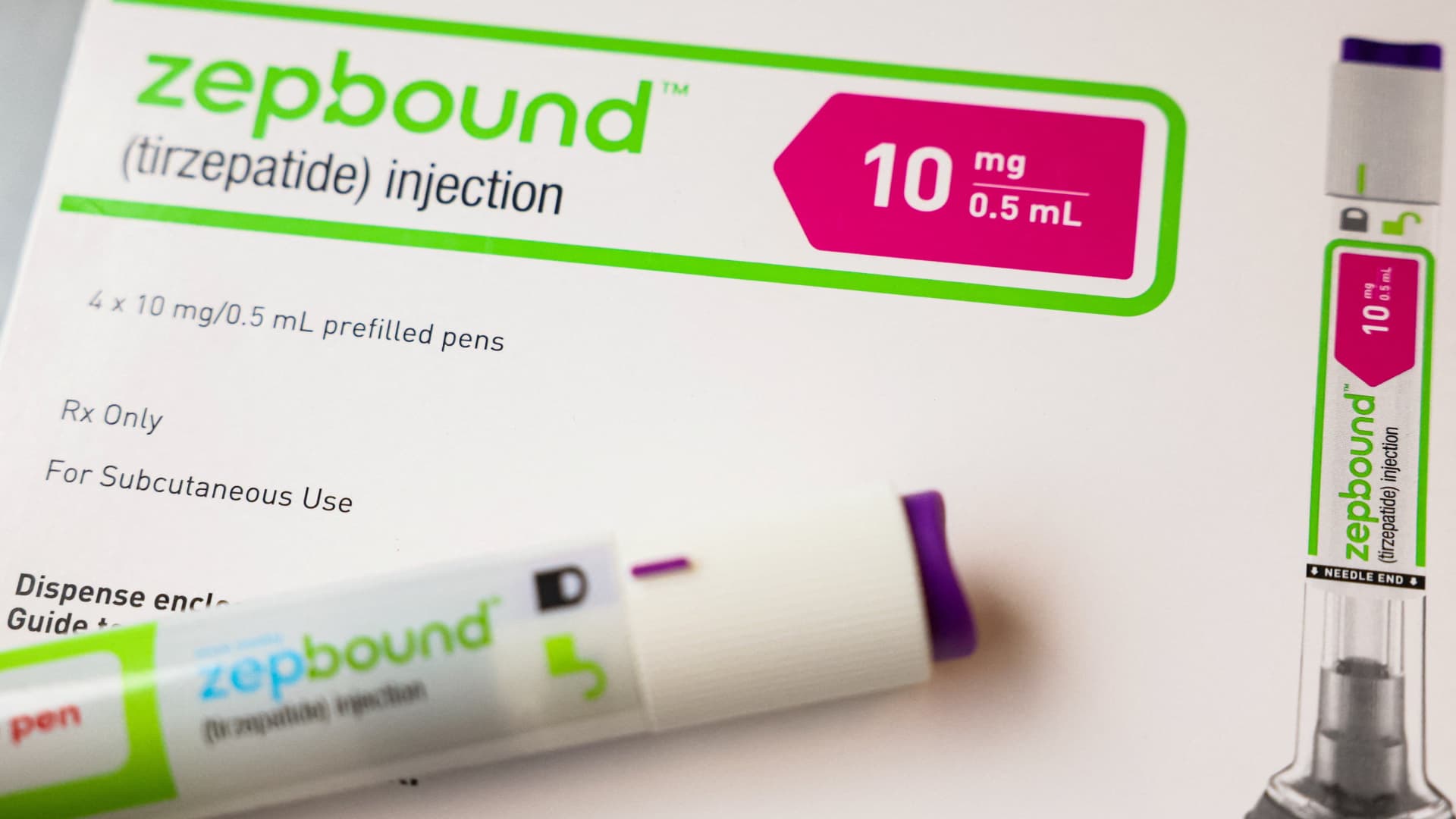
An injection pen of Zepbound, Eli Lilly's weight loss drug, is displayed on December 11, 2023 in New York City, United States.
Brendan McDermid | Reuters
Eli Lilly said Wednesday that its wildly popular weight-loss drug Zepbound has shown potential in two late-stage clinical trials to treat patients with the most common sleep-disordered breathing disorder.
The early findings add to the long list of potential health benefits of weight loss and diabetes treatments, demand for which has skyrocketed in the last year despite their high prices and little insurance coverage.
According to preliminary data from both studies, Zepbound was more effective than placebo in reducing the severity of obstructive sleep apnea (OSA) in patients with obesity after one year. OSA refers to pauses in breathing during sleep due to narrowed or blocked airways. The pharmaceutical giant said it plans to present the results at an upcoming medical conference and submit them to the Food and Drug Administration and regulators in other countries in mid-2024.
Eli Lilly previously announced that the FDA granted Zepbound Fast Track Designation for patients with moderate to severe OSA and obesity. This designation ensures that medicines that are intended to both treat a serious or life-threatening condition and address an unmet medical need are reviewed more quickly.
The results are a first sign of hope for the estimated 80 million patients in the United States suffering from OSA, Eli Lilly said in a press release. According to Eli Lilly, about 20 million of these people have moderate to severe forms of the disease, but 85% of OSA cases go undiagnosed.
OSA can cause excessive daytime sleepiness and loud snoring and can lead to serious complications such as high blood pressure, stroke and heart failure. Patients with this condition have limited treatment options other than cumbersome and often uncomfortable devices that generate positive airway pressure (PAP) to allow normal breathing.
“It is critical to directly address this unmet need, and although there are pharmaceutical treatments for the excessive sleepiness associated with OSA, [Zepbound] “has the potential to be the first drug treatment for the underlying disease,” said Dr. Jeff Emmick, senior vice president of product development at Eli Lilly, said in Wednesday's press release.
There have been shortages since Zepbound was approved in the U.S. for weight management in November. The active ingredient in Zepbound, known as tirzepatide, is also approved for diabetes under the brand name Mounjaro.
Mounjaro and other diabetes medications are typically covered by insurance, but Zepbound and other weight loss medications are not. But the new data on sleep apnea patients gives Eli Lilly a “path to getting Medicare Part D coverage for Zepbound” even before changes are made to the federal program's reporting on obesity treatments, analyst Chris Schott wrote at JPMorgan Chase, in a note on Wednesday.
Under new guidance issued in late March, Medicare may cover certain weight loss medications if they are approved by the FDA for additional health benefits. Medicare prescription drug plans managed by private insurers (Part D) cannot currently cover these weight loss medications on their own.
Schott added that the new data shows Eli Lilly a way to increase the use of Zepbound in men. He said the company has suggested that men may be more likely to use a so-called GLP-1 drug like Zepbound for sleep apnea than for obesity.
Eli Lilly's Zepbound mimics two naturally produced gut hormones called GLP-1 and GIP. GLP helps reduce food intake and appetite. GIP, which also suppresses appetite, may also improve the way the body breaks down sugar and fat.
First test results
In the two Phase III studies, both called SURMOUNT-OSA, Zepbound was tested in two groups of patients. What is noteworthy is that 70% of the study participants were men, Eli Lilly said in its press release.
Specifically, the researchers examined how much the weekly injection reduced the so-called apnea-hypopnea index (AHI), which measures how many times per hour a person's breathing shows a restricted or completely blocked airway. The index is used to evaluate the severity of obstructive sleep apnea and the effectiveness of treatments for the condition.
In both sub-studies, Zepbound was superior to placebo in reducing AHI, the main goal of the studies.
cherry beans | Istock | Getty Images
The first study evaluated the drug in adults with moderate to severe obstructive sleep apnea and obesity who were not receiving PAP therapy.
According to the results, people taking Zepbound experienced an average of 27.4 fewer AHI events per hour after 52 weeks, compared to an average reduction of 4.8 events per hour with the placebo.
According to the results, Zepbound also met the study's second goal, resulting in an overall AHI reduction of 55%, compared to a 5% reduction for placebo.
In the second study, Zepbound was tested in adults with the same conditions, but these patients were receiving PAP therapy and planned to continue it.
People who took Zepbound had an average of 30.4 fewer AHF events per hour after 52 weeks, compared to an average reduction of 6 events per hour in the placebo group.
Zepbound resulted in an overall reduction in AHI of almost 63%, compared to a reduction of more than 6% for placebo.
The results exceeded Wall Street expectations. Investors largely viewed a 50% reduction as the threshold for deeming Eli Lilly's attempts a success. The roughly 60 percent improvement shows “outsized benefits,” Deutsche Bank analyst James Shin wrote in a note Wednesday.
In both studies, Zepbound helped patients lose about 20% of their weight. However, Eli Lilly noted that men are known to achieve less weight loss than women with therapies like Zepbound.
In a note Wednesday, Morgan Stanley analyst Terence Flynn called that weight reduction encouraging and said the company expected a 15% to 18% weight loss in the study. Morgan Stanley views “this as another positive data point that supports the efficacy profile of tirzepatide,” Flynn said.

Comments are closed.