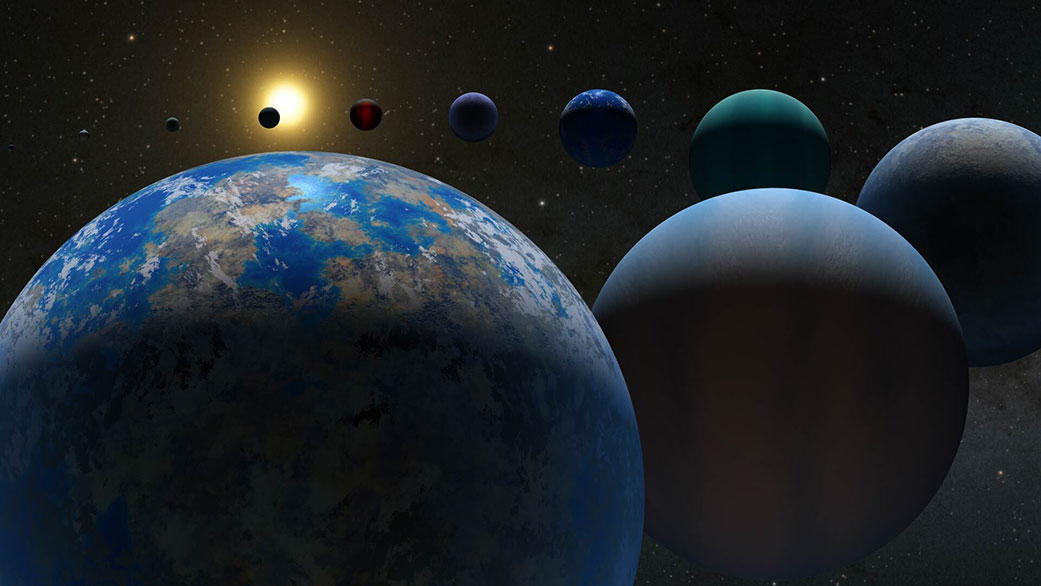
The search for exoplanets has increased dramatically in recent decades thanks to next-generation observatories and instruments. According to the current count, there are 5,766 confirmed exoplanets in 4,310 systems, with thousands more awaiting confirmation. Because there are so many planets to study, exoplanet studies and astrobiology are transitioning from discovery to characterization. Essentially, this means astronomers are reaching the point where they can directly image exoplanets and determine the chemical composition of their atmospheres.
As always, the ultimate goal is to find terrestrial (rocky) exoplanets that are “habitable,” that is, could support life. However, our ideas about habitability focus primarily on comparisons with today's Earth (i.e. “Earth-like”), which has been increasingly questioned in recent years. In a recent study, a team of astrobiologists examined how the Earth has changed over time and how different biosignatures have emerged. Their findings could aid future exoplanet searches with next-generation telescopes such as the Habitable Worlds Observatory (HWO), which is scheduled to launch into space in the 2040s.
The study was led by Kenneth Goodis Gordon, a graduate student in the Planetary Sciences Group at the University of Central Florida (UCF). He was joined by researchers from the SETI Institute, the Virtual Planetary Laboratory Team at the University of Washington, NASA's Nexus for Exoplanet System Science (NESS), the Space Science Division and Astrobiology Division at NASA Ames Research Center, and Sellers Exoplanet Environments Collaboration (SEEC) at NASA's Goddard Space Flight Center and NASA's Jet Propulsion Laboratory. The paper describing their findings is being considered for publication in the Astrophysical Journal.
Artist's concept of Earth during the late heavy bombardment period. Image credit: NASA Goddard Space Flight Center Conceptual Image Lab.
As the team states in their paper, the current count of exoplanets includes more than 200 terrestrial planets, dozens of which have been observed in the habitable zone (HZ) of their host stars. Many more are expected in the coming years, thanks to next-generation instruments such as ESO's James Webb Space Telescope (JWST) and Extremely Large Telescope (ELT). Equipped with state-of-the-art spectrometers, adaptive optics and coronagraphs, these and other telescopes will enable the characterization of exoplanets, the identification of biosignatures and the determination of their habitability.
This is a complex problem because a number of different planetary, orbital and stellar parameters must be taken into account. To date, Earth is the only known planet to harbor life, which limits our perspective. But as Goodis Gordon told Universe Today via email, that's not the only way in which habitability studies have been limited:
“There is currently only one known planet that supports life: our own Earth. However, when we think of habitability, we tend to only apply this term to modern Earth-like conditions: large-scale vegetation, animals, people, etc. This can significantly limit our approach to finding habitable exoplanets because it only provides us with one data point for comparison.
“But from biogeochemical analysis we know that Earth is not just a data point and that our planet has actually been habitable for eons. “So a better understanding of Earth’s signatures as it evolves gives us more points of comparison when searching for habitable worlds elsewhere.”
For example, life on Earth arose during the Archeon eon (about 4 billion years ago), when the atmosphere consisted predominantly of nitrogen, carbon dioxide, methane, and noble gases. In the late Paleoproterozoic (about 2.5 to 1.6 billion years ago), the major oxygen enrichment event occurred after a billion years of cyanobacterial photosynthesis. This period lasted 2.46 to 2.06 billion years ago and caused Earth's atmosphere to transition from a reducing to an oxidizing atmosphere, leading to the emergence of more complex life forms.
Artist's impression of the Earth during the Archean. Photo credit: Smithsonian National Museum of Natural History
During the same period, the Sun has undergone evolutionary changes over the past 4.5 billion years. At that time, the Sun was 30% dimmer than it is today and has gradually become brighter and hotter since then. Nevertheless, the Earth maintained liquid water on its surface and life survived and continued to thrive. The complex interrelationship between Earth's evolving atmosphere and the evolution of our Sun is key to maintaining habitability for billions of years. As Goodis Gordon explained:
“In addition, current strategies for characterizing exoplanets are typically based solely on the unpolarized light received from these worlds. Studies have shown that this can lead to errors in the determined fluxes and degeneracies in the calculated planetary parameters.” For example, if an exoplanet has very dense clouds or haze in its atmosphere, the observed flux spectrum may be flat and almost devoid of spectral features. This makes it extremely difficult to see what gases are in the atmosphere or what the clouds or haze that block the light are made of.”
In recent years, several studies have examined the flux and polarization signatures of light reflected from an early Earth. Others have simulated various scenarios throughout the Archean, Proterozoic (2.5 to 541 million years ago), and Phanerozoic (538.8 million years ago to present). Finally, some studies have analyzed how the signatures of these early Earth analogs would change as they orbited different types of stars. But as Goodis Gordon pointed out, almost all of these studies focused on the unpolarized flow from these worlds, so they missed some of the information available in the light:
“Polarization is a more sensitive tool than pure flux observations and can improve the characterization of exoplanets. Polarimetry is extremely sensitive to the physical mechanism of light scattering, allowing precise characterization of the properties of a planet's atmosphere and surface. Additionally, because polarization measures light as a vector, it is sensitive to the location of features on the planet, such as. B. Cloud and land distributions as well as daily rotation and seasonal variability. Within the solar system, polarimetric observations helped characterize the clouds of Titan, Venus, and the gas giants, while outside of it, polarimetry was used to characterize the cloud properties of brown dwarfs. In most of these cases, the characteristic discovery was only possible with polarimetry!”
This artist's concept represents one of several initial possible design options for NASA's Habitable Worlds Observatory. Image credit: NASA Goddard Space Flight Center Conceptual Image Lab
This could have profound implications for the study and characterization of exoplanets in the near future. Using an expanded concept of habitability that takes into account Earth's evolution over time and benefits from the study of polarized light, astronomers are likely to identify far more habitable planets as next-generation observatories like the HWO become available. Plans for this observatory build on two previous mission concepts – the Large Ultraviolet Optical Infrared Surveyor (LUVOIR) and the Habitable Exoplanets Observatory (HabEx).
Based on these previous studies and the experience astronomers have gained from working with previous exoplanet hunting missions – Hubble, Kepler, the Transiting Exoplanet Survey Satellite (TESS) and the JWST – the HWO will be specifically designed to study the “atmospheres “designed by exoplanets for possible evidence of life” (also called “biosignatures”) and determine whether they are potentially habitable planets. As Goodis Gordon suggested, his team's research could help support future investigations using the HWO and other next-generation observatories:
“Our models provide more data points with which we can compare observations of terrestrial exoplanets, helping to support studies on the habitability of these worlds.” Additionally, there has been a push in the exoplanet community in recent years to use polarimetry in Integrate observatories of the near future such as the Extremely Large Telescopes on Earth or the Habitable Worlds Observatory in space. We hope that our models will help demonstrate the power of polarimetry in characterizing and distinguishing different habitable exoplanet scenarios in a way that is not possible with unpolarized flux observations.”
Further reading: arXiv
Like this:
Load…
