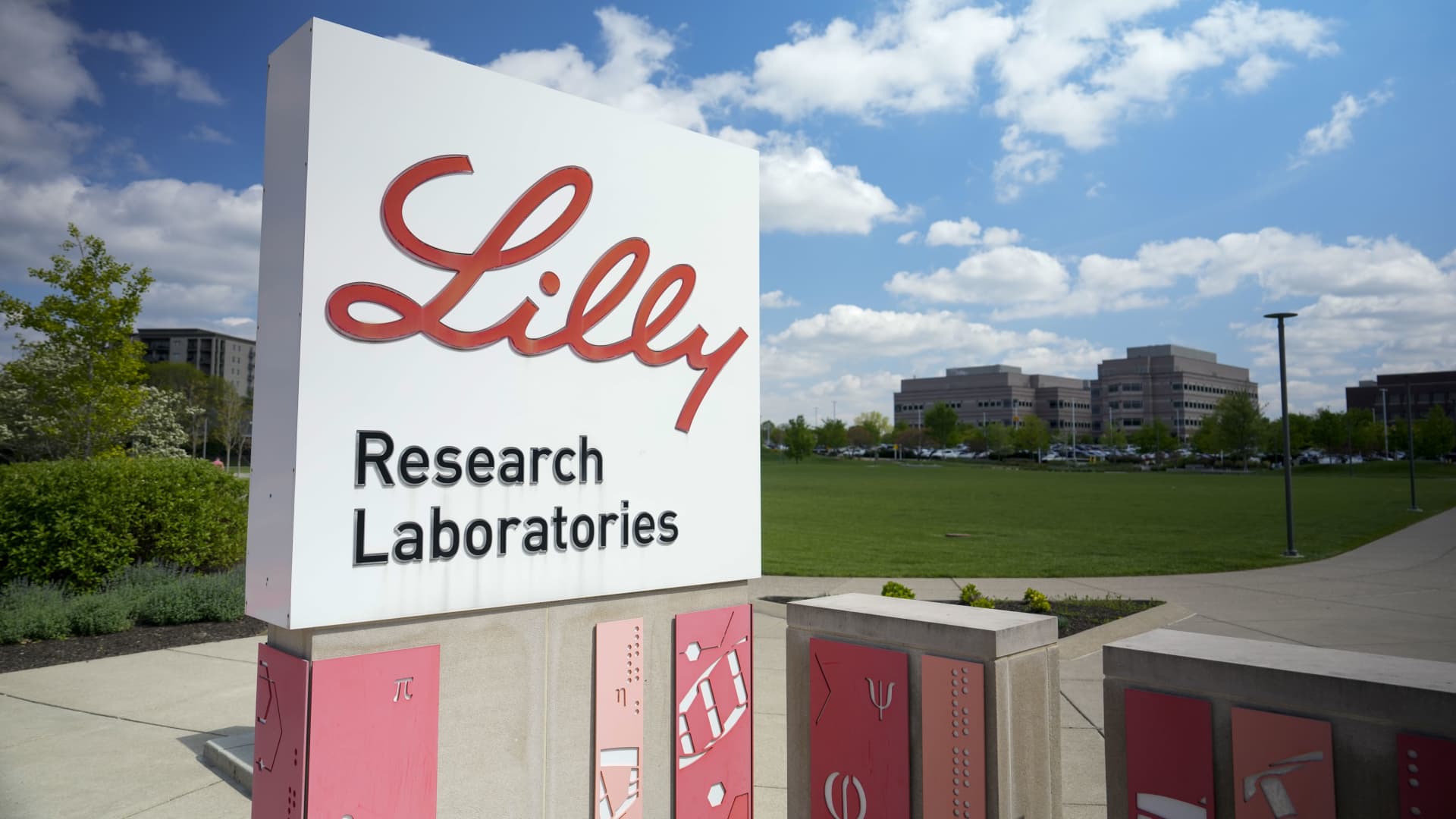
Eli Lilly headquarters in Indianapolis, Indiana, U.S., on Wednesday, May 3, 2023. Eli Lilly & Co. shares rose in early U.S. trading after its experimental Alzheimer's drug slowed the progression of the disease in a late-stage trial, paving the way for the company to seek U.S. approval.
AJ Mast | Bloomberg |
A panel of independent advisers to the Food and Drug Administration recommended on Monday Eli LillyThis paves the way for the treatment to be fully approved in the United States later this year.
The FDA typically follows the recommendations of its advisory panels, but is not required to do so. If Eli Lilly's donanemab is approved, it would be the second Alzheimer's drug of its kind to hit the U.S. market, following another drug called Leqembi from Biogen and its Japanese partner Eisai.
Approval would expand the currently limited treatment options for the more than six million Americans who suffer from Alzheimer's disease. Alzheimer's is the fifth leading cause of death in adults over 65.
In an initial vote, 11 committee members unanimously said available data on the drug showed it was effective in treating Alzheimer's patients in the early stages of the mental illness. However, several advisers noted that more data on donanemab in black and Hispanic patients and other groups are needed.
In a second vote, the advisers unanimously declared that the benefits of Eli Lilly's donanemab outweighed the risks.
“There is a huge unmet medical need here that hopefully can be met,” said Sarah Dolan, interim committee member, during a meeting Monday. Dolan is a consultant for the nonprofit Critical Path Institute, whose goal is to improve the drug development process.
The recommendation follows the obstacles Eli Lilly faced in bringing the drug to market.
In March, the FDA convened a last-minute advisory panel meeting to further review the safety and effectiveness of Eli Lilly's drug in a late-stage trial, just weeks before the agency's deadline to decide on the treatment.
This was another setback for Eli Lilly. The company had originally expected donanameb to be approved at the end of last year. The FDA also rejected the drug in January last year because there was not enough data for approval.
Leqembi and donanemab are milestones in the treatment of Alzheimer's after efforts to develop drugs to treat the deadly disease failed for three decades.
Both drugs are monoclonal antibodies that target the amyloid plaques in the brain that are considered a hallmark of Alzheimer's disease and slow the progression of the disease in early-stage patients.
But none of the treatments is a cure.
Drugs that specifically clear amyloid plaques can also cause brain swelling and bleeding in patients, which in some cases can be serious and even fatal. Three patients taking Eli Lilly's drug in a late-stage trial died from severe cases of these side effects, called amyloid-related imaging abnormalities, or ARIA.
A number of hurdles have delayed Leqembi's launch since its approval in July, including the steps needed to diagnose Alzheimer's and monitoring and managing the weekly infusions required with the drug. Biogen and Eisai signaled in April that they were seeing increasing uptake.
In a note on Sunday, David Risinger, an analyst at Leerink Partners, said he expected limited commercial acceptance of donanemab compared to leqembi because Eli Lilly's drug has “more safety risks” and is less convenient because it is administered once a month through a vein, a method known as an intravenous infusion.
Leqembi is currently given as an infusion twice a month, but Biogen expects to launch an injectable version of the drug next year, Risinger noted. He expects donanemab to generate $500 million in sales by the end of the decade.
How effective is Eli Lilly’s Alzheimer’s drug?
Eli Lilly's Phase 3 trial of more than 1,700 patients found that donanemab slowed the progression of Alzheimer's disease by 29% compared with placebo after about 18 months, based on a traditional tool for measuring dementia severity.
These results are comparable to those of Leqembi.
Patients in Eli Lilly's Phase 3 trial had to test positive on a PET scan for amyloid plaques and another protein in the brain called tau, which is considered a marker of the severity of Alzheimer's disease. People with no or very low levels of tau were not included in the trial's primary analysis because researchers thought their disease would be less likely to progress during the trial.
Eli Lilly's study focused primarily on patients with low to moderate tau levels, who appeared to benefit more from treatment than patients with high tau levels.
Westend61 | Westend61 |
Eli Lilly argued that patients needed to be tested for amyloid plaque to be eligible for the drug, not tau. The company said it tested for tau in the trial to include patients whose conditions were expected to worsen, making it more likely that the trial could “clearly determine” the drug's effects.
Most advisers agreed that tau testing should not be required for access to donanemab, as this would likely limit the number of people who can benefit from the drug.
“From a very practical perspective, I don't think it's wise to put in place such an obstacle,” said Dr. Kathleen Poston, temporary committee member and professor of neurology, neuroscience and neurosurgery at Stanford University, during Monday's meeting.
Patients who took Eli Lilly's drug as part of the study were able to switch to a placebo if the amyloid level in their brain fell below a certain threshold. At the end of the study, 60 percent of participants who received donanemab were able to stop treatment.
Dolan said the ability to stop the drug once enough amyloid has been cleared could be a “motivational factor” for patients to stick with their infusions and regular testing.
Risks of brain swelling, bleeding
About 24% of study participants taking donanemab experienced brain swelling, while 31% experienced brain hemorrhage.
The majority of these ARIA cases were mild to moderate, with 6% of participants with brain swelling and 1% with brain hemorrhage experiencing symptoms including headache, confusion, dizziness, nausea, and in rare cases, seizures.
Severe cases occurred in 1.5% of patients with brain swelling and in less than 1% with cerebral hemorrhage.
If donanemab is approved, FDA officials expect the drug's label to include a prominent warning about the risks of brain swelling and bleeding, especially in people with two copies of a gene called ApoE4. They also expect to recommend MRIs to monitor these side effects in patients, among other strategies.
This is in line with the Leqembi seal of quality.
According to a final data analysis by FDA staff, there were 19 deaths among participants taking donanemab during the 18-month trial, including three attributed to Eli Lilly's drug, compared with 16 deaths on placebo, reflecting a smaller imbalance in the number of deaths between people taking donanemab and those not taking it.
