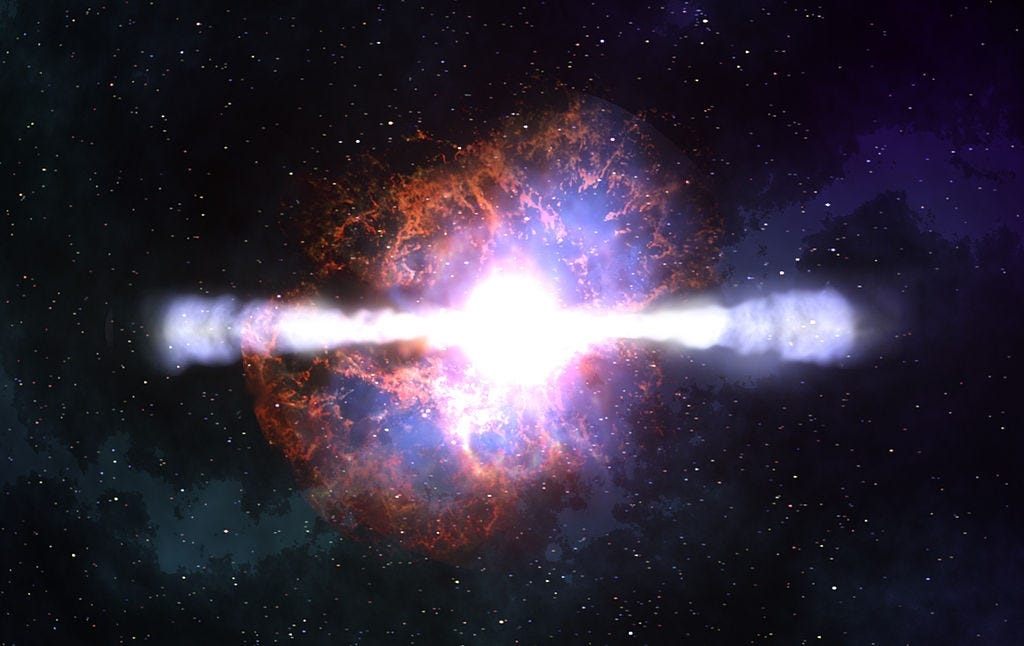
When a massive star explodes as a supernova, it not only releases an extraordinary amount of energy. Supernova explosions are also responsible for the creation of some heavy elements, including iron, which is hurled into space by the explosion. On Earth, there are two accumulations of the iron isotope Fe60 in seafloor sediments that scientists trace back to about two to three million years ago and about five to six million years ago.
The explosions that created the iron also exposed the Earth to cosmic radiation.
In a new study submitted to the Astrophysical Journal Letters, scientists examine how much energy from these explosions reached Earth and how this radiation may have affected life on Earth. The paper is titled “Life in the Bubble: How a nearby supernova left fleeting traces in the cosmic ray spectrum and indelible marks on life.” The lead author is Caitlyn Nojiri of UC Santa Cruz.
“Life on Earth is constantly evolving because it is constantly exposed to ionizing radiation of both terrestrial and cosmic origin,” the authors write. Terrestrial radiation slowly decays over billions of years. Cosmic radiation, on the other hand, does not. The amount of cosmic radiation Earth is exposed to varies as our solar system moves through the galaxy. “Nearby supernova activity can increase radiation levels at the Earth's surface by several orders of magnitude, which is expected to have profound effects on the evolution of life,” they write.
The authors explain that the two-million-year-old accumulation came directly from a supernova explosion and the older accumulation was formed when the Earth flew through a bubble.
The bubble in the title of the study comes from a specific type of star called OB stars. OB stars are massive, hot and short-lived stars that usually form in groups. These stars emit strong winds that create “bubbles” of hot gas in the interstellar medium. Our solar system is located in one of these bubbles, the so-called Local Bubble, which is almost 1,000 light years across and formed several million years ago.
Artist's impression of the hot local bubble. Image credit: NASA
The Earth entered the Local Bubble about five or six million years ago, which explains the older Fe60 accumulation. According to the authors, the younger Fe60 accumulation from two or three million years ago came directly from a supernova.
“The 60Fe peak at about 2-3 million years probably originates from a supernova that occurred in the Upper Centaurus Lupus association in Scorpius Centaurus (~140%) or the Tucana Horologium association (~70%). The peak at about 5-6 million years, on the other hand, is probably due to the entry of the solar system into the bubble,” the authors write.
The left panel shows the Local Bubble and nearby stellar associations, while the right panel shows their galactic coordinates. The right panel also shows a new galactic bubble discovered in 2018. It is likely the remnant of a SN that exploded in upper Centaurus Lupus. Image credit: Nojiri et al. 2024.
The Local Bubble is not a quiet place. It took several supernovas to create it. The authors write that it took 15 SN explosions in the last 15 million years to create the LB. “From the reconstruction of the LB history, we know that at least 9 SN explosions occurred in the last 6 million years,” they write.
The researchers took all the data and calculated the amount of radiation from several SNe in the LB. “It is not clear what biological effects such radiation doses would have,” they write, but discuss some possibilities.
This figure shows the average dose rate at ground level as a function of distance to the nearby SN. The average dose is calculated over the first 10,000 years (solid line) and over the first 100,000 years (dashed line) after the SN explosion. It is not enough to trigger an extinction, but it may have contributed to biodiversity. Image credit: Nojiri et al. 2024.
The radiation dose may have been strong enough to cause double-strand breaks in DNA. This is serious damage and can lead to chromosomal changes and even cell death. But there are also other effects on the development of life on Earth.
“Double-strand breaks in DNA can potentially lead to mutations and jumps in species diversification,” the researchers write. A 2024 study showed that “the rate of virus diversification accelerated in Africa's Lake Tanganyika 2-3 million years ago.” Could this be related to SN radiation?
“It would be interesting to better understand whether this is due to the increase in the cosmic radiation dose that we predict for this period,” the authors joke.
The SN radiation was not strong enough to cause species extinction. However, it could have been strong enough to trigger further mutations that could lead to greater biodiversity.
Radiation is always part of the environment. It rises and falls as events unfold and as the Earth moves through the galaxy. Somehow it must be part of the equation that created the diversity of life on our planet.
“It is therefore clear that cosmic radiation is a crucial environmental factor when it comes to assessing the viability and evolution of life on Earth. The crucial question is at what threshold radiation becomes a beneficial or harmful trigger for the evolution of species,” the authors write in their conclusion.
Unfortunately, we don't know exactly how radiation affects biology, what thresholds exist, and how they might change over time. “The exact threshold can only be established with a clear understanding of the biological effects of cosmic rays (especially muons, which dominate near the ground), which are still largely unexplored,” write Nojiri and her co-authors.
The study shows that our space environment has a strong influence on life on Earth, whether we see it in everyday life or not and whether we are aware of it or not. SN radiation may have influenced the mutation rate at critical times in Earth's history and thus helped shape evolution.
Without supernova explosions, life on Earth might be very different. Many things had to go just right for us to be here. Perhaps supernova explosions in the distant past played a role in the evolutionary chain that led to us.
Like this:
Load…
