Few space images are as iconic as those of the Horsehead Nebula. Its shape makes it immediately recognizable. Over the decades, several telescopes have captured its image, making it a kind of test case for telescope performance.
The JWST beat them all.
The Horsehead Nebula is about 1,300 light-years away in Orion. It is part of the much larger Orion Molecular Cloud Complex. In an enlarged image, Horse's Head can be seen near the three stars in Orion's Belt.
The Horsehead Nebula is visible in this image of Orion's Belt. It is located at the bottom left and extends horizontally to the bottom left side of the belt star Alnitak. Photo credit: By Davide De Martin (http://www.skyfactory.org); Image credit: Digitized Sky Survey, ESA/ESO/NASA FITS Liberator – https://www.spacetelescope.org/projects/fits_liberator/fitsimages/davidedemartin_12/ (direct link), Public Domain, https://commons.wikimedia.org/ w/index.php?curid=1329999
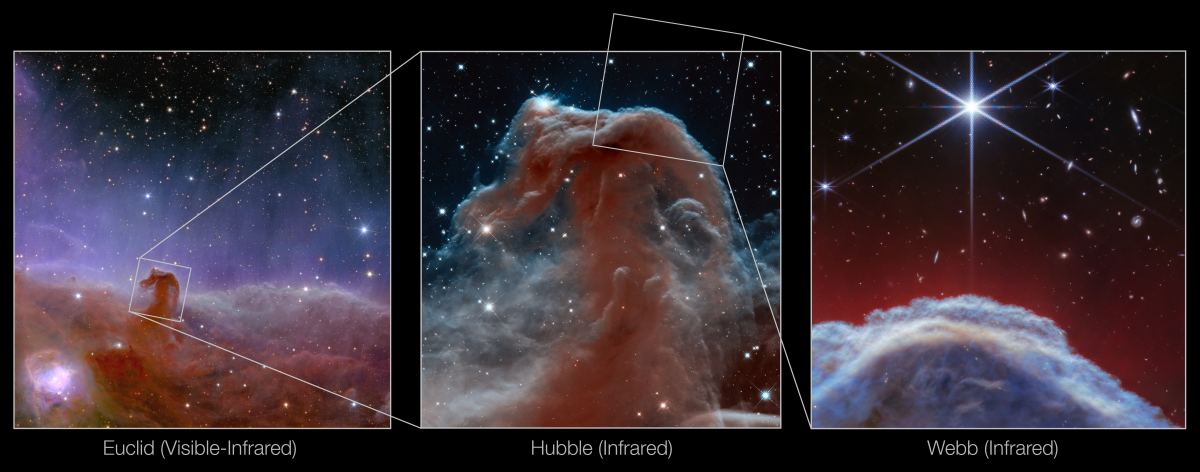
The main image shows JWST's view of the Horsehead Nebula along with two other views. The Euclid image was taken in November 2023. Euclid has a 600-megapixel wide-angle camera whose main task is to measure the redshift of galaxies and the expansion of the universe due to dark energy. It took Euclid about an hour to capture the image, demonstrating the telescope's ability to quickly collect very detailed images.
The Hubble image was taken in 2013 and released as a special image to mark the telescope's 23rd anniversary. The venerable Hubble does a good job of discovering structures hidden by dust. There is nothing left to say about the Hubble that hasn't already been said. It is the revered elder of telescopes, and if you don't feel awe for it, its contribution to science, and the people responsible for it, you may find yourself in dire boredom.
The third image is a new one from JWST's NIRCam instrument. It is described as the sharpest image of the horse's head ever captured. It shows a small part of the iconic nebula in detail that we don't normally see. The JWST is so powerful that it even shows background galaxies.
An enlargement of the JWST image. The detail is incredible. Image source: ESA/Webb, CSA, K. Misselt, M. Zamani (ESA/Webb)
The Horsehead Nebula is the result of stellar erosion. The nebula itself was formed by a collapsing cloud of material and a nearby hot star called Sigma Orionis illuminates the structure. The nebula is denser than its surrounding gas and has resisted the star's dissipative energy, while the gas that once surrounded it has long since disappeared.
This definitely isn't the last we see of Horsehead. New, powerful telescopes coming online soon, such as the Giant Magellan Telescope and the European Extremely Large Telescope, will likely make an attempt to study the nebula. Let yourself be inspired.
There is no rush. According to astronomers, the Horsehead Nebula will eventually erode, but not for about five million years.
Like this:
Is loading…
