Mars holds a very special place in our hearts. Especially because, of all the other planets in the solar system, Mars is the most likely place where we'll find some tantalizing clues, or maybe even evidence, of prehistoric life. NASA's Perseverance rover has been driving around Jezero Crater, looking for evidence that it once hosted life. To do so, it's collected not only rock samples, but air samples as well, and scientists can't wait to get their hands on them.
The Mars Rover Perseverance is part of NASA's Mars 2020 mission. It launched on July 30, 2020 and successfully landed in the Jezero Crater on February 18, 2021. The site was chosen because it is a dried-up riverbed and if there is any evidence of early primitive life on Mars, this is a likely location. Perseverance is equipped with a variety of instruments, including a drone called Ingenuity to explore the planet.
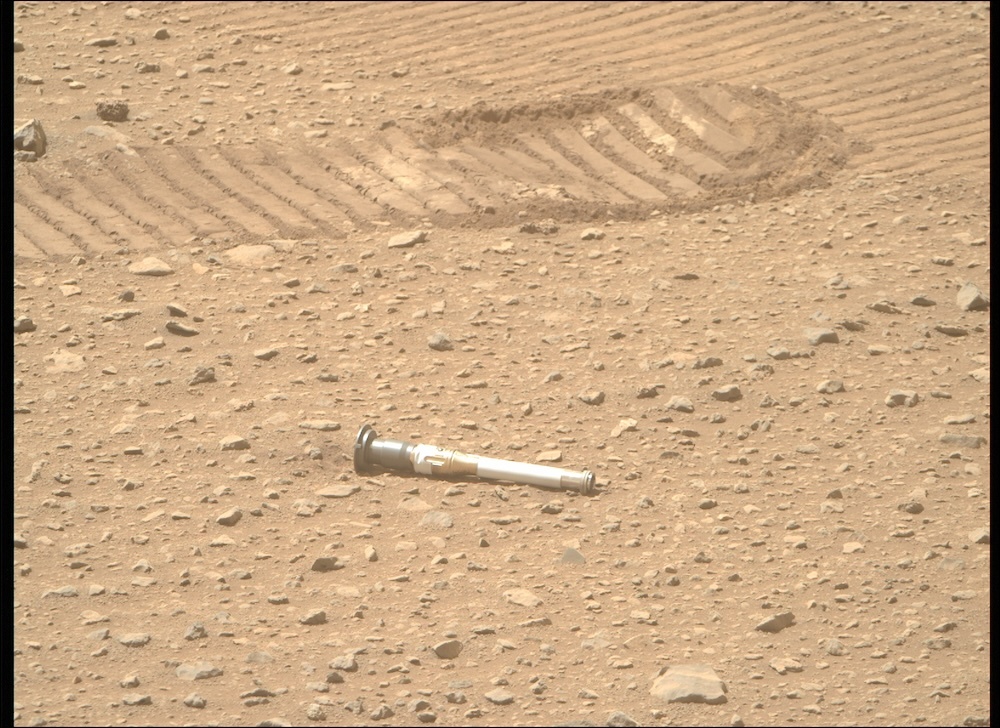
The Mars rover Perseverence sent back this image of its parking spot during the Mars solar conjunction. Courtesy of NASA/JPL-Caltech
An exciting element of the mission is the collection of rock samples as part of the Mars Sample Return Campaign. So far, 24 core samples have been taken and deposited on the surface so that they can be picked up by a future mission. But it wasn't just rock samples that were collected. In what is known as “headspace,” there is air around the rock samples, and that is exactly what excites the scientists.
It is not only the rocks that hold secrets about Mars, but also its atmosphere. The atmosphere is rich in carbon dioxide, but probably also contains traces of other gases. Information about the current climate can be obtained from the trapped gases, but by analyzing the rocks, one can also learn something about the evolution of the atmosphere. There is one particularly important tube that is completely filled with gas from the atmosphere.
Image of the Martian atmosphere and surface taken by the Viking 1 orbiter in June 1976. (Source: NASA/Viking 1)
Since the sample may remain on the surface of Mars for many years, the trapped gas will react with the rock in the sample tube. The interaction will only stop when the tubes are opened upon their return here to Earth. It is hoped that this will provide more information about the water vapor concentration near the surface of Mars.
It's not just the water vapor that's of interest, but also the trace gas concentrations. By analyzing the gas samples, we can determine if there are gases like neon, argon, and xenon, which are non-reactive. Since these gases don't react, their presence in the tube samples could indicate that Mars had an atmosphere. We know that it had a much denser atmosphere in the past, but we don't know if it was always there or if it evolved later.
Analysis of the samples will bring many benefits, including the dust concentration that will help future human exploration. Justin Simon of NASA's Johnson Space Center in Houston said: “The gas samples have a lot to offer Mars researchers. Even those who don't study Mars will be interested in them because they provide insight into how the planet forms and evolves.”
Source: Why scientists are fascinated by the air in NASA's Mars sample tubes
Like this:
Is loading…
