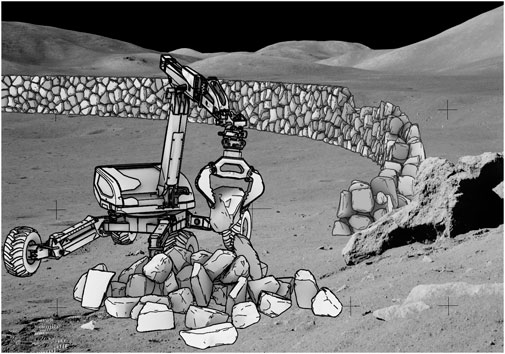
Lunar exploration equipment on any future lunar base is at risk from debris hurled at it by future lunar landers. This danger isn't just theoretical—Surveyor III was an Apollo-era lander that was damaged by Apollo 12's landing rocket and returned to Earth for closer study. Many ideas have been put forward to limit this risk, and we've reported on many of them, from building landing platforms out of molten regolith to 3D printing a blast shield from available materials. But a new paper by researchers in Switzerland proposes a much simpler idea—why not just build a blast wall by piling a bunch of rocks on top of each other?
On the moon, this task is not as easy as it sounds. You would need an autonomous excavator to examine the rocks, collect them, and stack them on top of each other so they don't fall over. Depending on the size of the rocks, this task could be successfully accomplished by a toddler, but for a robot it remained science fiction until recently.
In another paper, some of the same co-authors described an autonomous boulder stacking robot for use in construction projects on Earth. In it, they demonstrated a control algorithm that could successfully stack a rock face of medium-sized boulders completely autonomously. Applying this algorithm to construction projects on the Moon seemed like the next logical step.
Video of autonomous boulder stacking method being used on Earth.
Source: ETH Zurich YouTube channel
But first, an excavator would need to ensure there are enough boulders to effectively build the wall. In the paper, the authors use data from the Lunar Reconnaissance Orbiter to examine the distribution of boulders at two possible landing sites—the Shackleton-Henson Connecting Ridge and the Aristarchus Plateau. They also extrapolate the size of smaller boulders based on the limits of LRO's resolution and the distribution law for boulder sizes. Final confirmation came in the form of rock abundance data from another instrument on LRO. Their final estimates agreed that there should be enough loose material for an autonomous excavator to successfully build a blast wall from locally sourced boulders.
Calculating the amount of material needed to build the blast shield was actually a precursor to confirming that there were enough boulders. It was also necessary for another important calculation – to understand how much energy this process would consume compared to alternative solutions such as machined stone walls or microwave-heated landing platforms. According to the author's calculations, stacking existing rocks is two to three times less energy-intensive than alternatives.
But that's not to say there aren't hurdles to overcome. The most obvious is the lack of an autonomous excavator that can be used on the Moon. The excavator used in the experiments on Earth was prohibitively large, and developing a system for use on the lunar surface is notoriously difficult due to radiation and electrostatically charged dust particles. These electrostatically charged particles could also be a problem, but more modeling is needed to understand whether lunar chunks would be affected by significant dust accumulations.
Fraser discusses the need for our return to the Moon.
The idea itself is still relatively new and has a lot to offer given its advantages and the proof-of-concept demonstration already performed on Earth. While there are currently no plans to build an autonomously constructed rock wall, there is a good possibility that the idea, or something similar, will be taken up as part of the Artemis mission's infrastructure. At the very least, the Artemis mission designers will have plenty of potential solutions to this problem, regardless of their choice.
Learn more:
Walther et al. – Autonomous construction of lunar infrastructure with in-situ boulders
UT – NASA wants to build landing sites on the moon
UT – What is the best way to build landing pads on the moon?
UT – A practical attachment could make building the moon child’s play
Cover image:
Drawing of an autonomous excavator stacking boulders for a rock wall on site.
Source: Walther et al.
Like this:
Is loading…
