

It is a measure of human ingenuity and curiosity that scientists are discussing the possibility of life on Venus. They discovered a long time ago that the surface of Venus is absolutely hostile to life. But haven't scientists found a biomarker in the planet's clouds? Could life exist there that never touches the planet's scorching surface?
It seems to depend on who you ask.
We'll start with phosphine.
Phosphine is a biomarker, and in 2020 researchers reported the detection of phosphine in the atmosphere of Venus. There should be no phosphine because phosphorus should be oxidized in the planet's atmosphere. The paper said no abiotic source could explain the approximately 20 ppb level found.
The evidence was then challenged. When others tried to find it, they couldn't find it. Additionally, the authors of the original paper informed everyone of an error in their data processing that could have affected the conclusions. These authors re-examined the problem and largely stuck to their original finding.
At this point the phosphine question appears to be unresolved. But if it is present in the atmosphere of Venus and is biological in nature, then where could it come from? The surface of Venus is out of the question.
This leaves the cloud-filled atmosphere of Venus as the only abode of life. While the idea may seem ridiculous at first, researchers have studied the idea extensively and have come up with some interesting results.
In a new paper, researchers explore the idea of microscopic life living and reproducing in water droplets in the clouds of Venus. The title is “Necessary conditions for terrestrial life floating in the atmosphere of Venus.” The lead author is Jennifer Abreu from the Department of Physics and Astronomy at Lehman College, City University of New York. The paper is currently in pre-print.
Spacecraft have to contend with the harsh conditions on the surface of Venus. The Soviet lander Venera 13 captured this image of the planet's surface in March 1982. NASA/courtesy nasaimages.org
“It has long been known that the surface of Venus is too harsh an environment for life,” the authors write. “In contrast, it has long been speculated that Venus's clouds provide a favorable habitat for life, but are restricted to an essentially fixed altitude.” So if there were life in the clouds, it wouldn't spread everywhere. Only at certain altitudes does everything that life needs to survive seem to be available.
The type of life the authors imagine is consistent with other ideas about atmospheric life on Venus. “The archetypal living being
Here's how the authors think it might work.
Venus is shrouded in clouds so dense that we can only see the surface with radar. The clouds reach around the globe. The cloud base is about 47 km (29 miles) from the surface, where the temperature is about 100 °C (212 °F). At the equator and mid-latitudes they extend up to an altitude of 74 km (46 miles) and at the pole, they extend up to about 65 km (40 miles).
Cloud structure in the atmosphere of Venus in 2016, revealed by observations in two ultraviolet bands by the Japanese Akatsuki spacecraft. Image source: Kevin M. Gill
The clouds can be divided into three layers based on the size of the aerosol particles: the upper layer
56.5 to 70 km altitude, the middle layer from 50.5 to 56.5 km and the lower layer from 47.5 to 50.5 km. Tiny droplets can float in all three layers. But the largest droplets, which the authors call type 3 droplets with a radius of 4 µm, only occur in the middle and lower layers.
“It has long been suspected that Venus's cloud tops provide a watery habitat in which microorganisms can grow and thrive,” the authors write. Everything life needs is there: “Carbon dioxide, sulfuric acid compounds and ultraviolet (UV) light could provide food and energy to microbes.”
Due to the temperature, life in the clouds of Venus would be limited to a certain altitude range. At 50 km the temperature is between 60 and 90 degrees Celsius (140 and 194 degrees Fahrenheit). The pressure at this altitude is about 1 Earth atmosphere.
This research illustration shows the temperature and pressure throughout Venus' atmosphere. Image credit: Image credit: S. Seager et al. 2021. doi:10.1089/ast.2020.2244
There is a precedent for life in the clouds. This is happening here on Earth, where scientists have observed bacteria, pollen and even algae at altitudes of up to 15 km (9.3 miles). There is even evidence that bacteria grow in droplets in a supercooled cloud high in the Alps. These organisms are thought to have been carried aloft by wind, evaporation, eruptions, or even meteor impacts. However, there is an important difference between Earth's clouds and Venus's.
The clouds of the earth are fleeting. They are constantly forming and dissolving. But Venus's clouds are long-lasting. Compared to Earth's clouds, they are a stable environment. In Earth's clouds, aerosol particles are stored for only a few days, while in Venus's clouds they can be stored for much longer periods.
Add it all up and you get stable cloud environments where aerosol particles can sustain themselves in an environment where energy and nutrients are available. The researchers say that while aerosol particles and the life within them will eventually fall to the surface, they still have time to multiply before that happens.
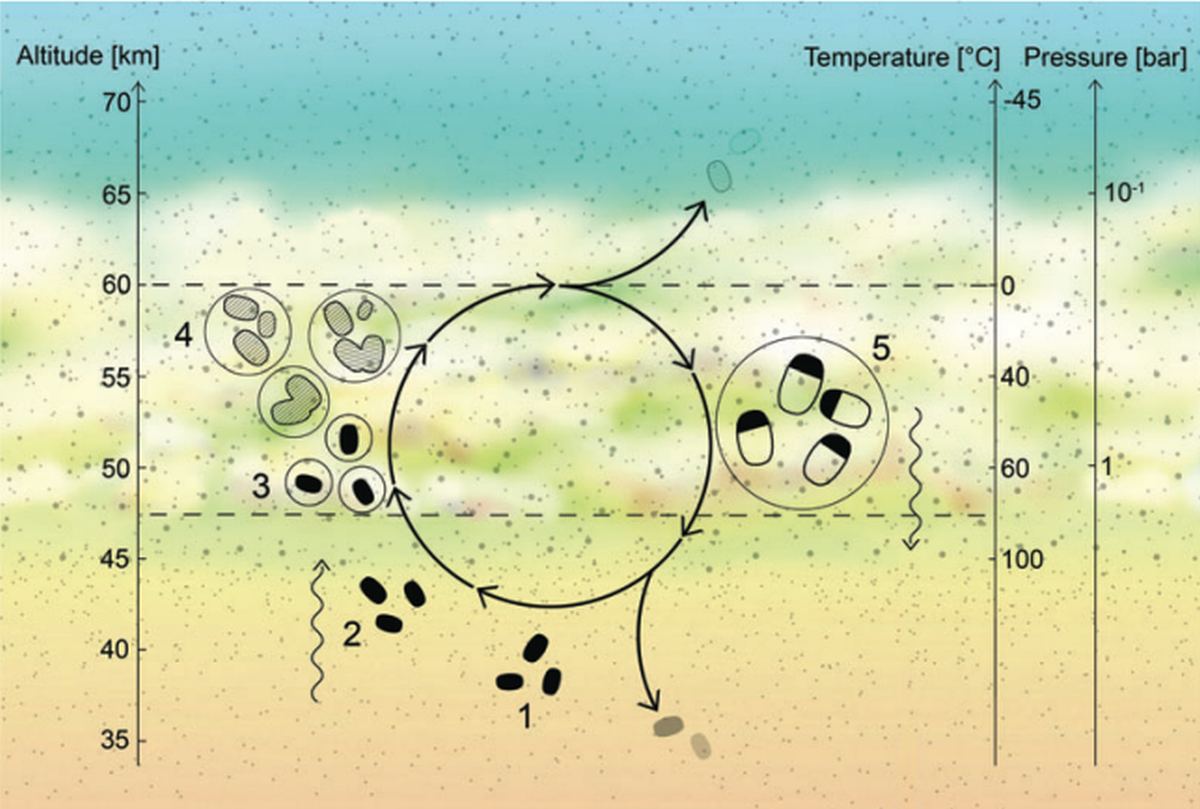
This image shows the cycle of microbial life on Venus. Image source: S. Seager et al. 2021. doi:10.1089/ast.2020.2244
The idea of a microbial life cycle in Venusian clouds was developed by other researchers in their 2021 paper “The Venusian Lower Atmosphere Haze as a Depot for Desiccated Microbial Life: A Proposed Life Cycle for Persistence of the Venusian Aerial Biosphere.”
The cloud lifecycle proposed by Venus consists of five steps:
- Dormant, desiccated spores (black blobs) partially populate the lower haze layer of the atmosphere.
- Updrafts transport them into the habitable layer. The spores could reach the clouds via gravity waves.
- Shortly after reaching the habitable layer (middle and lower cloud), the spores act as cloud condensation nuclei and more and more water collects into a single drop. Once the spores are surrounded by liquid containing the necessary chemicals, they germinate and become metabolically active.
- Metabolically active microbes (dashed blobs) grow and divide into liquid droplets (shown as solid circles in the figure). The liquid droplets continue to grow through coagulation.
- Eventually the droplets are large enough to be released from the atmosphere by gravity; Higher temperatures and droplet evaporation trigger cell division and sporulation. The spores are smaller than the microbes and resist further downward sedimentation. They remain suspended in the lower layer of haze (a depot for hibernating microbial life) to restart the cycle.
In this new work, the researchers focus on time.
“One of the key air life cycle assumptions proposed by Seager et al. 2021 is the period in which droplets would remain in the habitable layer to enable replication,” the authors write. “That’s what we want to study now.”
This table from research shows the generation times of some bacteria common on Earth. Image source: Abreu et al. 2024.
In their work, the authors used E. coli generation times under optimal conditions. Under aerobic and nutrient-rich conditions, E. Coli can multiply in 20 minutes. Thus, the E. coli population will double three times within an hour. In order to feed, bacteria must multiply faster than they can reach the surface. You need to form a colony.
The researchers calculated that the time it takes for bacteria to travel from the habitable part of the atmosphere to the habitable part must be more than half an Earth day in order to sustain themselves. As the droplet size increases, the droplets would begin to sink. “As the droplet size approaches 100 µm, the droplets begin to sink into the lower haze layers,” they explain. However, their detailed calculations show that reproduction exceeds the fallout rate.
According to the team's work, a population of bacteria could be feeding in the clouds of Venus.
There are of course still some questions. How confident are we that nutrients are available? Is there enough energy? Are there updrafts that can carry spores to the right layer of the atmosphere?
But the really big question is: How did this all get started?
“An optimist might even imagine that microbial life actually originated in a benign surface habitat, perhaps a primitive ocean, before the planet suffered a runaway greenhouse and the microbes took to the clouds,” the authors write. If that is the case, then this unique situation arose billions of years ago. Is there another possibility? Could life have originated in the clouds?
Many scientific studies of Venus, phosphine, clouds, and life are based on little evidence. Few are willing to take a risk and proclaim that Venus can and does support life. We need more evidence.
For that we have to wait for missions like the Venus Life Finder Mission. It is a private mission developed by Rocket Lab and a team from MIT. Who knows what VLF and other missions like DAVINCI and VERITAS will find? Stronger evidence of phosphine? Better data about the atmospheric layers of Venus and the conditions therein?
Life itself?
Artist's impression of the Rocket Lab mission to Venus. Photo credit: Rocket Lab
Like this:
Is loading…

Comments are closed.