

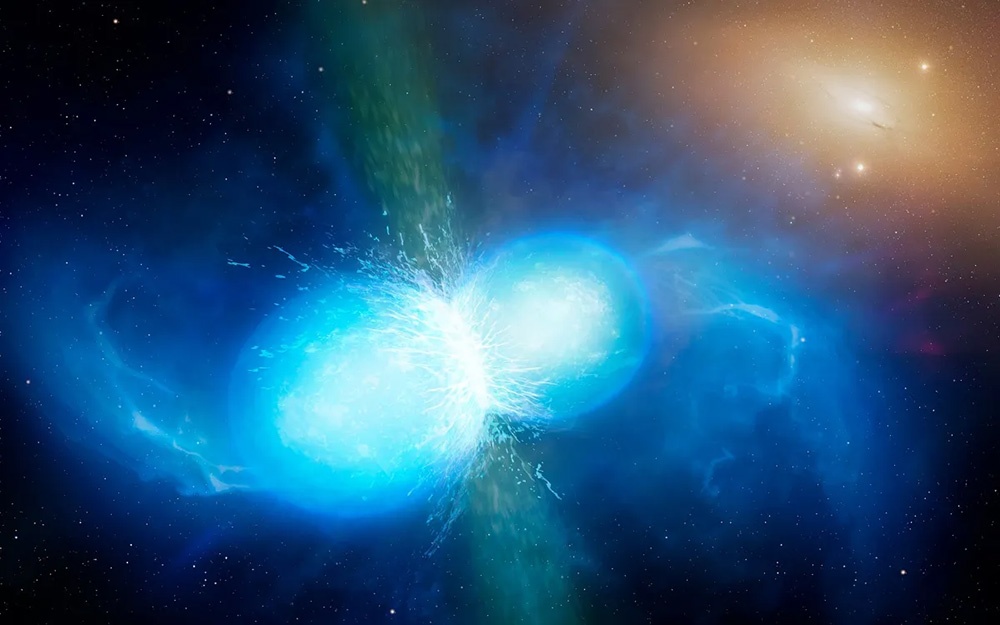
When neutron stars dance with each other, the grand finale they experience could create the densest form of matter in the universe. It's called “quark matter,” a most strange combination of liberated quarks and gluons. It's unclear whether this matter existed in their cores before their dance ended. But in the wild aftermath of a neutron star collision, the strange conditions could free quarks and gluons from protons and neutrons. This allows them to move freely in the aftermath. So researchers want to know how freely they move, and what conditions might impede their movement (or flow).
These strange stars are enormously dense and strange collections of neutrons. So when two of them dance and merge, they change shape under the pressure of the merger. They also heat up. The conditions eventually change the states of matter in their cores. According to Professor Aleksi Vuorinen of the University of Helsinki in Finland, this is what astronomers believe happens in neutron star mergers. However, he points out that no one fully understands these conditions and the behavior of the quarks in them. “Describing neutron star mergers is particularly challenging for theorists because all conventional theoretical tools seem to break down in one way or another in these time-dependent and really extreme systems,” he said.
How quarks are involved in neutron star collisions
Crab Nebula from JWST. The forming neutron star at its heart rotates rapidly and emits a signal, making it a pulsar. Image credit: NASA, ESA, CSA, STScI, T. Temim (Princeton University)
Neutron stars are some of the stranger inhabitants of the cosmic zoo. They are the highly magnetized remnants of old supermassive stars that died in supernova explosions. The catastrophic collapse of the dying star creates a solid ball of neutrons where the star's core once was. Some of them rotate very rapidly and send signals out into space. The pulsar in the Crab Nebula is a good example of such an object. Its core rotates about 30 times per second and its signal appears as regular pulses in radio frequencies as well as gamma and X-ray wavelengths. That's why it is called a “pulsar.”
When neutron stars merge, they obviously mix and mingle their constituents. Researchers want to know the viscosity of the material created by the merger. Essentially, this would be a measure of how strongly particle interactions would resist flow. Or you can think of it as measuring how “sticky” the flow of quark soup would be. A thick quark soup would flow more slowly, while a thin one would be faster. The idea is to understand the conditions and how they affect the flow of quarks during a merger.
Theories about sticky quarks
Researchers want to determine the so-called “bulk viscosity” of the material created in the neutron star collision. Essentially, the bulk viscosity describes the energy loss when the system involved in the merger undergoes radial oscillations. They show how the quark-gluon density changes regularly and periodically. Vuornin and his colleagues wanted to determine the bulk viscosity of the quark matter involved in such a collision. They investigated the problem using two theoretical methods, one based on principles of holography and the other on a quantum field study called perturbation theory.
Illustration of a quark nucleus in a neutron star. Image credit: Jyrki Hokkanen, CSC – IT Center for Science
Essentially, the holographic approach looks at the quark matter problem as a factor in the densities and temperatures that occur in neutron star collisions. The team is interested in something called “quantum chromodynamics,” which is the study of the interactions between the quarks and gluons in the material created by the collision.
Perturbation theory studies the strength of the interactions between these particles. By applying both methods, the team was able to characterize the viscosity of the bulk, or the “stickiness” of the quark matter. They were then able to find that this stickiness occurs at lower temperatures than expected. This is a major step forward in understanding the behavior of neutron star matter during mergers. “These results could also help in interpreting future observations. For example, we could look for viscous effects in future gravitational wave data, and the absence of these could reveal the creation of quark matter in neutron star mergers,” adds university lecturer Niko Jokela.
A simulation of the collision of two dense neutron stars. In some cases a larger neutron star is formed, sometimes a black hole is created. Courtesy: A. Tchekhovskoy, R. Fernandez, D. Kasen
Diving into a neutron star with physics and quantum theory
No one has ever entered the strange universe inside the neutron star. However, it has to be one of the strangest places in the cosmos. As mentioned, they are made up of nothing but neutrons – combinations of protons and electrons. Unlike most stars, they do not radiate heat and the residual heat they contain dissipates over time. These strange objects have extremely strong magnetic fields.
Neutron stars are incredibly dense. Even a small amount of their material (about the size of a standard wallet) would weigh around 3 billion tons. This makes these strange stars the second densest objects in the universe after supermassive black holes. Astronomers and particle physicists are interested in them because they can offer insights into topics such as superconductivity, the behavior of dense fluids, and a subject called quantum chromodynamics. Studying the collisions of these superdense objects also offers insights into how these objects grew after their initial formation in catastrophic supernova explosions.
More information
Neutron star mergers shed light on the secrets of quark matter
Estimation of the bulk viscosity of strongly coupled quark matter using perturbative QCD and holography
Quantum chromodynamics
Like this:
Load…

Comments are closed.