

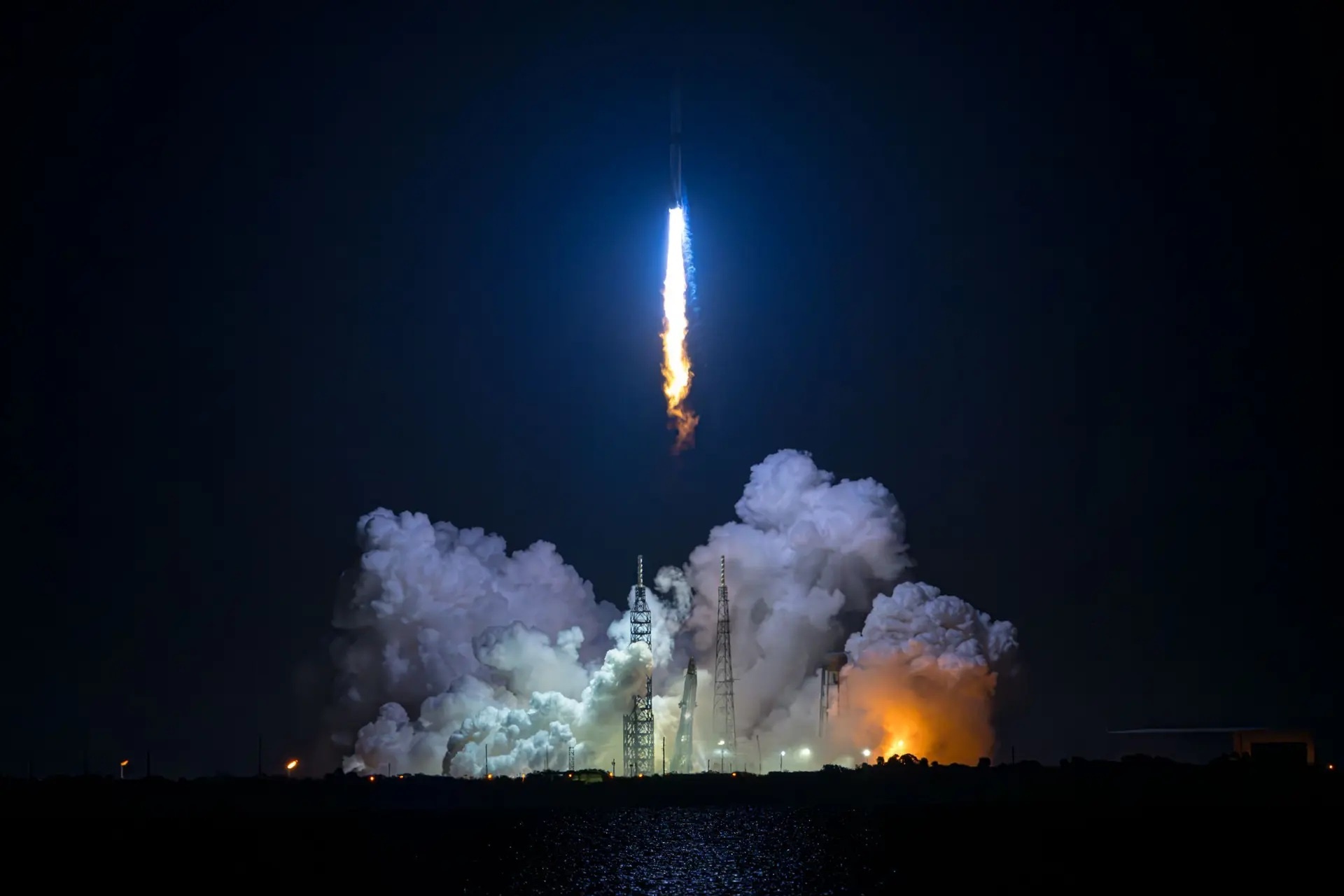
On Thursday, January 16, at 2:03 a.m. EST, Blue Origin's New Glenn rocket lifted off on its maiden flight from Launch Complex 36 at Cape Canaveral Space Force Station. This was a significant event for the company as the two-stage heavy-lift rocket has been in development for many years, features a partially reusable design, and is critical to Bezos' plan to “build a road to space.” While the company failed to recover the first stage booster during the flight test, the rocket made it to orbit and successfully delivered its payload – the Blue Ring Pathfinder – into orbit (which has since begun collecting data).
According to Blue Origin's latest statement, the second stage reached its final orbit after two successful burns of its two BE-3U engines. The successful launch of NG-1 means Blue Origin can now launch payloads into low Earth orbit (LEO), a major milestone for the commercial space company. “I am incredibly proud that New Glenn reached orbit on its first attempt,” Blue Origin CEO Dave Limp said in a company statement. “We knew that landing our booster “So You're Tell Me There's a Chance” on the first try was an ambitious goal. We'll learn a lot from today and try again on our next launch this spring. Thank you to the entire Blue team for this incredible milestone.”
The rocket is named after NASA astronaut John Glenn, a member of the Mercury 7 and the first American astronaut to orbit Earth on July 21, 1961 as part of the Liberty Bell 7 mission. This is consistent with Blue Origin's naming story – their launch vehicles are modeled after famous astronauts, such as the New Shepard rocket. This single-stage suborbital launch vehicle is named after Alan Shepard, the first American astronaut who flew into space on May 5, 1961 as part of the Freedom 7 mission.
Unlike the New Shepard, a fully reusable vehicle used primarily for space tourism and technology demonstrations and experiments, the New Glenn features a reusable first stage designed for landing at sea on a barge called the Jacklyn or Landing Platform Vessel 1 ( LPV1). While the second stage is not currently reusable, Blue Origin has been working on a reusable second stage since 2021 (through Project Jarvis). While development of the New Glenn began in 2013, the rocket has been stuck in “development hell” since 2016. shortly after the initial announcement.
As a result, Blue Origin lagged behind its main competitor (SpaceX) and missed out on billions of dollars worth of contracts. These included the company's failure to secure a National Security Space Launch (NSSL) procurement contract and the US Space Force ending its launch technology partnership in late 2020. In 2021, the ongoing delay led to Jeff Bezos announcing his resignation as CEO of Amazon Web Services (AWS) to take over the reins of Blue Origin. In February 2024, the first fully developed New Glenn rocket was unveiled at Launch Complex 36.
This mission not only confirmed the launch vehicle, which is crucial to the company's future plans in space. It was also the first of several demonstrations to be certified for use in the National Security Space Launch program. “The success of the NG-1 mission marks a new chapter for launch operations in the Eastern Range and redefines commercial-military cooperation to maintain SLD 45’s position as the world’s premier gateway to space,” Airman 1st Class Collin Wesson wrote from the US Space Force (USSF) Space Launch Delta 45 (SLD 45) Public Affairs, shortly after launch.
These plans include the launch of Amazon's proposed constellation of internet satellites (Project Kuiper) and the creation of the Orbital Reef – a planned commercial space station being developed by Blue Origin and Sierra Space. They also have a contract with NASA to launch the Escape and Plasma Acceleration and Dynamics Explorers (ESCAPADE) mission, two satellites that will study how the solar wind interacts with Mars' magnetic environment and drives atmospheric escape. NASA also has a contract with Blue Origin to provide payload and crewed launch services for the Artemis program.
Artistic concept of the Blue Moon Mk. II lander. Photo credit: Blue Origin
These include the Blue Moon Mark 1 and Mark 2 cargo landers, which will transport the Artemis V astronauts to the lunar surface. With this flight and subsequent flights, Blue Origin joins other commercial space companies poised to break the near monopoly that SpaceX has held for over a decade. Blue Origin’s New Glenn Senior VP Jarrett Jones said:
“Today begins a new era for Blue Origin and for commercial space. We are focused on increasing our launch frequency and production rates. My heartfelt thanks go to everyone at Blue Origin for the tremendous work that made today's success possible, and to our customers and the space community for their continued support. We felt that immensely today.”
Further reading: Blue Origin
Like this:
Load…

Comments are closed.