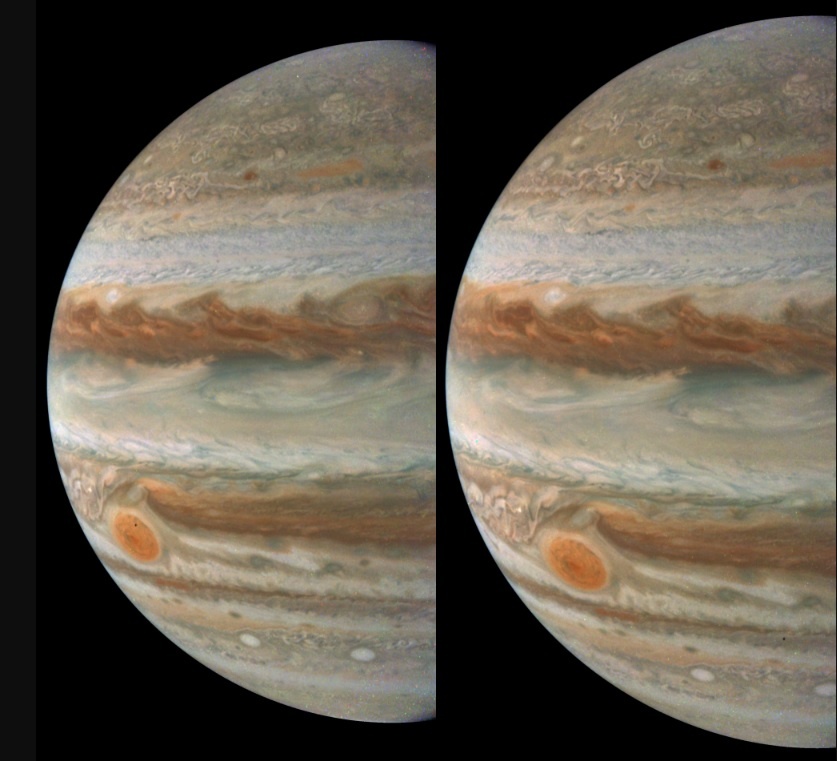
NASA's Juno spacecraft spies a tiny inner moon of Jupiter, Amalthea.
It's tiny, but it's there. By now, we're all used to regularly seeing amazing photos of Jupiter from NASA's Juno mission. Many of these are processed by volunteer “citizen scientists,” showing Jupiter’s swirling cloud tops in stunning detail, courtesy of the spacecraft’s JunoCam.
Recently JunoCam captured something special. Look closely at the side-by-side images of Jupiter from March 7, 2024, and you'll see a tiny speck crossing the Great Red Spot in the main left image that isn't visible in the right. This is the tiny inner moon Amalthea, just 84 kilometers across. The image was taken during the 59th perijove (close flyby) of the “King of the Planets” at a distance of 265,000 kilometers (about two-thirds of the Earth-Moon distance).
Amalthea (arrow) transits Jupiter. Image credit: NASA/JPL-Caltech/SwRI/MSSS. Image editing by Gerald Eichstädt.
Amalthea: An Origin Story
The elusive moon was discovered on the night of September 9, 1892 by prolific astronomer and observer EE Barnard. Barnard used the 36-inch-diameter refractor telescope at Lick Observatory to discover the magnitude +14 moon, which never passes more than 30 inches from Jupiter (smaller than the planet's apparent diameter) in its 12-hour orbit . Amalthea is considered the last moon discovered by direct visual observation and the first moon of Jupiter discovered since Galileo first discovered the four large Galilean moons in 1610. Today Jupiter has 95 known moons, most of which are captured asteroids. These were discovered primarily photographically and during spacecraft flybys.
One of Juno's giant solar panels deployed on Earth. NASA/JPL/SWrI
Like other small moons, Amalthea is not large enough to form into a true ball. Instead, like the Martian moons Phobos and Deimos, Amalthea is a potato-shaped, captured asteroid.
Amalthea: No more red
The moon is also the reddest object in the solar system and is undoubtedly experiencing strong tidal change thanks to nearby Jupiter's enormous gravitational field. Amalthea is located 180,000 kilometers from Jupiter, just over 100,000 kilometers outside Jupiter's Roche limit radius. Any approach to Jupiter would tear Amalthea to pieces. The innermost moon Metis just exceeds this limit.
Color image of Amalthea from Voyager 1 in 1979. Photo credit: NASA/JPL
Voyager 1 and 2 gave us the first blurry views of the Moon. NASA's only other Jupiter orbiter, Galileo, gave us the best images of Amalthea to date with a flyby 374,000 kilometers away on November 26, 1999. These images show a misshapen world, not unlike the Martian moon Deimos. From the surface of Amalthea, Jupiter would be an amazing sight, spanning almost half the sky at 42 degrees in diameter.
The best view of Amalthea from the Galileo spacecraft. Image credit: NASA/JPL
Juno and the current status of the mission
Juno launched from the Cape on August 5, 2011 and reached Jupiter on July 5, 2016. The mission explores Jupiter's interior and its magnetic and radiation environment. Juno will answer important questions, including whether the planet has a solid core. Juno is the first solar-powered (as opposed to nuclear/plutonium-powered) mission to the outer planets, meaning its nominally long-range orbit was intended to avoid radiation damage to the solar panels. Engineers only allowed the spacecraft to pass by Jupiter's inner moons during the longer and final phase of the mission. Juno will operate until at least September 2025.
Two more missions are on their way to Jupiter; ESA's JUICE (Jupiter Icy Moons Explorer) was launched on April 14, 2023, and NASA's Europa Clipper is scheduled to launch in October 2024.
Jupiter seen from the surface of Amalthea. Photo credit: Stellarium
Look out for more amazing images courtesy of Juno as the mission enters its final months and days.
Like this:
Is loading…
