By Steve Goreham
Originally published by MasterResource.
In March, the US Environmental Protection Agency released new regulations for methane emissions in the oil and gas industry. The European Union issued new rules in May to reduce methane emissions in the energy sector. Agriculture is also in the crosshairs for methane. But even if methane regulations were implemented worldwide, they would have no measurable impact on global temperatures. They would, however, increase the cost of energy and food and impact consumers and businesses.
On March 8, the Environmental Protection Agency (EPA) adopted its regulation on methane emissions from the oil and gas sector. The regulation is intended to “reduce wasteful methane emissions that endanger communities and exacerbate the climate crisis.”
The new regulation will impose a penalty of $900 for every ton of methane that exceeds the limits set by the EPA, starting this year. 24 states have filed suit against the EPA's new regulation.
On May 27, the European Union (EU) announced new rules on methane emissions from coal, gas and oil operations. These rules require energy companies to monitor and report methane emissions and reduce flaring of methane from their operations. The rules also apply to international companies that supply hydrocarbon fuels to Europe.
Methane (CH4) is also known as natural gas. It is released from oil and gas operations through flaring or system leaks. CH4 is also produced when organic material decays, such as in landfills. The EPA and EU have proposed methane regulations to combat global warming.
But nature and human agriculture are bigger sources of methane than the energy industry. Termites and other insects emit large amounts of methane. We have about 1.5 billion cows on Earth and numerous other livestock and wild animals that emit methane from both their noses and tails.
Methane is a greenhouse gas and part of the Earth's greenhouse effect, which is blamed for global warming. Sunlight, a high-energy radiation, enters the atmosphere and is absorbed by the Earth's surface. Like any warm body, the Earth emits radiation. Because the Earth's temperature is lower than that of the Sun, it emits lower-energy radiation called infrared radiation or long-wave radiation, which is invisible to our eyes.
This longwave radiation tries to leave the Earth's atmosphere, but is almost completely absorbed by greenhouse gases in the atmosphere. These gases then re-radiate the absorbed energy, causing the Earth's surface to warm. The warming caused by the absorption of infrared radiation is called the greenhouse effect. Emissions from human industrial processes amplify this effect and increase global temperatures.
But the Earth's greenhouse effect is predominantly a natural effect. Water vapor, not carbon dioxide or methane, is the Earth's predominant greenhouse gas. Water vapor is responsible for 70 to 90 percent of the greenhouse effect.
Carbon dioxide (CO2) is the second most important greenhouse gas, but most of the CO2 in the atmosphere comes from nature, such as CO2 emissions from the oceans and the biosphere. Every day, nature releases 20 times more carbon dioxide into the atmosphere than all human-caused emissions and removes about the same amount from the atmosphere. Methane ranks only third as a greenhouse gas.
The European Union declares:
“… the ability of methane to trap heat in the atmosphere is even stronger than that of carbon dioxide. On a time scale of 100 years, methane has a global warming potential 28 times higher than carbon dioxide, and on a time scale of 20 years, it is 84 times more effective.”
Although these claims by the EU and other sources are widely cited, they are false. Claims about the global warming potential of methane are accurate in the laboratory, but not in the atmosphere.
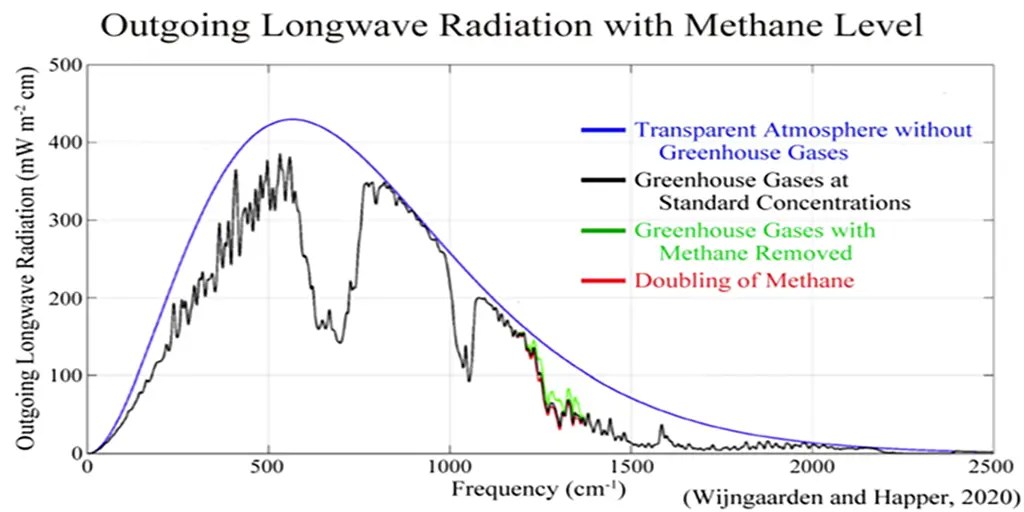
No one paints a room in their house ten times, because after two coats there is no noticeable difference. Likewise, greenhouse gases in the Earth's atmosphere are already saturated at the frequencies at which methane absorbs outgoing longwave radiation. Additional methane will have almost no effect.
A 2020 analysis by Wijngaarden and Happer examined the absorption of outgoing longwave radiation by methane and other greenhouse gases across the radiation spectrum. The researchers found that a doubling of atmospheric methane, whether due to natural or human causes, would only increase greenhouse gas absorption by about 0.3 percent, a negligible amount.
Agriculture has become a target of efforts to reduce methane emissions. Earlier this year, New York Attorney General Letitia James sued JBS, the world's largest beef producer, over the company's methane emissions and alleged misleading sustainability claims to the public. The cost of this litigation will drive up food prices even further for consumers.
Earlier this year, the EU tried to impose regulation on European farmers to use their products sustainably. Ursula von der Leyen, President of the European Commission, said the agricultural sector needed to move to a “more sustainable production model”. Farmers were asked to reduce the size of their dairy herds and limit the use of nitrogen fertilizers to reduce greenhouse gas emissions of methane and nitrous oxide. German Federal Agriculture Minister Cem Özdemir even proposed an excise tax on meat.
But angry farmers launched violent protests in France, Germany, Italy, the Netherlands, Spain and other countries. Hundreds of tractors blocked traffic in major cities and police were pelted with eggs and manure. The SUR was rejected and the EU backed away from further agricultural regulations, including those on methane and the use of nitrogen fertilizers.
Perhaps the most bizarre emissions reduction legislation was the Australia Carbon Farming Initiative Act of 2011, which awarded carbon credits for the killing of feral (wild) animals, including:
“…reducing methane emissions through the humane husbandry of feral goats, feral deer, feral pigs and feral camels.”
The killing of animals for emissions certificates was stopped in 2012.
In any case, due to the saturation of greenhouse gases in the atmosphere, methane regulations worldwide will not have a measurable impact on global temperatures. But if implemented, they will increase the costs of energy and food production and prices for consumers and businesses.
Steve Goreham is a speaker on energy, environment and public policy and author of the new bestseller Green Breakdown: The Coming Renewable Energy Failure.
Like this:
Is loading…
