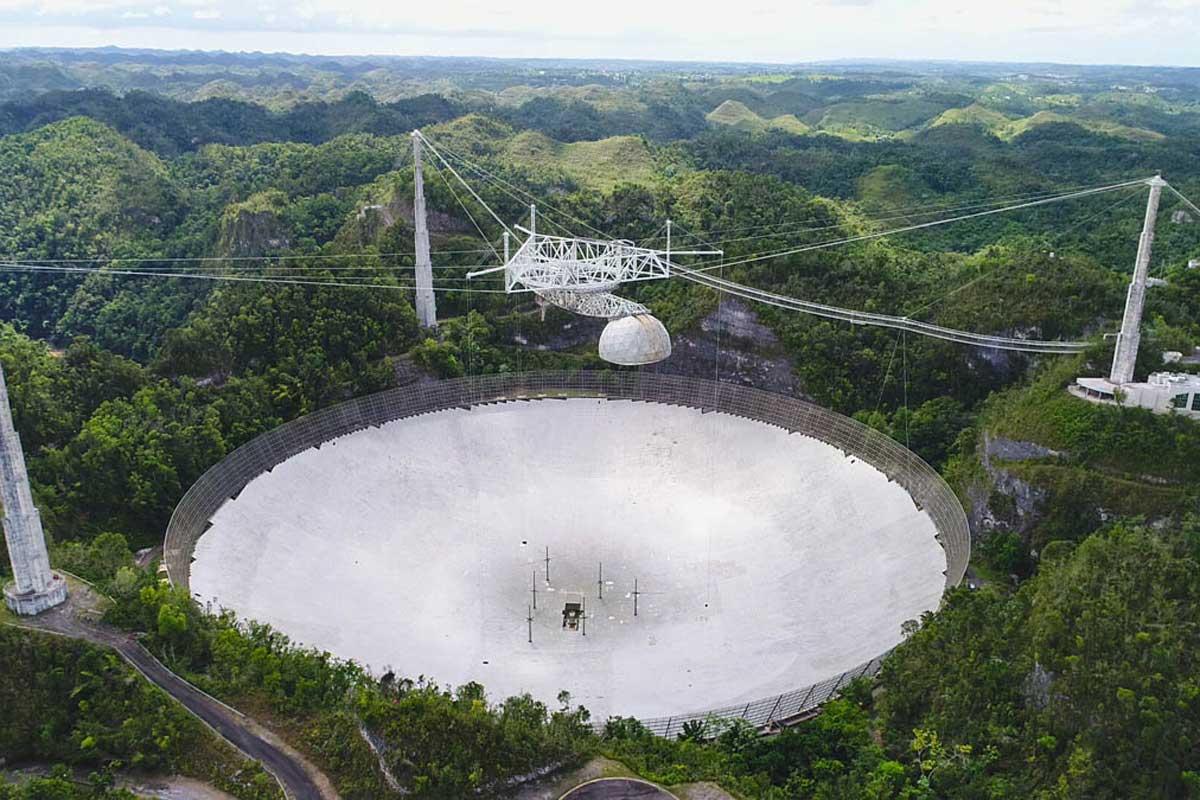
In 1963, the Arecibo Observatory on the island of Puerto Rico became operational. At 305 meters (~1000 feet) in diameter, Arecibo's spherical reflector dish was then the largest radio telescope in the world – a record it held until 2016 with the construction of the Five-hundred-meter Aperture Spherical Telescope (FAST) in China. In December 2020, Arecibo's reflector dish collapsed after some of its support cables snapped, prompting the National Science Foundation (NSF) to decommission the observatory.
Shortly thereafter, the NSF and the University of Central Florida began investigations to determine what caused the collapse. After almost four years, the Committee to Analyze the Causes of the Failure and Collapse of the 305 Meter Telescope at the Arecibo Observatory released an official report detailing its findings. The report said the collapse was due to weakened infrastructure caused by long-term zinc creep-induced failure of the telescope's cable connectors and previous damage from Hurricane Maria.
The huge dish was originally called the Arecibo Ionosphere Observatory and was intended not only for radio astronomy but also for ionospheric research. The first task was part of the Advance Research Projects Agency (ARPA) Defender program, aimed at developing ballistic missile defense systems. In 1967, the NSF took over management of Arecibo and made it a civilian facility dedicated to astronomical research. In 1971, NASA signed a letter of intent to contribute to the costs of maintaining and modernizing the facility.
Radar images of 1991 VH and its satellite from the Arecibo Observatory in 2008. Image credit: NSF
During its many years of operation, the Arecibo Observatory has accomplished some amazing feats. This included the first-ever discovery of a binary pulsar in 1974, which led to the discovery team (Russell A. Hulse and Joseph H. Taylor) being awarded the Nobel Prize in Physics in 1993. In 1985, the observatory discovered the binary asteroid 4337 Arecibo in the outer regions of the main asteroid belt. In 1992, Arecibo discovered the first exoplanets, two rocky bodies about four times the mass of Earth around the pulsar PSR 1257+12. This was followed in 2016 by the discovery of the first repeating fast radio burst (FRB).
The observatory was also responsible for sending the famous Arecibo message, the most powerful broadcast ever sent into space and humanity's first real attempt at transmitting extraterrestrial intelligence (METI). The visual message, created by a group of Cornell University and Arecibo scientists that included Frank Drake (inventor of the Drake Equation), famed science communicator and author Carl Sagan, Richard Isaacman, Linda May and James CG Walker, aimed to do just that from the globular cluster M13.
According to the committee's report, the structural failure began in 2017 when Hurricane Maria hit the observatory on September 20, 2017:
“Maria exposed the Arecibo Telescope to wind speeds between 105 and 118 miles per hour, with the cause of this uncertainty in wind speed discussed below… Based on a review of available records, Hurricane Maria's winds damaged Arecibo's cables. “The telescopes are subjected to the highest structural stress they have ever endured since their opening in 1963.”
However, inspections conducted after the hurricane concluded that “no significant damage had compromised the structural integrity of the Arecibo Telescope.” Still, repairs were ordered, but the report identified several problems that caused those repairs to be delayed for years. Still, the investigation found that due to the misalignment of repairs “toward components and replacement of a main cable that ultimately never failed,” they still would not have prevented the observatory's collapse.
Aerial view of the damage to the Arecibo Observatory after the telescope platform collapse on December 1, 2020. Photo credit: Deborah Martorell
Additionally, a structural failure of an auxiliary and main cable occurred in August and November 2020, leading to the NSF announcing it would decommission the telescope via a controlled demolition to prevent a catastrophic collapse. They also stated that the observatory's other facilities would continue to operate, such as the Ángel Ramos Foundation Visitor Center. However, before this could happen, additional support cables buckled on December 1, 2020, causing the instrument platform to collapse into the dish.
This collapse also removed the tops of the support towers and partially damaged some of the observatory's other buildings. Luckily no one was injured. According to the report, the Arecibo telescope's cable potting bushings were significantly damaged, as demonstrated by previous cable failures. They also explain that the collapse was triggered by “hidden external wire breaks” that had already broken due to shear stress from zinc creep (also known as zinc decay) in the telescope's cable potting bushings.
This issue was not identified during the post-Mariah inspection, resulting in failure to account for the deterioration mechanisms and overestimation of the potential strength of the other cables. According to NSF statements from October 2022 and September 2023, the observatory will be converted into an educational center called Arecibo C3, which will focus on ciencia (science), computación (computing), and promoting comunidad (community). Although the observatory's long history of radio astronomy has come to an end, it will continue as a STEM research center and its legacy will endure.
Further reading: National Academies Press, Gizmodo
Like this:
Load…
