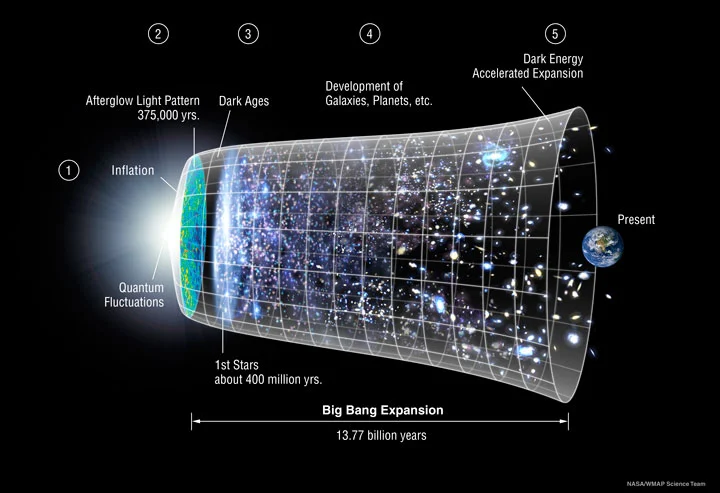
For about a century, scientists have known that the universe is in a state of constant expansion. In honor of the scientists who conclusively demonstrated this, this extension became known as the Hubble constant (or Hubble-Lemaitre constant). Today, scientists use two main techniques to measure the expansion rate: the cosmic microwave background (CMB) and the cosmic distance ladder. The former is based on redshift measurements of the CMB, the relic radiation left over from the Big Bang, while the latter is based on parallax and redshift measurements of variable stars and supernovae (also called “standard candles”).
The only problem is that the two methods do not agree, resulting in what is known as “Hubble tension.” This problem is considered one of the greatest cosmological puzzles facing scientists today. Fortunately, new methods are emerging that could help resolve this “tension” and bring order to the Standard Model of cosmology. In a recent study, a team of astrophysicists, cosmologists and physicists from the University of Illinois and the University of Chicago proposed a new method that exploits tiny ripples in spacetime known as gravitational waves (GWs).
The study was led by Bryce Cousins, an NSF Graduate Research Fellow from the Institute of Gravitation and the Cosmos (IGC) at the University of Illinois Urbana-Champaign. He was joined by several colleagues from the IGC as well as researchers from the Kavli Institute for Cosmological Physics and the Enrico Fermi Institute at the University of Chicago. Their study, “Stochastic Siren: Astrophysical gravitational-wave background measurements of the Hubble Constant,” appeared Jan. 16 in Physical Review Letters.
Scientists hoping to resolve the Hubble tension have proposed several solutions, ranging from early dark energy (EDE) and interactions between dark matter (DM) and neutrinos to the evolving dynamics of dark energy. In recent years, the discovery of gravitational waves has also emerged as a way to resolve the tension by offering a new way to measure cosmic expansion. Originally predicted by Einstein’s theory of general relativity, gravitational waves are waves that arise in the fabric of space-time and are created by the merger of massive objects (neutron stars and/or black holes).
They were first confirmed in 2016 by scientists at the Laser Interferometer Gravitational Wave Observatory (LIGO). Thanks to improved tools and international collaboration, the LIGO-Virgo-KAGRA (LVK) collaboration has discovered more than 300 GW events. During this time, astronomers have found ways to use events to study cosmological phenomena, including measuring the expansion of the cosmos. In current research, the team has found a way to improve these measurements by exploiting the gravitational wave background (GWB) caused by astrophysical collisions that the LVK network is not yet sensitive enough to detect.
They call it the “standard stochastic siren” method because the collisions that form the gravitational wave background occur stochastically. Daniel Holz, UChicago professor and co-author of the study, explained in a UIUC press release:
It’s not every day that you come up with an entirely new tool for cosmology. We show that we can learn about the age and composition of the universe using the background hum of gravitational waves from merging black holes in distant galaxies. This is an exciting and completely new direction, and we look forward to applying our methods to future datasets to help constrain the Hubble constant as well as other important cosmological quantities.
*Artist’s impression of the electromagnetic signal from the merger of two neutron stars. Photo credit: NSF/LIGO/Sonoma State University/A. Simonnet*
As a proof of principle, the team applied their method to recent LVK collaboration data. They found that failure to detect the GWB provides evidence against slow cosmic expansion rates. They then combined their method with measurements of the Hubble constant based on individual black hole collisions to get a more accurate rate. “Because we observe individual black hole collisions, we can determine the frequency of these collisions throughout the universe,” Cousins said. “Based on these rates, we expect there will be many more events that we cannot observe, called the gravitational wave background.”
This showed that at lower values of the Hubble constant, the total volume of space in which collisions occur is smaller. This would mean that the density of object collisions is higher and the strength of the GWB signal increases to a level that current instruments could detect. “This result is very significant – it is important to obtain an independent measurement of the Hubble constant to resolve the current Hubble voltage,” added co-author Nicolás Yunes, the founding director of the Illinois Center for Advanced Studies of the Universe (ICASU). “Our method is an innovative way to improve the accuracy of Hubble constant conclusions using gravitational waves.”
Due to LVK’s improved architecture, scientists believe that the GWB will likely be discovered within the next six years. If this happens, the team’s method could be used to further improve measurements of the Hubble constant. Until then, the stochastic siren method could be used to constrain higher values of the Hubble constant, thereby setting upper limits on the GWB and allowing scientists to study it before a full discovery occurs.
“This should pave the way for future application of this method as we can further increase the sensitivity, better isolate the gravitational wave background and perhaps even detect it,” says Cousins. “By incorporating this information, we expect to obtain better cosmological results and come closer to resolving the Hubble tension.”
Further reading: University of Illinois
