

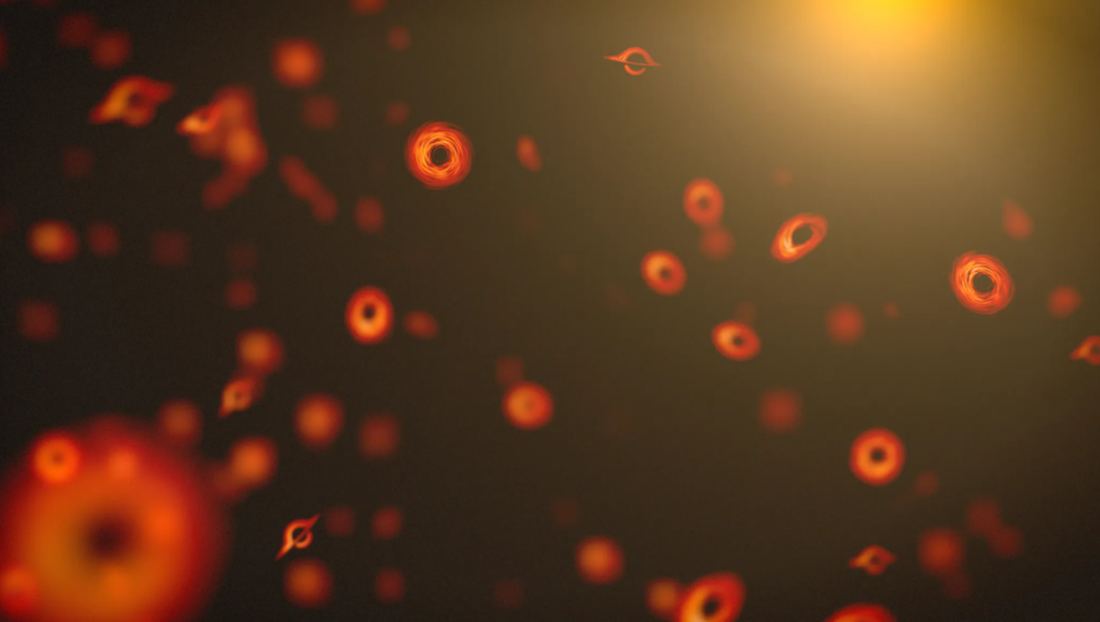
Primordial black holes formed in the earliest stages of the universe's evolution. Their enormous gravity could wreak havoc in star systems. They can transfer energy into vast binary star systems, disrupting their orbits. But like celestial tyrants, their disruption could lead to extreme consequences, such as the ejection of a star, which is then replaced by the black hole itself! A new paper examines the interactions of such systems and looks for ways we might be able to detect them.
It is thought that black holes could have formed in the first moments after the Big Bang. They are not the result of the collapse of supermassive stars, but rather were formed by fluctuations in the density of matter. Regions of high density would simply collapse under their own gravitational influence, forming so-called primordial black holes (PBHs). Their size is thought to vary from subatomic to those more massive than the Sun.
Whether primordial black holes are actually responsible for the dark matter in the universe is still a matter of debate. There is general agreement in the astronomical community that they cannot be responsible for all dark matter, but probably account for up to 10% of dark matter in the planetary mass range (10-7 to 10-3 solar masses). Whether these PBHs are responsible for any dark matter in the universe requires further investigation.
Researchers are making progress in mapping dark matter, but don't know what it is. This is a 3D density map of dark matter in the local Universe, with the Milky Way marked with an X. Dots are galaxies and the arrows indicate the directions of motion inferred from the reconstructed gravitational potential of dark matter. Image credit: Hong et al., doi: 10.3847/1538-4357/abf040.
When considering large scales, PBHs are indistinguishable from a background of particulate dark matter. On small scales, the distribution of PBHs in the Universe is not uniform relative to the background of particulate dark matter, and so we are forced to look for a unique and new theory. Observing PBHs to understand how close the model is to reality is difficult, but it is possible to study their interactions with stellar systems.
In a paper published by Badal Bhalla of the University of Oklahoma and a team of astronomers, they investigate how PBHs can lose energy when interacting with binary star systems. These interactions can lead to one of five possible outcomes:
1: Hardening – the two bound objects lose energy to the third free object, which reduces their distance;
2: Softening – the free body transfers energy to the bound system, increasing the distance but keeping the two bodies bound;
3: Disturbance – the free body transfers enough energy to the bound system so that the components separate and all objects remain unbound;
4: Capture – the bound objects capture the free object;
5: Exchange – the free object transfers enough energy to release one of the bound objects and loses enough energy to become bound to the remaining object.
Previous studies have investigated softening and disorder in PBH and binary interactions, as well as the capture model. The team suggests that hardening is also unlikely, so they are investigating the possibility of the exchange model. They found that the exchange model should lead to a population of PBH binaries in the Milky Way, and indeed some observations suggest that they may exist. The team also suggests that it may be possible to detect PBHs in binary systems with a sub-solar mass PBH based on the properties of the system. Observations are now needed to validate the model. The discovery of black holes in a binary system could be detectable and support the results to some extent.
Source: Dancing with invisible partners: three-body exchange with primordial black holes
Like this:
Load…

Comments are closed.