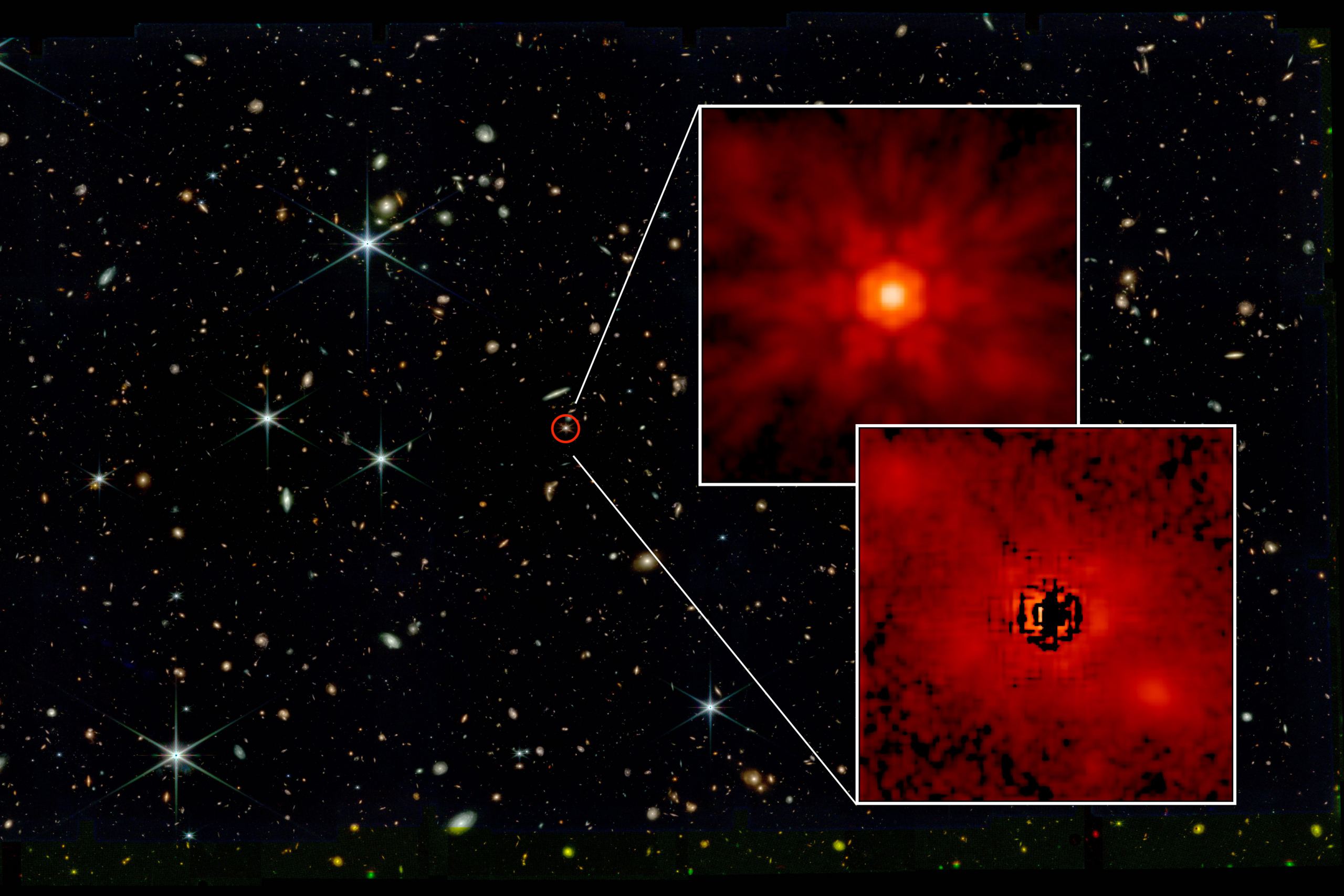
Supermassive black holes are central to the dynamics and evolution of galaxies. They play a role in galaxy formation, star production, and possibly even dark matter accumulation. Almost every galaxy has a supermassive black hole, which in nearby galaxies can be only a small fraction of a galaxy's mass. Although we know a lot about these gravitational monsters, the question still remains as to how supermassive black holes were able to gain mass so quickly.
Most of what we know about early black holes comes from quasars. These occur when supermassive black holes are in an extremely active phase, consuming enormous amounts of matter and emitting intense light that is visible throughout the universe. Observations from the James Webb Space Telescope (JWST) and other observatories have observed quasars as early as 13 billion years ago, meaning they were already large and active just a few hundred million years after the Big Bang. But these brilliant beacons also pose a challenge for observation. Early quasars are so bright that they far outshine their host galaxy, making it difficult to observe the surroundings of early quasars. But a new study in the Astrophysical Journal has used a spectral trick to detect these distant galactic hosts.
The team collected JWST data on six distant quasars known to be about 13 billion light-years away. Because the quasars were observed at different wavelengths, the team then compared the light to model quasars and were able to categorize which wavelengths likely came from the quasar's compact source and which from the more diffuse galaxy around it. By filtering out the quasar light, they obtained the first images of the distant galaxies that are home to these ancient quasars.
Because the brightness of each light source is related to its mass, the team was able to compare the mass of a quasar to the mass of its parent galaxy. The result was surprising. In these early galaxies, the mass of the supermassive black hole is about 10% of the galaxy's mass. This is much larger than the mass ratio observed in local galaxies, where supermassive black holes can make up only a tenth of a percent of a galaxy's mass. This likely means that early supermassive black holes grew extremely quickly and could even have been the seeds of their galaxies. The observations contradict the idea that early galaxies formed first and that their black holes formed later.
Astronomers still don't know how supermassive black holes formed so quickly in the early universe, but it's now clear that they did. While answering a question about the evolution of supermassive black holes, the team raised several other questions.
Reference: Yue, Minghao et al. “OWNER. V. Characterization of the host galaxies of luminous quasars at z ? 6.” The Astrophysical Journal 966.2 (2024): 176.
Like this:
Is loading…
