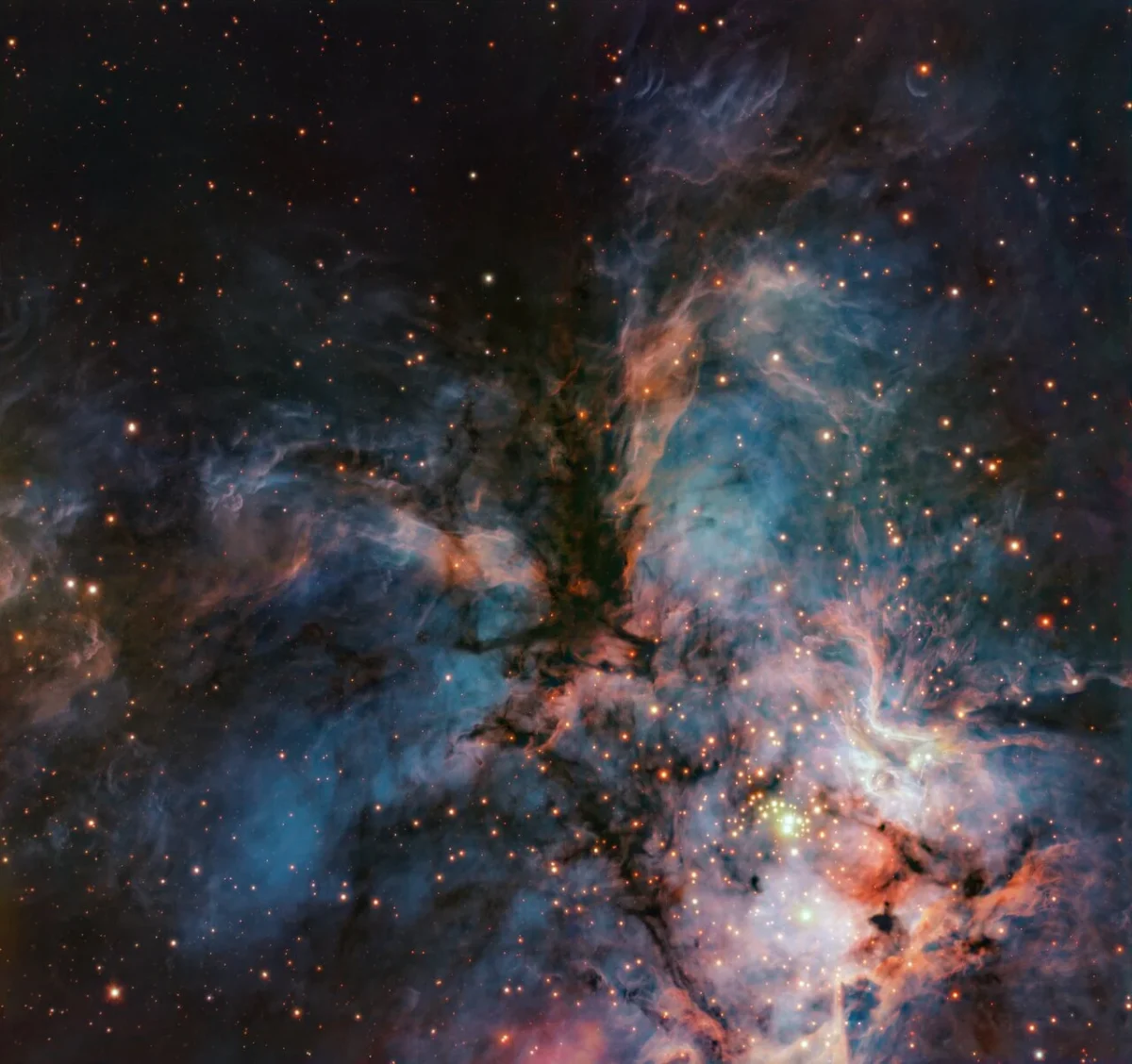
The European Southern Observatory (ESO) has just released its photo of the week. This image, taken by the Very Large Telescope (VLT) in Chile, shows the nebula RCW 36, located about 2,300 light-years away in the constellation Vela. But to observers, it looks like a cosmic falcon spreading its wings: the dark clouds in the center resemble the falcon’s head and body, and the filaments running to the right and left serve as wings. And the nice thing about it: The image itself was taken with the High Acuity Wide-field K-band Imager-1 (HAWK-1) instrument on the VLT.
This powerful near-infrared imager is designed to capture deep, high-resolution images, allowing it to penetrate the dust and gas clouds that obscure dimmer objects such as newly forming stars. Below the falcon in the image, several new stars are visible, embedded in clouds of nebula gas and dust. The intense radiation from these massive young stars illuminates the nebula, causing it to glow blue, red and white. However, it is the population of faint brown dwarfs that was of interest to the astronomers who captured this image.
Brown dwarfs are essentially substellar objects, very large gas giants that were not massive enough to undergo gravitational collapse and fuse hydrogen. The HAWK-1 is ideal for this task because it combines high sensitivity with adaptive optics that correct for atmospheric disturbances. This allowed the international team, led by astronomers from the Instituto de Astrofĩsica e Ciências do Espaço (IA) in Lisbon, to identify the many fainter objects in the image. Their efforts are described in an article published in *Astronomy & Astrophysics*: “Substellar population of the young massive star cluster RCW 36 in Vela.”
The study not only provided important data that will improve our understanding of brown dwarf formation, but also provided a striking picture. Afonso do Brito do Vale, a graduate student at IA and lead author of the paper, described it as “massive stars ‘pushing away’ the gas and dust clouds surrounding them, almost like an animal breaking through its eggshell for the first time.” This completes the picture and gives the impression that the falcon is protecting these baby stars and brown dwarfs as if they were its eggs. Over time, new stars will “hatch” and join the nest!
Further reading: ESO, astronomy and astrophysics
