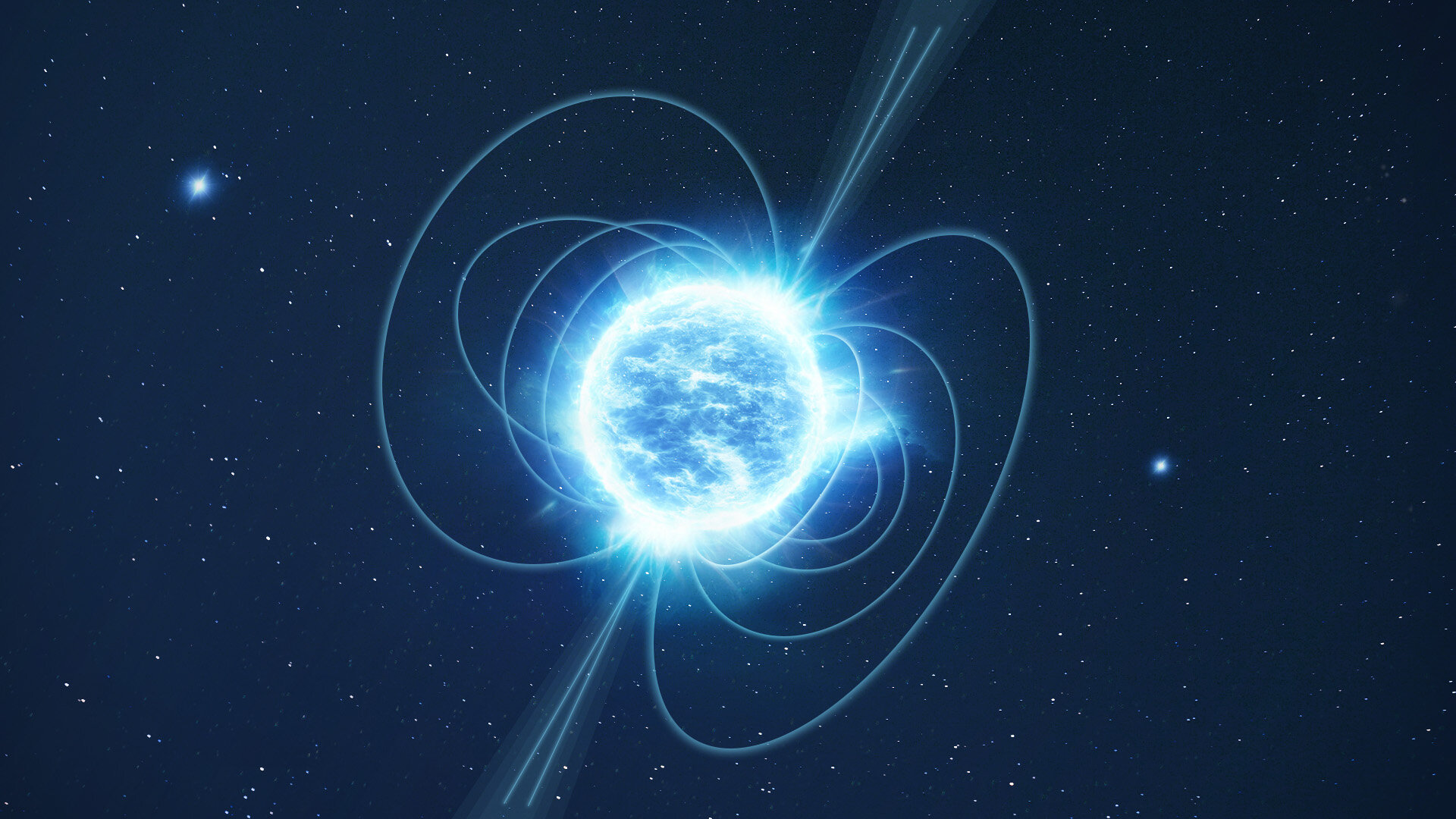
Neutron stars are among the densest objects in the universe after black holes. Like black holes, neutron stars are what's left when a star reaches the end of its life cycle and undergoes gravitational collapse. This creates a massive explosion (a supernova) in which a star sheds its outer layers, leaving behind a super-compressed stellar remnant. In fact, scientists speculate that the matter at the center of the star is so compressed that even atoms collapse, causing electrons to fuse with protons to form neutrons.
Traditionally, scientists rely on the “equation of state” – a theoretical model that describes the state of matter under certain physical conditions – to understand what physical processes can occur inside a neutron star. However, when a team led by scientists from the Spanish National Research Council (CSIC) studied three exceptionally young neutron stars, they found that they were 10-100 times colder than other neutron stars of the same age. The researchers concluded that these three stars are incompatible with most of the proposed equations of state.
The team included astrophysicists from the Institute of Space Sciences (ICE-CSIS) in Barcelona, the Institute of Space Sciences of Catalonia (IEEC) and the School of Applied Physics of the University of Alacant. Alessio Marino, a postdoctoral researcher in astrophysics at ICE and IEEC, was the lead author of the team's paper (“Constraints on the dense matter equation of state from young and cold isolated neutron stars”), which recently appeared in Nature Astronomy.
Three “eccentric” neutron stars are too young to be that cold. Image credit: ESA/ATG
While astronomers are still not sure which equation of state models are correct for neutron stars, the laws of physics dictate that all neutron stars must obey the same model. In addition, the cool nature of neutron stars is a reliable way to determine their age – the older they are, the cooler they become. While it is difficult to study invisible light, their rotating nature and magnetic fields (which direct energy toward the magnetic poles) produce X-ray pulses that can be observed.
After analyzing data from ESA's XMM-Newton missions and NASA's Chandra missions, the team found evidence of three neutron stars. The extreme sensitivity of these telescopes allowed the team not only to detect these neutron stars, but also to collect enough light to determine their temperatures and other properties. According to astrophysicist Nanda Rea, whose research group at ICE-CSIC and IEEC led the investigation, the results were very surprising:
“The young age and low surface temperature of these three neutron stars can only be explained by a rapid cooling mechanism. Since increased cooling can only be triggered by certain equations of state, we can rule out a significant proportion of the possible models,”
“Neutron star research spans many scientific disciplines, from particle physics to gravitational waves. The success of this work shows how fundamental teamwork is to advancing our understanding of the universe.”
To do this, Rea and her colleagues – Alessio Marino, Clara Dehman and Konstantinos Kovlakas – benefited from their combined and complementary expertise. Marino, a postdoctoral fellow at ICE-CSIS and IEEC, led the team's efforts to deduce the other physical properties of the neutron stars. In addition to determining their temperature from the X-rays they emit, the size and speed of the surrounding supernova remnants provided an accurate indication of their age.
Here is an artist's illustration of an erupting, magnetically strong neutron star, known as a magnetar. Courtesy of NASA.
Next, Clara, a postdoctoral researcher at the University of Alicante, calculated the “cooling curves” of neutron stars based on different masses and magnetic field strengths, plotting what each “equation of state model” predicts for the change in temperature of a neutron star (indicated by its brightness) over time. Finally, Kovlakas, a postdoctoral researcher at ICE-CSIC and IEEC, led a statistical analysis using machine learning to match the simulated cooling curves to the properties of the three neutron stars.
These simulations showed that without a rapid cooling mechanism, none of the equations of state matched the data. In addition, the team concluded that the properties of these stars do not match about 75% of known neutron star models. By narrowing the range of possibilities, astronomers are one step closer to understanding which neutron star equation of state governs them all. This could also have important implications for understanding how the fundamental laws of the universe – general relativity and quantum mechanics – fit together.
This makes neutron stars a perfect laboratory to test the laws of physics, as they possess densities and gravitational forces far beyond anything that can be replicated on Earth. Much like black holes, these objects are the point at which the laws of physics begin to crumble, and where the most profound breakthroughs in our understanding of those laws can often be made!
Further information: ESA, Nature Astronomy
Like this:
Is loading…
