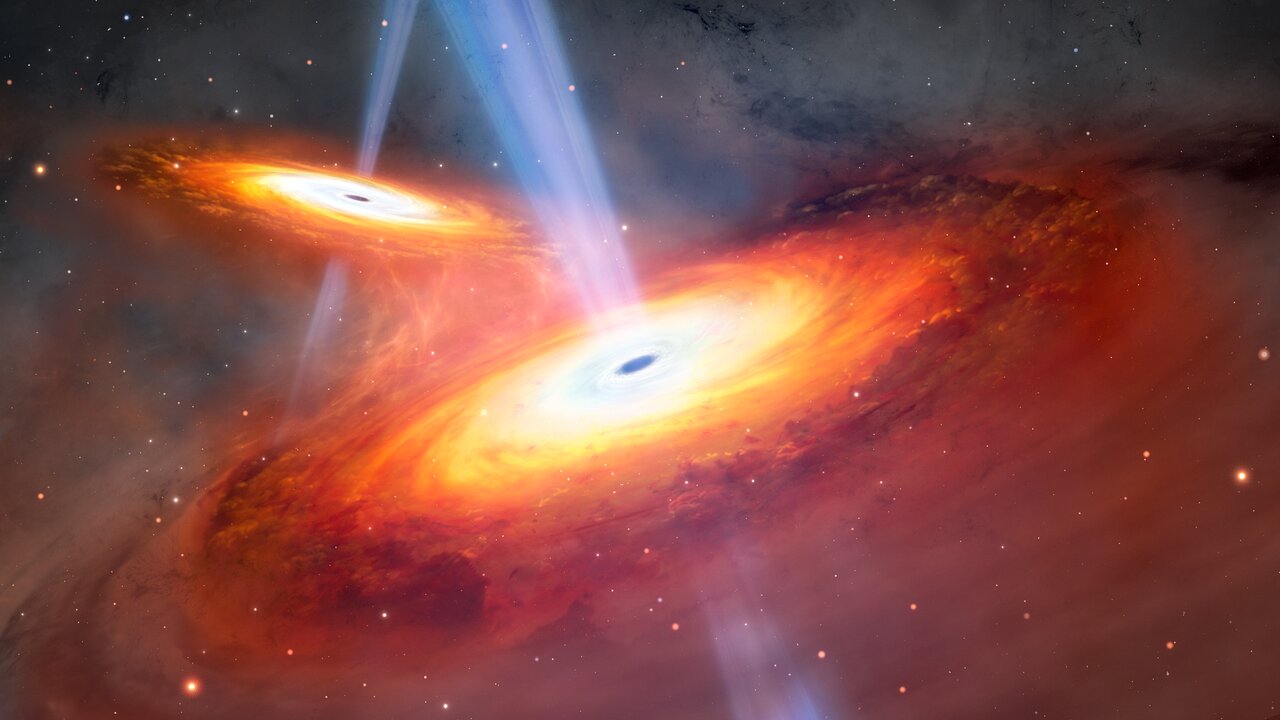
There are many massive galaxies in the universe today. But the universe wasn't always like this. Astronomers believe that galaxies grew large through mergers, so what we see in space is the result of billions of years of merging galaxies. When galaxies merge, large amounts of gas can enter their centers, sometimes creating a quasar.
Much of it is theoretical and shrouded in mystery, but astronomers may have found evidence that a quasar was formed when galaxies merged.
All galaxies contain interstellar gas, but some – typically younger ones – have a much higher concentration. When gas-rich galaxies merge, they trigger rapid star formation and feed large amounts of gas into the central black hole, which then flares up brightly and appears as a glowing quasar.
A quasar is essentially an extremely active black hole. It seems that all large galaxies host a supermassive black hole at their center, and when these black holes are actively feeding, they are called active galactic nuclei (AGN). Quasars are the most luminous of all AGN and can outshine entire galaxies.
But quasars are largely a thing of the past. Quasars' activity seems to have peaked about 10 billion years ago, which is one reason why there are still so many questions about how they formed.
Astronomers have observed the merger of two old, distant galaxies. There are dark quasars in both centers. Could they be the precursors of bright, massive quasars in the early universe? An international team of researchers believes so.
Their findings are contained in a new research paper published in the Astrophysical Journal titled “Merging Gas-rich Galaxies That Harbor Low-luminosity Twin Quasars at z = 6.05: A Promising Progenitor of the Most Luminous Quasars.” Takuma Izumi of the National Astronomical Observatory of Japan is the lead author.
The pair of distant, faint quasars discovered with the Subaru telescope. Image credit: NAOJ/Izumi et al. 2024.
“When we first observed the interaction between these two galaxies, it was like watching a dance in which the black holes at their centers had already begun to grow.”
Takuma Izumi, NAOJ
Quasars become extremely luminous and easier to observe, but by that time the merger that created them is already complete. Astronomers need to observe the dark quasars in a pre-merger state to find answers to their questions. They want to know what processes govern the merger of gas-rich galaxies and how some of the gas is taken up in a burst of star formation while some is channeled toward the center, creating a quasar.
“While the observation of quasars at multiple wavelengths has made significant progress in recent years, the understanding of their precursors lags behind,” the authors write in their article.
At z = 6.05, these quasars are exceptionally distant and old. The light that reaches us now left these objects about 12.7 billion years ago, in the cosmic dawn of the universe. Due to the expansion of the universe, the light traveled about 23.5 billion light-years. For many of these photons, their long journey ended when they reached the Subaru telescope and the ALMA radio telescope.
The Subaru Telescope is an optical/infrared telescope on the summit of Maunakea, Hawaii, operated by the National Astronomical Observatory of Japan (NAOJ). It is equipped with the Hyper Suprime-Cam, a 900-megapixel digital camera with an extremely wide field of view. Together, the Subaru Telescope and the Hyper Suprime-Cam enable astronomers to detect very faint objects during surveys.
Subaru/Hyper Suprime-Cam discovered the pair of dark galaxies earlier this year using the Gemini North telescope. Yoshiki Matsuoka of Ehime University in Japan was looking at images taken with the Subaru telescope and noticed a faint red spot. “When I was looking through the images of quasar candidates, I noticed two similar and extremely red sources next to each other,” says Matsuoka. “The discovery was pure serendipity.”
The Subaru telescope with its Hyper Suprime Cam discovered the galaxy pair. Image credit:
The pair of quasars discovered by Subaru is so dim that astronomers assumed they were a pre-merger pair. To determine the exact nature of the objects, however, lead author Izumi and his colleagues turned to another powerful observatory: ALMA, the Atacama Large Millimetre/submillimetre Array. To understand what they were seeing, the researchers needed to see how the gas behaved in the galaxies. ALMA is one of astronomers' most powerful tools for observing gas.
Most of the gas in galaxies is hydrogen, but it can be difficult to detect. ALMA observes what is known as the CII absorption line. Since both hydrogen and CII are common in gas clouds, the CII line serves as an indicator for hydrogen.
By observing the distribution and movement of hydrogen in the galaxies, astronomers concluded that the pair is in the process of merging. Two pieces of evidence support their conclusion: the bridge of matter that connects them and the movement of the gas.
This image from the research shows the quasar sites C2 and C1. It also shows the “bridge” and “tail” features, both signs that the galaxy pair is merging. “Both the bridge and the tail are most likely formed by interactions between the host galaxies of C1 and C2,” the authors write. Image credit: Izumi et al. 2024.
However, determining that the pair will merge was only the first step. The real question is whether the merging pair of galaxies will produce a glowing quasar. To determine this, the researchers had to measure the amount of gas.
The left image shows a velocity map of the galaxies and their quasars, labeled C2 and C1. The right image shows the four phases of the merger, including Phase IV, the observed phase. Image credit: Izumi et al. 2024.
Using ALMA, the researchers determined that the galaxies contain 100 billion solar masses of gas. That's more gas than some of the galaxies that contain the brightest quasars. This extraordinarily large amount of gas will not run out any time soon. It is enough to both trigger and sustain the explosive star formation after the merger and to power the supermassive black hole.
“Models of merger-driven galaxy evolution suggest that both star formation and active galactic nuclei are activated by the interaction of gas-rich galaxies,” the authors write in their study. “Therefore, we expect this pair to evolve into a luminous quasar with a high SFR of over 1000 solar masses per year, comparable to that observed for optically luminous quasars so far at high redshifts.”
Astronomers concluded that the two galaxies are interacting and in the process of merging. Image credit: ALMA/Izumi et al. 2024.
“When we first observed the interaction between these two galaxies, it was like watching a dance where the black holes at their centers had already started to grow. It was really beautiful,” said lead author Izumi.
These findings are of great importance because they provide astronomers with insights not only into the formation of quasars and explosive star formation events, but also into the structure and motion of galaxies.
“With the combined power of the Subaru telescope and ALMA, we have begun to reveal the nature of the central engines (supermassive black holes) as well as the gas in the host galaxies,” Izumi said.
The discovery of a pair of quasars about to merge is a milestone. Quasars have puzzled astronomers since they were first discovered using radio astronomy in the 1950s. At first, astronomers didn't know what they were and referred to them as quasi-stellar objects (QSOs) and quasi-stellar radio sources. The name was shortened to quasar and stuck.
By 1960, astronomers had discovered hundreds of quasars. Today we know what they are, but we have questions about how these objects form. This study answers some of those questions, but astronomers always crave a deeper understanding of nature, and Izumi says the pair are ripe for further observations that should reveal some answers.
Izumi points out that the properties of the stars in both host galaxies are unknown. “With the help of the James Webb Space Telescope, which is currently in operation, we could learn more about the stellar properties of these objects. Since these are the long-sought ancestors of high-luminosity quasars that should serve as a valuable cosmic laboratory, I hope to deepen our understanding of their nature and evolution through various observations in the future,” Izumi said.
Like this:
Load…
