

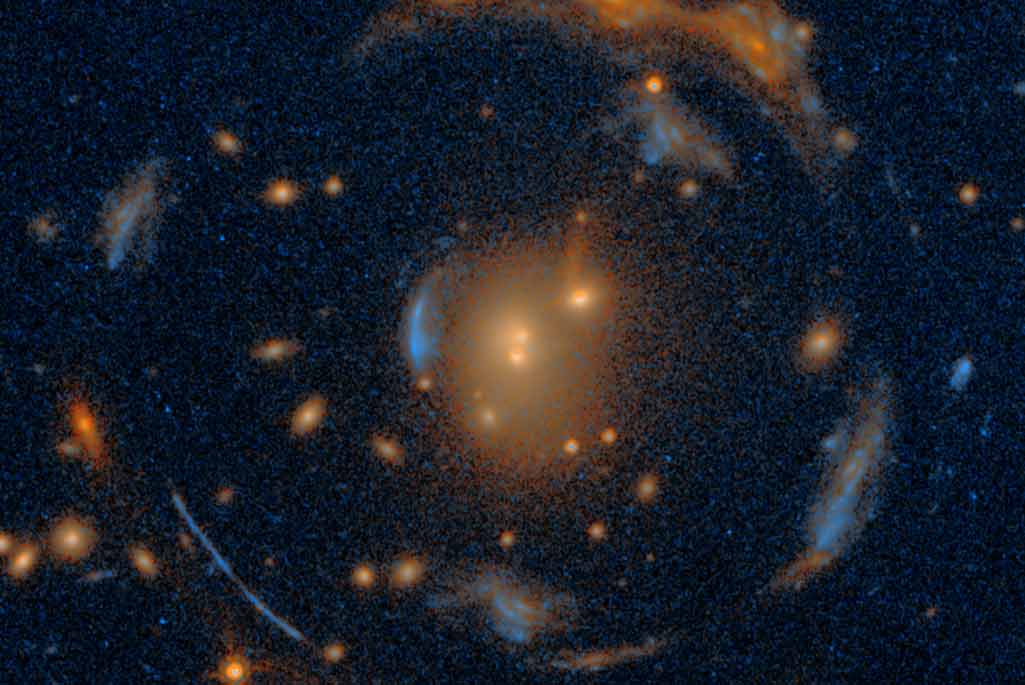
A gravitational lens is the ultimate distorting mirror in the universe. It distorts the view of objects behind it, but also provides amazing information about distant galaxies and quasars. Astronomers using the Hubble Space Telescope (HST) recently released a new image of one of these strange phenomena, called the “carousel lens.” It is a rare arrangement of seven background galaxies, all of which appear distorted by an intervening galaxy cluster.
According to David Schlegel, senior scientist at Berkeley Lab, this gravitational lens is a great find for astronomers. “This is an incredibly lucky 'galactic alignment' – a random arrangement of several galaxies along a line of sight that spans most of the observable universe,” he said. “Finding such an alignment is like looking for a needle in a haystack. Finding all of them is like finding eight needles lined up exactly in that haystack.”
The Carousel Lens was discovered several years ago in data from the Dark Energy Survey. Now astronomers are focusing on it to measure its mass and the effect it has on images of more distant galaxies. This gravitational lensing arrangement of seven galaxies and a foreground galaxy cluster may well provide new insights into the early universe through the high-redshift galaxy sources, the properties of the lens cluster, and unanswered questions in cosmology.
An example of the Carousel gravitational lensing found in DESI Legacy Survey data. There are four sets of lensed images in DESI-090.9854-35.9683. They correspond to four different background galaxies, from the outermost giant red arc to the innermost bright blue arc. They all appear to be gravitationally distorted – or lensed – by the orange galaxy at the center.
Deconstruction of the carousel gravitational lens
Typical large-scale gravitational lenses in the universe consist of a “lensed object” and more distant objects beyond it. Generally, these far-flung objects are galaxies and quasars. (Small-scale gravitational lensing occurs, for example, when a planet passes in front of its star.) The carousel lens, however, is more “cosmic” in nature, involving objects millions of light-years apart. In particular, the cluster doing the lensing is about 5 billion light-years from Earth. Also referred to as DESI-090.9854-35.9683, it has at least four large galaxy members, as well as several other possible cluster members.
The carousel forms a lens of at least seven distant galaxies. They lie between 7.62 and 12 billion light-years from Earth. Their alignment with the lens cluster resulted in multiple images of each of the more distant galaxies. Their shapes are the result of the “distorting mirror” effect, which stretches their appearances. The galaxy, designated “4a, 4b, 4c, 4d,” actually forms a nearly perfect “Einstein cross,” showing the symmetrical distribution of mass in the lens.
The carousel is a great example of a “strong lens” in the universe, says Xiaoshang Huang, who is part of the team at Berkeley studying it. “Our team has been looking for strong lenses and modeling the most valuable systems,” Huang said. “The carousel lens is an incredible arrangement of seven galaxies in five groupings that line up almost perfectly behind the foreground lens. When they appear through the lens, the multiple images of each of the background galaxies form roughly concentric circular patterns around the foreground lens, like a carousel. It's an unprecedented discovery, and the computer model created offers a promising prospect for measuring the properties of the cosmos, including the properties of dark matter and dark energy.”
The carousel lens as seen by the HST, marked by the galaxies. The “L” indicators near the center (La, Lb, Lc, and Ld) show the most massive galaxies in the lens cluster. Seven unique galaxies (numbered 1 to 7) – located another 2.6 to 7 billion light-years beyond the lens – appear in multiple, distorted “distorting mirror” iterations (indicated by the letter index of each number, e.g., a to d) as seen through the lens. (Credit: William Sheu (UCLA) using HST data.)
What makes this lens so special?
In their recently published paper, Schlegel, Huang and others described how they modeled the carousel lens to understand its structure. They point out that it exhibits almost every lens configuration that astronomers see in such phenomena. There are various arcs, diamond shapes, the Einstein ring and double lenses.
The large distance spread between the lens itself and the galaxies it distorts also offers some interesting areas of cosmological study. In particular, the science team hopes to conduct further spectral studies to understand the distribution of matter in the lensed cluster. At least seven lensing sources will help constrain the amount of matter in the cluster and understand the amounts of dark and baryonic matter in such systems.
In addition to the distribution of matter, the team can also use this lensing system to understand the properties of the distant lensing sources. This is important because the most distant sources provide insight into conditions at different periods of cosmic history. Source 7, for example, is an interesting “nearby” source that could be a “dormant” galaxy at very high redshift. It appears very “red” in infrared measurements, and others of this type have been observed by the HST. Source 7 could be a powerful example of what is called “early galaxy extinction.”
This happens when star formation stops and the galaxy becomes inactive. This can happen in a number of ways, but the most common is some kind of feedback loop between the central supermassive black hole and the outlying regions. This could happen, for example, as a result of galaxy mergers, which were very common in the early Universe. The Carousel Lens (and others like it) offers a special way to study this era of cosmic history and the events that shaped the galaxies we see today.
More information
Magnification of space through the “carousel lens”
The Carousel Lens: A well-modeled strong lens with multiple sources, spectroscopically confirmed by VLT/MUSE
Gravitational lens found in DESI Legacy Survey data
Like this:
Load…

Comments are closed.