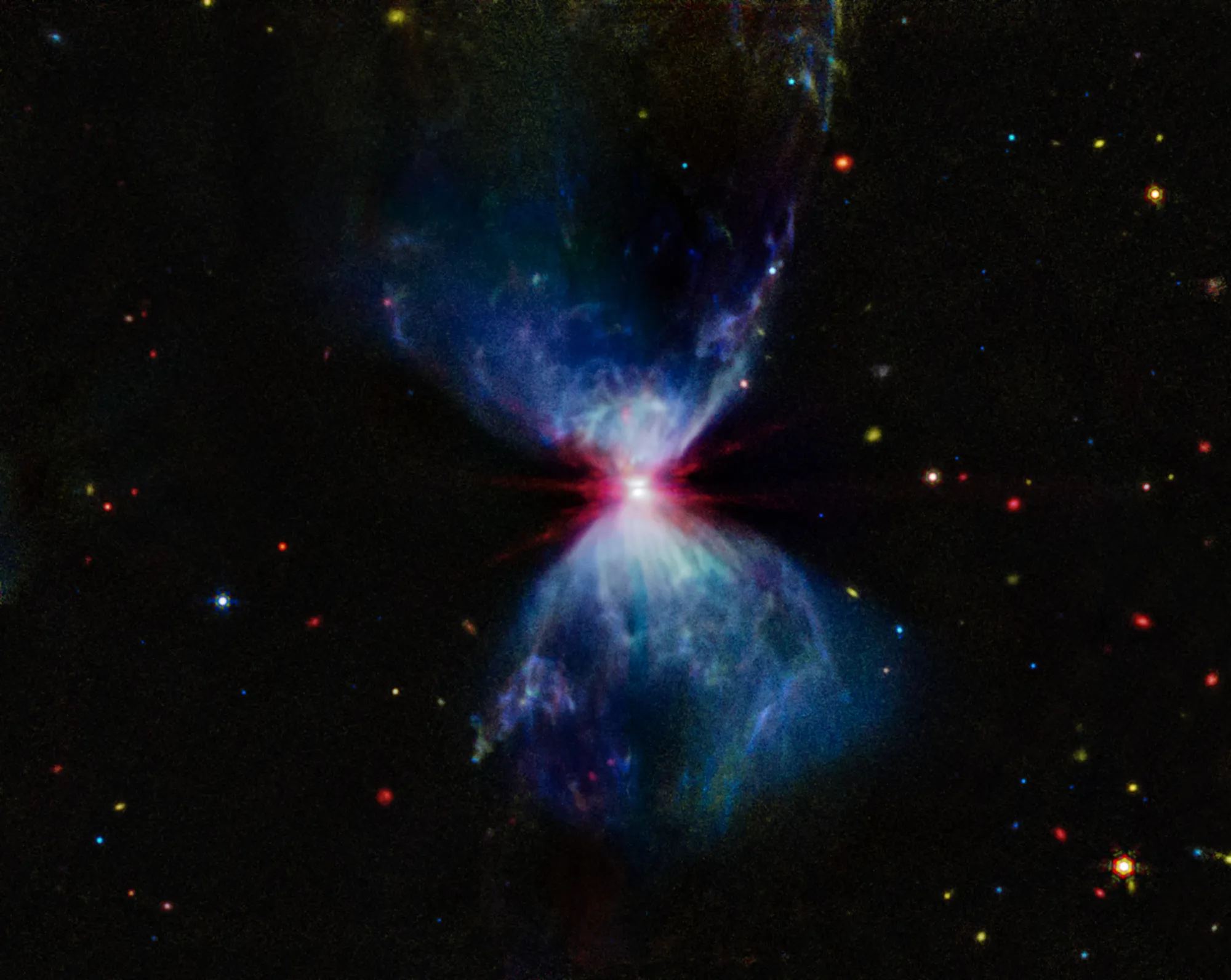
Wherever the JWST looks in space, matter and energy interact in spectacular ways. The Webb telescope reveals more details of these interactions than any other telescope because it can see through the dense gas and dust that envelop many objects.
In a new image, the JWST discovers a young protostar that is only 100,000 years old.
The star is named L1527 and despite its young age it is still enclosed in the molecular cloud from which it emerged. This is one of the reasons NASA built the JWST (with support from ESA and CSA). The telescope can see through dust and gas to reveal the earliest stages of star formation.
This image was taken with MIRI, the mid-infrared instrument. The young protostar is at the heart of it all and is still growing, gathering mass from the protoplanetary disk that surrounds it. The disk is the tiny dark horizontal line in the middle of the image.
The protostar is not a main sequence star and so does not undergo fusion like the Sun. There may be a small amount of deuterium fusion in its core, but it generates energy in other ways. As the star's gravitational pull pulls material closer, the material is compressed and heats up. Further energy comes from shock waves created by incoming material colliding with existing gas. This is the energy that makes the star and its surroundings glow in the giant molecular cloud that gave birth to it.
As young protostars gain mass, they generate strong magnetic fields. Combined with the rotation of the star, these fields drive matter away from the star. So as a protostar gains mass, it also pushes some of it back into space in spectacular hourglass-shaped jets that emanate from the star's poles. These jets create visible bow shock waves in the matter around the star, the filament-like structures.
The star's surroundings contain polycyclic aromatic hydrocarbons (PAHs). These are organic compounds that are common throughout the universe and may have contributed to the emergence of life. They glow blue in the image, including in the filament-like structures.
The red region in the middle is a thick layer of gas and dust surrounding the young star, illuminated by the star's energy. The white region between the red and the blue is a mix of materials. There are more PAHs here, as well as ionized gases such as neon and other hydrocarbons.
This is not the first time that JWST has studied L1527. In 2022, it observed the protostar with its near-infrared camera (NIRCam).
JWST took this image of L1527 with its near-infrared camera (NIRCam). The upper central region has bubble-like shapes that are the result of stellar “burps” or sporadic ejections. The different colors come from layers of dust. The more dust there is, the less blue light escapes, so the orange/red areas are denser dust than the blue areas. Image credit: NASA, ESA, CSA, and STScI. Image processing: J. DePasquale, A. Pagan, and A. Koekemoer (STScI)
This beautiful spectacle of the interaction of matter and energy is fleeting. Over time, the protostar's powerful outflows will clear its surroundings of much of the gas and dust, although it will still have its protoplanetary disk. Eventually, the star will become a main sequence star, easily seen without its veil of gas and dust. At this point, the star's planetary system will begin to take shape.
There are unanswered questions about how protostars form, and one of the main scientific goals of JWST is star formation. For example, astrophysicists do not know exactly how and when fusion is triggered and a protostar becomes a main sequence star.
Although astronomers know that protostars are surrounded by strong magnetic fields, it is not yet known exactly how these fields are formed and what role they play in the collapse and rotation of the stars.
JWST has made some progress on this question. It recently confirmed that jets from young stars are aligned due to the star's rotation and magnetic fields. This is supported by theory but has not yet been confirmed by observations.
There are also uncertainties regarding the formation of binary stars. Do they form in the same way as single stars? Why are so many stars binary stars?
The exact nature of the events that trigger star formation is also unclear. Shock waves from supernovas can trigger the birth of stars, but what about other cases? Is it just a question of density?
The answers to these questions will come gradually. With its ability to see more detail in the young stars and the clouds of swirling gas and dust that surround them, JWST is making progress one frame at a time.
Like this:
Is loading…
