

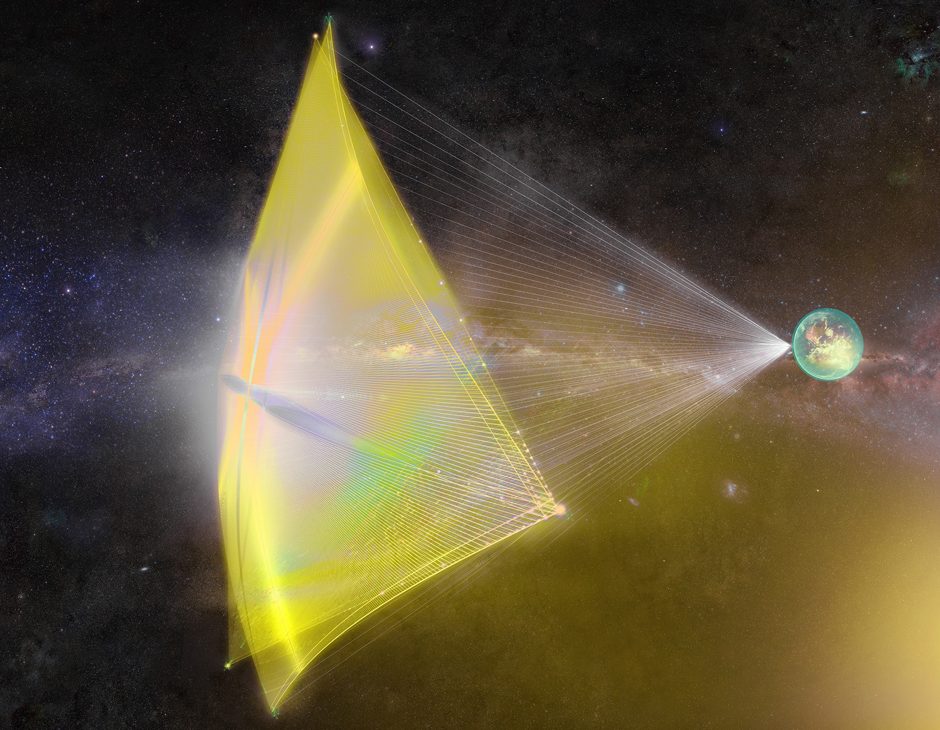
It was 1903 when the Wright brothers made the first successful self-propelled flight. They plunged into history and laid the foundation for transatlantic flights, supersonic flights and perhaps even solar system exploration. Now we stand on the precipice of a journey among the stars, but among the many ideas and theories, what is the ultimate and most effective way to explore our nearest star neighbors? After all, there are 10,000 stars within a 110 light-year radius of Earth, so there is a lot to choose from.
It's not just the stars that entice us to explore the boundaries of our solar system. Since the first discovery of an exoplanet in 1992, we have been discovering more and more alien worlds around distant stars. There are now over 5,500 confirmed exoplanets, and they too demand our attention as we look among the stars. Many ideas and technologies have been proposed in recent years, but to date even Proxima Centauri (the closest star system to ours) remains out of reach.
In his recently published dissertation, lead author Johannes Lebert from the Technical University of Munich (TUM) attempts to develop a strategy based on existing interstellar probe concepts and knowledge of nearby star systems. Lebert was driven by the discoveries of exoplanets, which continue to progress rapidly, as well as the development and interest in interstellar probes, both commercial and technical. He not only researches the technologies, but also looks at the returns.
Artist's illustration of HD 104067 b, the outermost exoplanet in the HD 104067 system, which may be responsible for generating massive tidal energy on the innermost exoplanet candidate TOI-6713.01. (Source: NASA/JPL-Caltech)
In the strategy developed in the work, he considers the two main objectives, namely the duration of the mission and the returns. By return he means the sum of all rewards that the stars explored during the mission offer, which of course must be largely scientific. He is considering a multi-vehicle, multi-probe approach that does not return to Earth and is capable of exploring different stars, maximizing mission returns. Finally, he examines the process of such a mission in order to ensure maximum mission returns. In a nutshell, he calls this his “bi-objective multi-vehicle open routing problem with gains.”
The work concludes with several recommendations. First, efficient guidance around the stars allows a more limited number of probes to be used, limiting fuel costs. This should be offset by mission results increasing faster when more probes are deployed to explore the same number of stars at the same time. However, this increases mission costs due to higher fuel costs. Whatever strategy is used, small remote-controlled or autonomous vehicles are far better suited to the need.
Lebert further explains that higher numbers of probes also have the advantage that probes can be tailored to the star systems they are intended to explore. As opposed to a smaller number of probes that need to cover a wider range of systems. There is a concept known as the “derived scaling law” which states that higher probe counts introduce the risk of less efficient deployment.
It's an interesting read that reminds us that as we develop the probes, there are quite a few of them on the drawing board; Breakthrough Starshot, Interstellar Express, Interstellar Probe, Innovative Interstellar Explorer, Tau Mission, to name a few: we need to think about how we plan, manage and deploy to maximize scientific returns.
Source: Optimal Strategies for Exploring Nearby Stars
Like this:
Is loading…

Comments are closed.